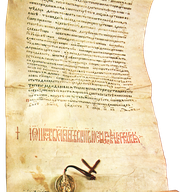
It set out that the orc tribes would make peace among one another, allow for certain outside access to their lands (for activities such as travelling, surveying, and the construction of military outposts and roads), and that the tribes would be responsible for the wrongs committed by their people. In return, the Valorian government would offer protection to the tribes, and pay an annuity of 50,000gp per year for 50 years. When the Emperor reduced the annuity to 10 years, all the tribes except the Stone Crows and Sabrecats accepted the cut. Nevertheless, the treaty was recognized as being in force. No land covered by the treaty was claimed by Valoria at the time of signing.
The treaty had a number of shortcomings which contributed to the deterioration of relations, and subsequent violence over the next several decades. From an inter-tribe view, the lack of any enforcement provisions protecting the boundaries established by the treaty proved a drawback for several of the tribes. The Valorian government never kept its obligation to protect tribe resources and hunting grounds, and only made a single payment toward the annuity.
The discovery of gold led to substantially increased travel through the area, which increasingly led to clashes between the tribes, settlers, and the Valorian military.
With the inter-tribe peace broken, several tribes called for the Valorian military to support them against raiding tribes.
The treaty states that if crimes were committed by bad men among the Valorian settlers, the government agreed to arrest and punish the offenders, and reimburse any losses suffered by injured parties. The tribes agreed to turn over criminals among them to the government for trial and punishment, and to reimburse any losses suffered by injured parties. If any orc committed a wrong or depredation upon the person or property of anyone, the Valorian government could pay damages taken from the annuities owed to the tribes. These terms effectively relinquished the authority of the tribes to punish crimes committed against them by Valorian settlers.
In 1224 Valoria exercised the right to withhold annuities and compensate for orc wrongs against anyone, including other orcs.
The new treaty made the tribal lands smaller, and moved them further northward.
The process of abandoning the forts, as part of the conditions agreed to, proved to be a long process. Once abandoned, Red Cloud and his followers, who had been monitoring the activities of the troops rode down and burned what remained.
Following the signing of the treaty, the commission recommended that the government cease to recognize the orc tribes as domestic dependent nations, and that no further treaties should be made with any orcish tribe.
The treaty represented a departure from earlier considerations of tribal customs, and demonstrated instead the Valorian’s more heavy-handed position with regard to the tribes and a desire to assimilate the orcs into Valorian arrangements and social customs.
Animosities over the treaty arose almost immediately when a group of orcs from the Frostwolf tribe were informed that they were no longer welcome to trade at Fort Brynmawr, being south of their newly established territory. This was notwithstanding that the treaty did not make any stipulation that the tribes could not travel outside their land, only that they would not permanently occupy outside land.