1. Notes

Magic in Asobria

Permeating throughout all the universe, Magic is the life blood of Asobria. Its boundless power has defined the history of all, leading to the birth of powerful nations and the recognition of some of the most brilliant minds. It is, undeniably, one of if not the most important aspect of Asobria itself.

Kanka is built by just the two of us. Support our quest and enjoy an ad-free experience for less than the cost of a fancy coffee. Become a member.

The Origins of Magic and its Forms

Magic exists in Asobria due to what is known as the Magic Essence: An intangible and invisible field of energy that permeates throughout the entire universe. The Essence is a fragment of the Progenitor's soul, which was used to bring the world to life during its creation. Once it was in its place, the Essence divided itself into the Six Terrestrial Elements, as well as growing to encompass the Two Heavenly Elements. It has persisted in this way, unchanging, since the dawn of creation. It was from this basis that the countless forms and methods of Magic came to be, of which are detailed further below.

The Elements of Magic

As mentioned above, the Magic Essence is divided into the Six Terrestrial Elements, which form the Material Plane, and the Two Heavenly Elements, which form other planes and are more abstract. These Elements represent some of the most primal forms the Magic Essence can take, and they are even said to be responsible for fueling the world's processes. Furthermore, each Element is associated with a virtue, which stems mostly from the Elements' connection to the Divine Dragons and their Dragon Aspects. Below is each Element in more detail, as well as a visual guide to them:

The Terrestrial Elements:

Fire: The Fire Element is what fuels any and all forms of heat and flame in Asobria: Wildfires that raze forests, lava that spews from volcanic eruptions, and even the warm climate of the tropics. Its associated virtues are anger and passion, which are alike embers that refuse to be extinguished.

Ice: The Ice Element is the source of all cold across Asobria, whether it be snow, ice, or the climate of the polar regions. It is also associated with solitude and patience, akin to ice that avoids fully melting even with the most extreme heat.

Earth: The Earth Element is the foundation of Asobria, taking the form of the stone and soil that creates mountains and valleys. Earth is associated with resilience and perseverance, reflecting how one hardens against adversity.

Water: The Water Element takes the form of the seas, rivers, and rains of Asobria, being found nearly everywhere throughout the Material Plane. As water has no definite shape, this Element is associated with adaptability and conformity.

Storm: The Storm Element forms the winds, thunder, and lightning of Asobria, creating the ever-changing weather. Its unpredictability associates it with freedom and impulsiveness.

Nature: The Nature Element is responsible for all the flora and fauna of the Material Plane, forming the basis for most of Asobria's life. As it works to nurture the environment, it is associated with kindness and compassion.

The Heavenly Elements:

Light: The Light Element is what forms the Cosmos above Asobria, with its all-encompassing light separating the day from the night. It represents hope, redemption, and good.

Dark: The Dark Element is what forms the Void below Asobria, and its shadows are what separate the night from the day. It represents fear, hatred, and evil.

None of the Elements can exist without one another. If one of the Terrestrial Elements were to cease to exist, then Asobria as we know it would fall out of balance and be rendered inhospitable. The balance of the Heavenly Elements is especially crucial, and its failure would tear the fabric of the universe apart. For evil without good is cruelty, and good without evil is naivety. And a universe of cruelty and naivety would be anarchy.

a0664d5b-8d12-4fa2-a58e-926c842aafc0.png

The Magic Provenances

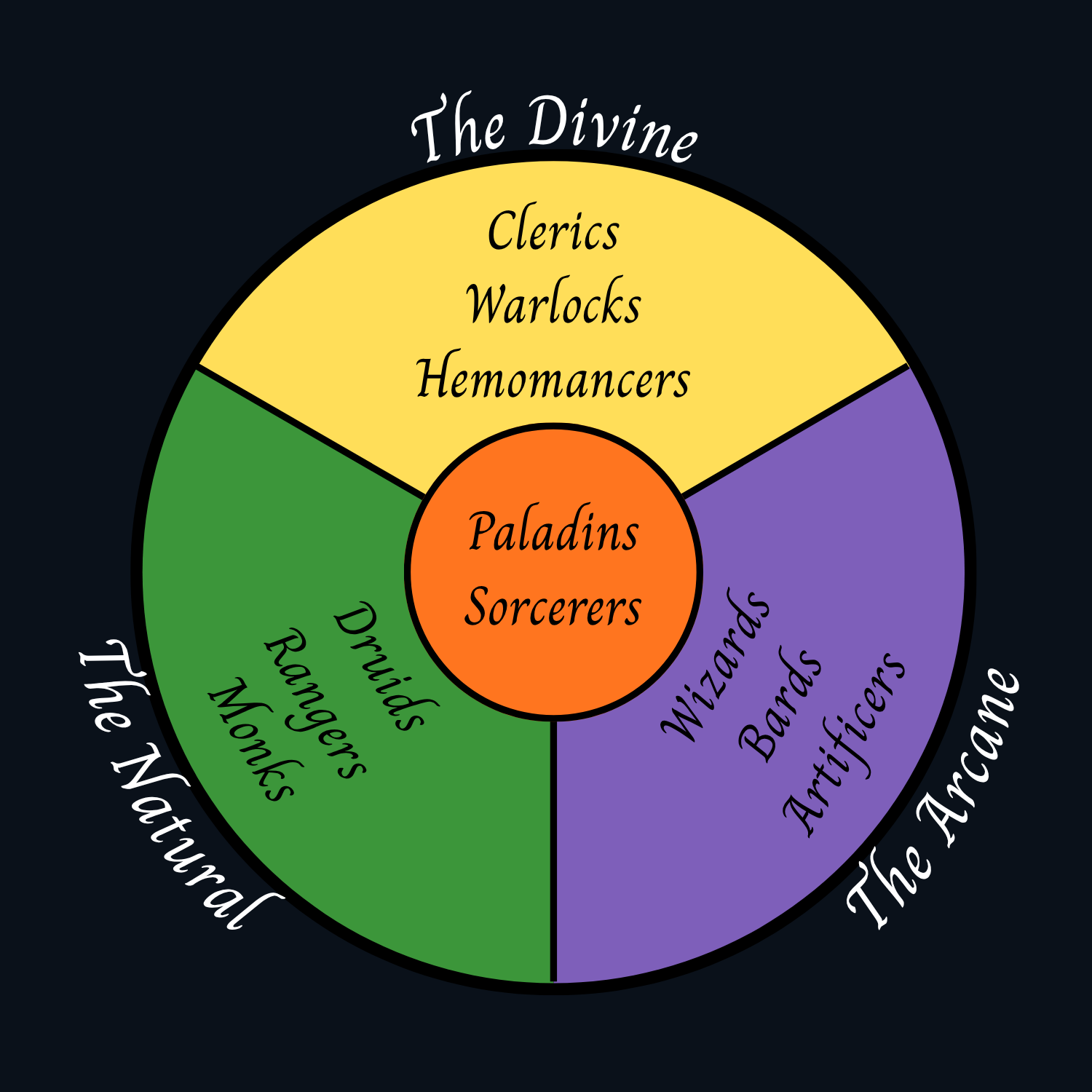
The Magic of Asobria is often divided into three groups known as the Magic Provenances. Each Provenance contains certain types of Magic users found throughout the world, being grouped by the source and general nature of their power. It is important to note, however, that there are countless exceptions to these categories. The Provenances are simply broad labels that attempt to define a system with no clear set of rules. Pictured below is a diagram of the Provenances, as well as an overview of each Provenance and its respective Magic users.

a057fd7d-3b64-42c9-9f8c-600d43c4d072.pngThe Divine: The Divine is perhaps the oldest source of Magic, being that which draws its power from higher beings that an individual serves. Divine Magic is embodied by the Cleric: Individuals who serve as intermediaries between the Gods and mortals. They draw upon their God's power to work miracles in their name, and the exact nature of their abilities is as varied as those above. As many Clerics are devoted to Gods of good morality, their Magic often serves to protect and heal others, but many exceptions exist. The Warlock acts as the step below the Cleric, as their Magic is born from pacts to beings of a lower status than the Gods. Seraphs, Fiends, Feyborn, or Aberrations are all potential patrons for a Warlock, and their Magic is as varied as these higher beings. Due to the nature of a Warlock's pact, however, their spells and abilities are often best suited to carry out their patron's will. The Hemomancer is the black sheep of this Provenance, specializing in Blood Magic that originates from the Laceration. By making offerings of blood to the Primordial, a Hemomancer can gain boons to their existing abilities or inflict curse-like banes on their foes. Hemomancy, however, is a dangerous practice often involving darker methods. One must be careful, or the practice may begin to take more than it gives.

The Natural: The Natural has existed since the dawn of mankind, and it draws its power from the natural world that surrounds an individual. This Provenance was also used as the main teaching of the now dead Magius, and most forms of Magic within the Natural fall under what is known as the Old Faith. The Old Faith includes both the Druid and the Ranger: Two very similar types of Magic users. Druids call upon their power from nature, with the ability to control plants, animals, and the earth itself. The world is its own living force in the eyes of the Druid, and those of the Old Faith see themselves as the environment's hands. The Ranger utilizes the same form of Magic as the Druid, but they use it much more sparingly. As opposed to becoming one with nature itself, they instead utilize its many resources to their benefit. Their limited spell repertoire is supplemented with more traditional martial methods, and they often act as the bridge between the natural and developed worlds. The Monk is the final and most unorthodox Magic user of this Provenance, as they do not cast spells in the traditional sense. First appearing with the creation of the Brotherhood of the Open Paw, Monks manipulate the energy, or Ki, in their own body to achieve a heightened physical state. While vastly different from other Magic users within the Natural, the Monk's abilities and spiritual practices place them among those of the Old Faith.

The Arcane: The Arcane is the most recently established Provenance, and its Magic wasn't discovered until the Great Change. Where Magic was previously viewed as a spiritual or religious field, the Arcane views it as more of a science. Those who study this Provenance have a much greater focus on the inner workings of the Magic Essence and the ultimate potential Magic holds. It is the Wizard that embodies this, as they have spent years studying how to bend the lifeforce of the universe to their will. Countless varieties and specialties of Wizard exist throughout Asobria, and they have a virtually infinite number of spells and abilities to learn. Bards are another type of Magic user that are quite similar to the Wizard, having originated as an offshoot of wizardry. Bards utilize music as their way of using Magic, lacing their instruments and voice with untold power. As their practice began to become more widespread and developed, they eventually broke away from the Wizards and created an identity of their own. Many of them combine the uplifting power of music with their Magic, leading to effects much stronger than boosted morale. Even more recent than the Bards are the Artificers, which have begun to tap into a new field of their own. Artificers combine Magic with technology, creating devices and objects that are powered by the Essence. Through their ingenuity, Artificers have conceptualized Mana-fueled machines that have the potential to revolutionize Asobria. While they haven't done much yet due to their recency, only time will tell of the full potential they hold.

There are two other types of Magic users that do not fall within any of the three Provenances, being the Sorcerer and the Paladin. The Sorcerer is one who has an innate connection to the Magic Essence, granting them a natural affinity for the practice as well as the ability to modify spells to a higher degree. Paladins are those who devote themselves to a cause, gaining their power from a promise they've made or an oath they've sworn. The reason these two types of Magic user are uncategorized is due to their varied sources of power. A Paladin can devote themselves to a God just as strongly as they could a king, and a Sorcerer could have earned their power through a bloodline or a blessing. Individuals from both of these groups could fall under any Provenance, and that is precisely why they sit unaffiliated with any of the three.

The Science of Magic

All Magic, and the Magic Essence itself, is fueled by Mana: The raw energy of the universe. Mana, by default, is invisible and intangible, and it exists throughout all things within Asobria. When an individual utilizes Magic, it is Mana that they are actively manipulating, changing its form and purpose according to their will. Through its study, the many properties of Mana and Magic were discovered, which are listed below in what are known as the Laws of Magic.

I. The Law of Permeation: As Mana exists within all things, all things are affected by Mana. - This Law states how all things throughout the universe have Mana flowing through them, as the Magic Essence permeates through creation. Due to this, Magic can be used to manipulate anything in Asobria, changing its form or state. It is worth noting that there is one exception to the Law, being the Troll. Excluding the Troll, however, all things living and nonliving, known and unknown, are affected by Magic.

II. The Law of Preservation of Mana: Mana cannot be created, nor can it be destroyed. - This Law is a fundamental principle of the Magic Essence, as its Mana cannot be created or destroyed. As such, there is technically a finite amount of Mana across the universe, but it is so abundant that it is virtually infinite. When Magic is utilized in any way, the Mana used simply changes form for the purpose of a spell or other action before returning to its natural state.

III. The Law of Transference: The use of Magic incurs an equal cost to the user. - This Law states the fundamental exchange that all Magic requires, which takes the form of one's own Mana. As Mana flows throughout all things, each individual has a set amount present within their own body. Magic users call upon and expend this Mana when using Magic, which throws off their internal balance.

IV. The Law of Annulment: All Magic that is done can be undone. - This Law is quite self-explanatory. Of any spell that is potentially cast or amount of Mana used, an equally powerful spell or amount of spent Mana can counter or dispel it.

V. The Law of Predestination: When Magic is used to perceive what could be, then what is seen is what will be. - This Law stands out as the most specific of the five, applying specifically to Divination Magic. There are a number of spells which allows the caster to gaze into the tapestry of the Weave, allowing them to see moments of the past, present, or future that they were not present for. As there is no definite future in Asobria, there are an infinite number of potential outcomes for any given moment. When these kinds of spells are used to view one of these potential futures, then that future becomes woven into the Weave and unavoidable.

There are numerous other laws and principles of Magic's countless uses, but only these five apply to every type of Magic. They form the foundations for an ever-expanding discipline practiced in countless ways across Asobria.

The Dangers of Magic

The Magic Essence was never a perfect system, especially not with the death of Magius, the God of Magic. As it was His role to keep the Essence in balance, His absence has left irreparable wounds on the universe's lifeforce. It is from these wounds of the Essence that the first Monsters were born, being distortions of preexisting creatures and forces. While these wounds have healed into scars over the eons, the damage has been done. Some of Asobria's most dangerous creatures were created from this tragedy, and they have by now worked their way into the natural order. It was also through Magius' death that the first Trolls came to be. Magius knew of the sheer power that Magic held, so he created the Curse of the Deprived with his dying breath. With it, anyone whose pride precedes the safe use of Magic will be stripped of all their Mana and lose their connection to the Magic Essence, making them unable to use or be affected by Magic. The loss of their Mana renders the souls of the cursed fractured, deforming their bodies and turning them into a Troll.

Even if Magius never died and the Magic Essence was kept in balance, there are many other potential consequences that come with using Magic. Below are some of the most common:

Mana Sickness: Mana Sickness is the most common side effect of Magic use, and most Magic users have experienced Mana Sickness at some point in their lives. Mana Sickness occurs when one's Mana is imbalanced, with its effects worsening as the imbalance grows greater. Mana Sickness often starts off simply as mild headaches or nausea, but more extreme cases can lead to physical atrophy, mental crippling, and even death. Any responsible Magic user spends time learning their limits, slowly acclimating to Mana imbalance and preventing Mana Sickness all together. Extended Magic use, however, can always lead to consequences.

Recoil: Recoil is a state that Magic can enter if it isn't used correctly, such as when a spell is miscast. When in Recoil, the Mana and energy used in the spell loses control and attempts to dispel itself violently. Depending on what type of spell failed, the effects of Recoil can be devastating. A failed fire spell can result in an explosion that could incinerate the user, and a psychic spell could lead to mental damage. As such, it is crucial that any Magic user maintains their focus on the spell they're casting to avoid catastrophic consequences. Luckily, Magic Foci help to protect a Magic user from potential Recoils. More details on Magic Foci are down below.

Shifting: Shifting is a process that occurs with the use of powerful Light or Dark Magic, causing changes in the user's personality. As the two Heavenly Elements are associated with good and evil respectively, the extended usage of those Elements over time can begin to cloud one's judgement. Those blinded by light have rational thought give way to naivety, and those consumed by darkness begin to forget what is right.

Magic Foci

Throughout nearly all disciplines of Magic, it is essential that a Magic user wields a Magic Focus: An item that serves to amplify their Magic ability. In the earlier days of Magical practice, it was found that having a physical object to focus one's power through assisted in the casting process, especially for novice Magic users. This works by having the Magic Focus channel the Mana that the Magic user is expending. The larger and more conductive a Magic Focus, the better it is at its purpose. Magic Foci can take any number of forms, but they all assist in Magic casting and even protect the user from mistakes. If a spell is miscast and enters Recoil, a Magic Foci helps to absorb the energy sent back to the caster, dampening the blow to the body. Below is a list of some common Magic Foci in Asobria.

The Staff: Easily the most common Magic focus, the Staff is regarded as the most beginner-friendly option for novice Magic users. Often being as long as a person is tall, its large size allows it to channel a higher amount of Mana than some other options, which is beneficial for those who may be struggling with focusing their Mana for spellcasting. Additionally, Staves can serve as excellent walking sticks for travelers or improvised blunt weapons for battle.

The Rod: Rods are quite similar to Staves, with the main difference being their shorter length of a couple feet. They also are often designed to work as a dedicated blunt weapon, such as a mace or hammer. Even with their shorter size, they still work as a novice's first Magic Focus and sometimes work well for smaller individuals. Most often, however, you see them used by Magic users who find themselves on the front line of battle, taking advantage of its dual strengths.

The Wand: Wands are miniaturized versions of Staves and Rods, typically measuring at less than a foot in length. Their short size makes them quite difficult to use for inexperienced Magic users, so they are most often used by those deemed as 'professionals' of the craft. This length means that they are only useful for casting spells, and their lack of versatility makes them impractical for use in adventuring or battle. As such, Wands are really only used for sport, being the Focus of choice for participants in Magic competitions or shows.

Music & Instruments: This type of Focus is specific to the Bard, who specialize in lacing their songs with Magic power. Being able to utilize this as a Magic Focus requires extensive study, which is part of the reason Bards diverged from wizardry some time ago. With the right training, however, anyone's voice or instrument can hold the power of the Magic Essence.

Amulets & Emblems: These Magic Foci work on a similar principle, being objects that symbolize someone or something that the user serves. Amulets take the form of jewelry or other accessories, and Emblems will be incorporated into clothing, armor, or other gear. These are prevalent among Clerics and Paladins, being items that act as a physical indicator of their connection to their God or Oath. While not necessary to utilize their Magic, most choose to use them to show their loyalty to others and remind them of their duties and promises.

Natural Materials: Followers of the Old Faith utilize materials and objects collected from the environment for their Magic. For Druids, they often find long branches that serve as Staves, only ever adorning it with natural charms to amplify its abilities or decorate it. Druids, as well as Rangers, will also collect various other materials such as certain flowers, animal bones, or even soil itself for the purposes of some spells. For those of the Old Faith, even the most common materials can hold great power.