1. Notes

Castle

A fortification consisting of, at least, a stone keep and outer wall, each with breastworks to facilitate defensive missile fire. A castle is distinguished from a shell keep, walled keep, or keep by the presence of fortified towers at the outer wall’s weak points (usually the corners). A castle will also usually possess a fortified gatehouse or barbican and may be surrounded by a moat, ditch, and/or earthworks. Additional concentric walls may also be present. Within the castle courtyard, or bailey, will be various outbuildings necessary to the normal operation of the castle’s household.

Castles are usually constructed only in districts where unrest may be expected, such as on the frontier and in rebellious or newly conquered regions. Since the possession of a castle (or any good fortification) renders its owner immune from all but the most powerful assaults, monarchs tend to outlaw the proliferation of such structures; only those absolutely necessary to defend against invasion or unrest will be permitted. Another limiting factor on the construction of castles is the tremendous expense. Castles require several years and a great deal of expertise to build. Only the richest of fiefholders will be able to afford them.

The City Index

The list of shops included in each city article is not meant to be comprehensive. The shops listed largely cover the essential requirements of the city, but GMs are free to add additional locations as they see fit. All shops have the following notations:

SIZE: The number of permanent workers, including the master, journeymen, apprentices, and slaves (if any).

QUALITY: A rating of the overall standard of goods or services to be found here.
✰ Poor
✰✰ Inferior
✰✰✰ Average
✰✰✰✰ Good
✰✰✰✰✰ Excellent

PRICES: An indication of prices likely to prevail at this establishment, based on a multiple of the prices listed in the HârnWorld Master Module.
Low 80–90%
Average 90–110%
High 110–130%
High+ 130–150%

Government of Towns

472682f3-80e1-4fef-9bc4-7c791685d762.jpgIn a strict legal sense, there are two different kinds of towns on Hârn: freetowns and feudal or sovereign towns. Aleath [E8], Golotha [D7], and Thay [M7] are freetowns and enjoy a fairly high degree of independence from external authority. Cherafir [N10] and Tashal [J5] are feudal towns, held directly by the king. Although the Thardic Republic is not a feudal realm, Coronan [E7] and Shiran [G6] are considered sovereign towns, as they are controlled by the state. To the average citizen, the distinctions are minimal.

All towns tax their citizens and pay aids and taxes to the king or state. However, taxes levied by freetowns tend to be less onerous and collected with less enthusiasm. To a runaway serf, however, the distinction is crucial. Only freetowns allow the serf to claim freedom after a year and a day of residence. Feudal towns offer no such protection.

Town Charters

The construction and maintenance of any significant fortification requires the approval of a higher authority. In the case of Hârnic towns, royal (or state) assent is needed, and this is formalized by a town charter. A freetown’s charter from the crown sets out the rights and privileges of its citizens and its obligations to the king. Each charter is unique but all have some basic common provisions. These include the right to build and maintain a city wall, hire mercenaries for defense, hold markets and fairs as often as desired, and freedom from feudal or other obligations to anyone except the king. The form and powers of civic government are laid out in the charter, as are the responsibilities for taxation, defense, and administration of justice. Feudal towns have no need for a charter but often have a document outlining the form and nature of town government.

City Officials

Governments in both kinds of towns tend to be similar in form. Civic offices are mainly filled by guildsmen and military offices go to men with military experience. The officers described below are common in Hârnic towns.

Alderman

An alderman is a custodian and expounder of the law and member of the town court. Although aldermen must be invested in their office by the sovereign or his representative, the office is often inherited because this is the way that knowledge of customary law is passed from one generation to the next. Most Hârnic cities have 12 aldermen, most of whom are prominent guildsmen and often associated with the Litigants’ Guild.

Mayor

Only freetowns have mayors, as such, but all others have some official who is responsible for administering civil and financial affairs. Mayors are usually appointed by the aldermen, often from a short list of candidates supplied by the crown. This official will run a sizable bureaucracy, including tax assessors and collectors.

Warden

Wardens command the city garrison and are responsible for maintaining civic law and order. A key duty of a town is to provide for the defense of its residents. Sufficient taxes must be collected to maintain fortifications and hire the city garrison. Even where the crown retains direct military control, a major expense for the city will be the military budget. Military authority is sometimes vested in a representative of the crown (such as constable or sheriff), but often the civic government is responsible (with royal assent) for appointing the warden.

Harbormaster

This officer is in charge of the town port, if any. Duties of a harbormaster include supervising port maintenance, providing pilotage services, and collecting maritime taxes such as pilotage, wharfage, and vessel registration fees. The harbormaster is usually appointed by the mayor and is almost always a member of the Pilots’ Guild. If the position is filled with a political appointee, a master pilot must be hired as an assistant. Harbormasters in the larger ports have several assistants.

Bondmaster

The bondmaster is responsible for overseeing the city bonding house and collecting hawking taxes and import duties. Appointed by the mayor, the bondmaster is usually a member of an important guild and may have assistants. Guards will be provided by the warden.

Town Law

Town law is quite different from rural justice and is sufficiently complex to support a guild of litigants. Towns are inhabited mainly by freemen, so royal justice is available to most citizens. Towns regard the right to operate their own courts, free from the interference of any local lord, as their most treasured prerogative. Freetown charters give their courts a place in the judicial hierarchy equal to a shire. Appeal from them is directly to the crown. Feudal towns are considered part of the shire in which they lie, so appeals are made first to the shire moot.

Towns are centers of trade and sometimes of scholarship and there is a somewhat greater dependence on written statute and precedent in town law. Financial transactions are much more common and civic penal codes may view economic or civil cases as dimly as crimes of violence. The importance of a suit is often a matter of how much (and whose) money is involved.

Most cases are settled informally. The parties to a dispute make an appointment for adjudication and the case will then be argued before a single alderman. The financial interests of the participants often lend themselves to a quick execution of justice. The alderman will pass judgment and levy and collect fines with dispatch. Appeals may be made to a town court of assembled aldermen. Important or complex cases will usually go directly to the town court. Aldermen may issue writs and warrants but, in a corrupt town, it is usually cheaper to seek a writ elsewhere.

The Thardic Republic has a judicial structure that is somewhat alien in the Hârnic context. The Thardic Senate in Coranan is the supreme court, but only important cases can appeal this high. Judicial administration in each province is headed by a provincial magistrate and each province is divided into districts, each headed by a legar. Most legal disputes among common folk, however, are handled informally by the client/patron system that dominates society. For more details, see Law (COL #5035).

Urban Geography

Most towns are roughly circular. Streets tend to radiate from several key points, notably the market and citadel, but they may well detour around vanished ponds or trees. Many streets existed before the town walls were built but new construction will take into account the location of city gates and gradually make the city appear more planned.

Street names are rarely posted; they tend to be a matter of oral rather than written tradition and change from time to time. Houses are not numbered. There is no official post office; mail is carried privately, at considerable expense. Few can read anyway.

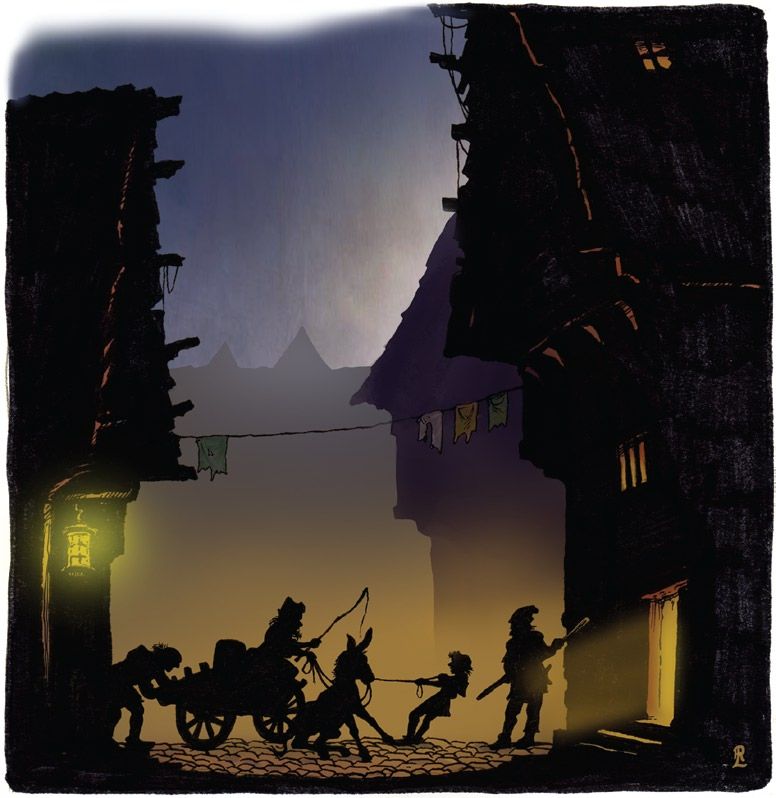
Crime is rampant in many cities. Street illumination is rare, so the streets are dark and dangerous at night. Policing is typically in the hands of notoriously corrupt and incompetent city garrison. Riding horses or openly carrying weapons on town streets is discouraged or prohibited; gentlefolk or those known to the civic authorities are often exempted.

Hârnic Buildings

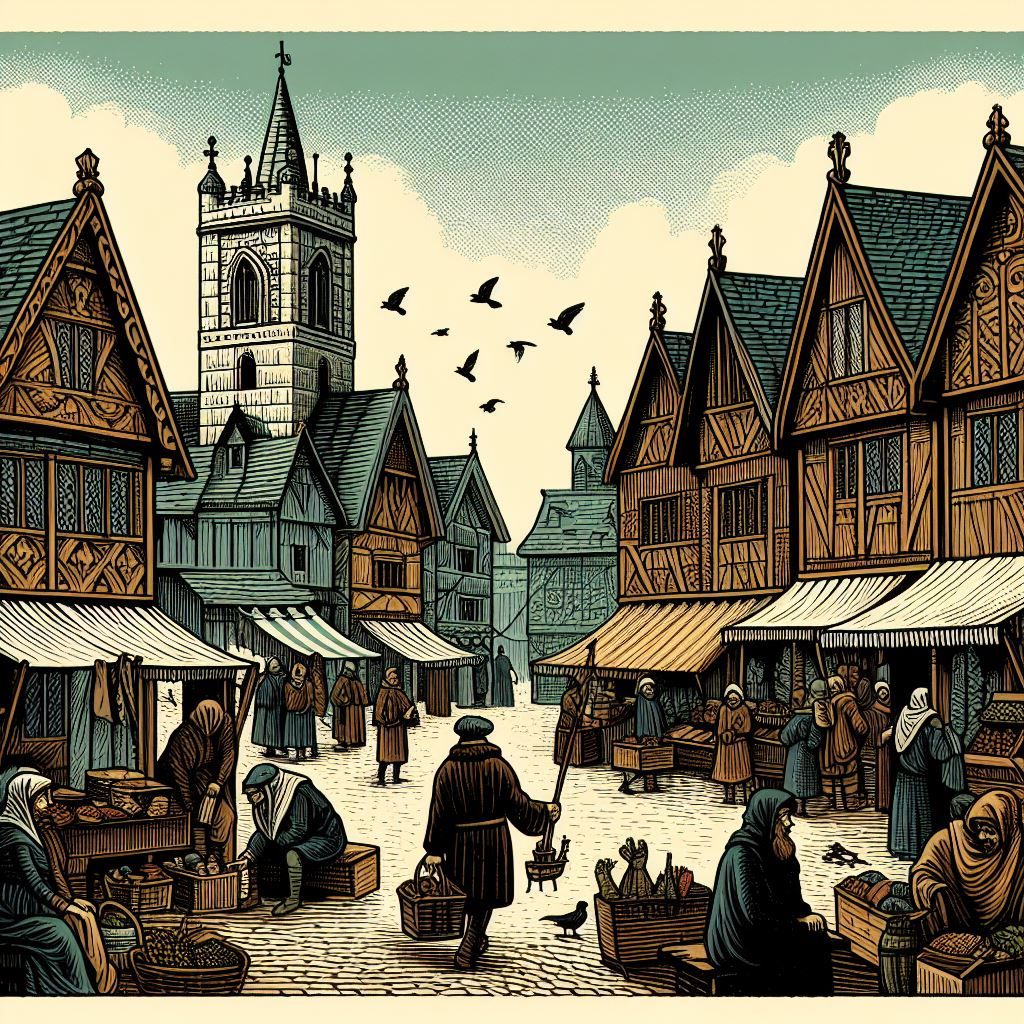
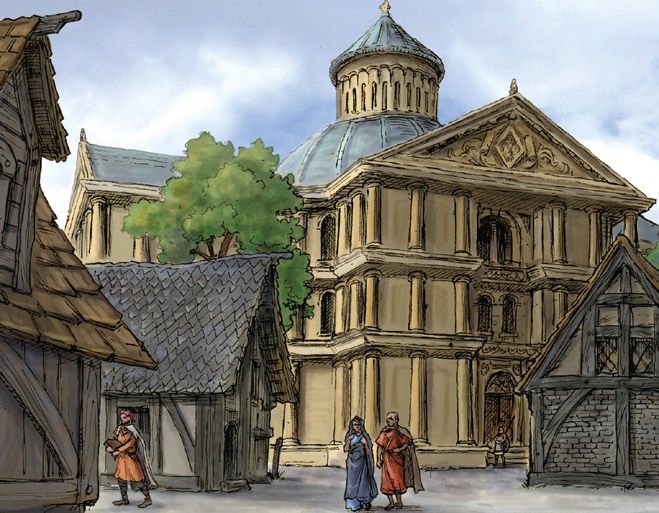
The quality of urban construction tends to be somewhat higher than in the countryside. Stone is the preferred medium of construction but wood is cheaper. Daub and wattle structures with timber framing are most common. However, there is wide variation from town to town. Aleath is famous on Hârn for its high standards of civic architecture; Golotha, on the other hand, is an urban blight. Sewers are rare.

Government buildings and temples tend to be built of stone on a lavish scale. However, most townsmen live in two- or three-story tenements in which overcrowding is the norm. Guildsmen can usually afford better accommodation and the homes of a few wealthy guildsmen may be quite luxurious.
2f491821-deab-4a1a-91ba-9b9cf7bcc2e9.jpg

Neighborhoods

Larger towns consist of neighborhoods or quarters. The urban poor, who make up most of the population, tend to rent rooms in multi-story tenements in slum districts, typically low-lying areas around docks and rivers or areas farthest from the market and city gates. Middle and upper-class neighborhoods tend to be upwind, in higher parts of town, closer to public squares and markets, and with wider streets. Better neighborhoods have special security, such as extra patrols by the town watch, private guards, or understandings with the Lia-Kavair (Thieves’ Guild).

For more details, see Real Estate (COL #4916).

Land Use

Land use is usually determined by the “free market.” Lots change hands without reference to any zoning bylaws, although government will occasionally step in to forbid construction and all urban governments have unlimited expropriation powers. These are seldom used, except for the edict in most towns against private construction close to the outside of defensive walls.

Town Markets

The heart of the town is its marketplace, the place where coin and goods are exchanged more or less freely. It is illegal to sell anything within five leagues of most towns except within its marketplace. Impromptu highway sales within this zone are forbidden by royal laws; the minimum penalty is confiscation. The marketplace itself is administered by the Mangai, the association of guilds. Selling space is usually granted free to local guild members. Foreign or unguilded vendors must pay a daily rent; a penny or two is typical for a small pitch. Vendors can sell from their own carts, tents, or stalls, or rent them from tentmakers or woodcrafters.

Local guildsmen have an advantage in the town economy. While they are required to pay property taxes to the government and dues to their guild, they are the only ones permitted to freely sell goods within the town. Goods imported into a city are subject to payment of hawking taxes and, if they are covered by a local guild monopoly, must be offered first to local guildsmen handling such wares to be marked up and resold.

Local guildsmen can petition the Mangai to forbid the sale of specific imported goods, although such injunctions are rarely given because most importers are members of the Mercantylers’ Guild. However, since the Mangai is made up of local guildsmen, importers must at all costs retain the goodwill of local merchants.

acbfa0ce-3415-4c23-a98d-8dcbbc04bde0.png

Shops

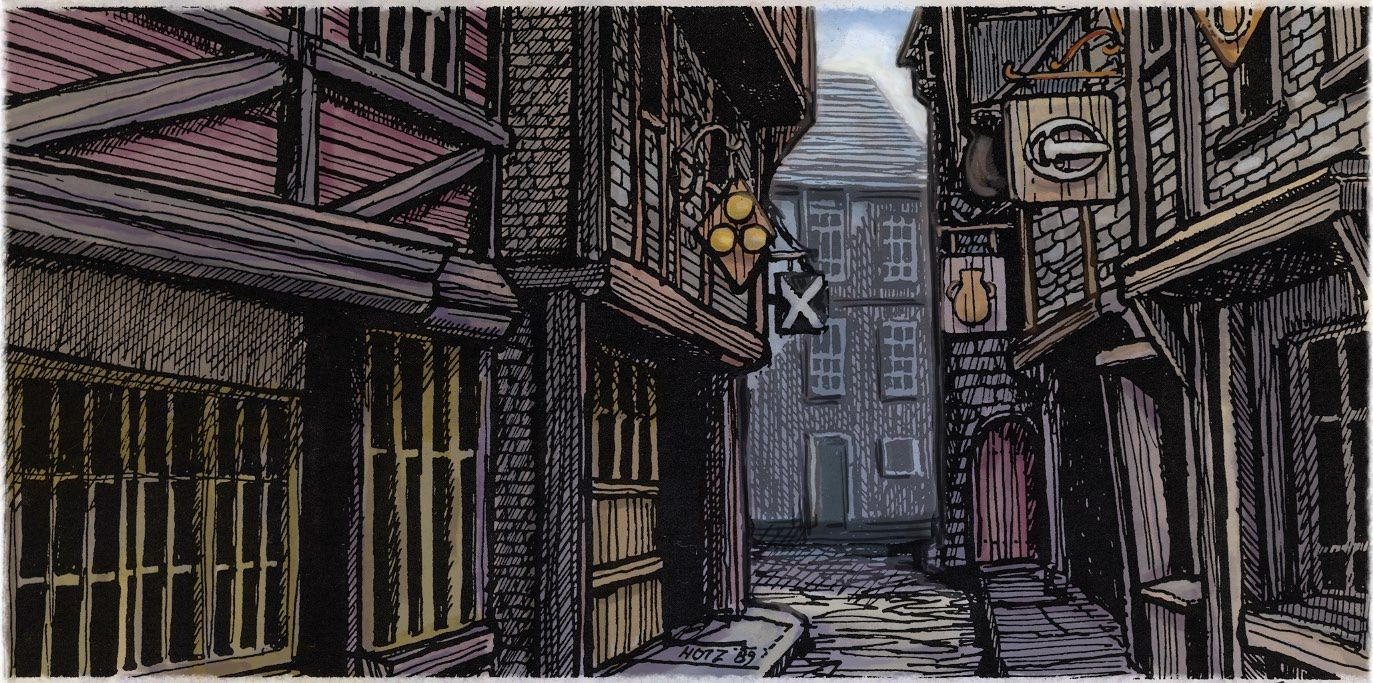
Most places of business within the towns are primarily workshops. While it is possible to walk into most shops and buy goods in stock or made to order, many artisans do most of their retailing in the marketplace. Craftsmen with small operations may spend three days making goods and one selling them. Businesses with a number of employees may be able to afford to keep a retail outlet open permanently. Many guildsmen, such as weaponcrafters, make most of their goods to order, or claim to.
8c2306cf-22e4-495b-b249-1ee6ec0cdeaa.jpg

Common Lands

Many towns are surrounded by commons rather than by arable fields. Such lands are generally available to anyone for grazing. To many of the poor residents, both within and outside the walls, the free use of common lands is the only way to feed the family goat.

Because it would be impracticable to keep all of the horses within the town itself, most towns also have an ostlers’ common nearby. This is usually an enclosed pasture owned by the Ostlers’ Guild and operated by a master ostler for the exclusive use of local guilded ostlers.
Townsmen

Town life is more sophisticated and volatile than life in the countryside. On the rural manor, everyone has his place, high or low, governed in accordance with old feudal traditions. Almost all rural activities center around the seasonal nature of agriculture. Townsmen, on the other hand, are typically freemen and their social and legal obligations seem less. Their duties may be limited to the payment of some rents or taxes, perhaps to military service in time of war. But while townsmen are not required to work on the land, no one guarantees them food or shelter. Their freedom from service is paid for by their lack of security. Unemployment and starvation come hand in hand; in time of famine, it is the urban poor who starve first.

Townsmen are divided into two major classes, guilded and unguilded.

The Guilds

A guild is a brotherhood of craftsmen who have banded together to control economic activity in specific or related trades. Throughout Hârn and western Lythia, virtually all significant commercial and professional activities are within the control of powerful international guilds whose monopolistic rights are protected by law. Although most guilds are mainly urban, some are rural and a few are both. Some guilds may be weak and have loosely defined monopolies, but most are strong with rigid monopolies.

The primary purpose of the guilds is to provide economic security for their members. To achieve this objective, they employ their legal monopolies to limit competition, primarily by restricting the number of franchises in a specific market. A franchise is a license granted by a guild to a qualified master to own and operate a business within a specific area.

For specific information about each guild, see the Guilds article (COL #4801).

Unguilded Occupations

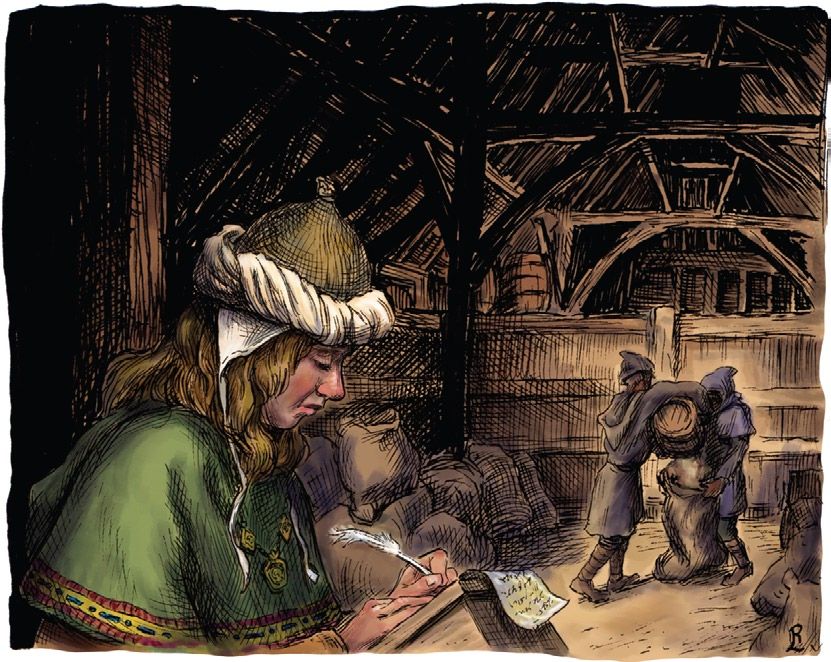
Most townsmen do not, however, belong to guilds. Anyone may enter an unguilded occupation, but these tend to be insecure, unfulfilling, and unprofitable. Some unguilded freemen are common soldiers and a few are successful scribes, artists, or toymakers, but most are common laborers who are typically worse off than the serfs of the countryside.

375d23e4-5cae-4ad3-a2c3-75bc68cbe5c3.jpg

Taxes and Tolls

The following taxes are levied in Hârnic towns. Averages are listed, but the actual tax rates are listed on the first page of each city article.

Property Tax

An annual tax charged on the assessed value of real estate, most of which is owned by wealthy guildsmen or gentlefolk. Bribery of civic tax assessors to deflate values is widespread. Landlords are responsible for payment of property taxes, generally on the first day of Savor in late autumn; rent on these properties is generally two to four times this tax. There are two tax rates, a business rate (6%) applicable only to guildsmen and a residential rate (8%) for everyone else. Properties outside a city wall but still under civic jurisdiction (generally within one league of the citadel) usually pay lower taxes (30–70% of the given figure). Many temples are given tax-exempt status.

Hawking Tax

A tax payable to the bondmaster on all goods brought into a city to be sold, including raw materials for further processing but excluding foodstuffs. The tax is usually a percentage of the consignment’s value but since the bondmaster tends to rely on “declared values,” assessments are generally low unless the mercantyler neglects the appropriate bribes. The average tax is 10%.

Most importing is done by members of the Mercantylers’ Guild who must, in almost all cases, sell to a local guildsman who handles like goods, if such exists. Duties charged at Cherafir for Lythian imports are in addition to these city taxes.

Bonding Fees

The mercantyler can delay payment of hawking tax by placing his goods in bond, which means storing them in the government bonding house. Goods temporarily brought into a city but destined to be exported must be placed in bond. This service incurs payment of a bonding storage fee (a percentage of declared value) payable in advance, with a minimum one-month fee. The average bonding fee is 1% per month.

Maritime Taxes

Piloting Fees:

Vessels more than 30’ in length, or any vessel of non-local registry (regardless of size), must take on the local pilot (harbormaster) when they enter or depart a port, paying a flat pilotage fee on each occasion.

Wharfage Fees:

Vessels berthed in a port must pay wharfage fees to the harbormaster. Wharfage fees are not
cheap. They are charged per foot of vessel length per day; it is obviously a good idea for a vessel to complete its business and leave as soon as possible. Vessels at anchor in the harbor, such as those awaiting wharf space or a sailing tide/winds, pay 20% of these rates.

Vessel Registration Fees:

Vessels registered in a port pay 50% of normal wharfage and anchorage fees. Piloting fees are not reduced but vessels of local registry, if less than 30’ length, do not require a pilot. Most vessels will register only in their “home port” but registration in two or more ports is possible. Registration fees are based on vessel length and are payable annually to the harbormaster.

Tolls

Government tollhouses exist along most major roads and tolls are often charged by various parties, not always legitimately, at bridges, fords, etc. Typical tolls are:
Per Person (afoot) 1f
Per Horse 3f
Per Cart (2-wheeled) 2f
Per Wagon (4-wheeled) 4f
Per Ox/Sheep/etc. 1f

Guild Dues

All master guildsmen pay 10% of their gross incomes to their guild, which then pays half of this amount to the town government. Unguilded occupations pay no guild dues but do pay the higher residential property tax.

e4daccd5-6d3c-42ef-90d0-0c94f316ae02.jpg