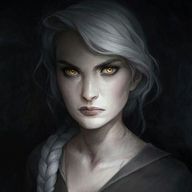
Residing only on the Isle of Kin, these bizarre humans share ancestry with dragons, sentient beasts that are known to exist but are rarely seen. As such their features often display some sort of draconic trait, such as draconic eyes, some scaly skin, or even horns. Normally reclusive and proud, recent famine on their island has resulted in a temporary suzerain status to Sangeria. Some are regarded with suspicion, due to their extended longevity, roughly an extra fifty or so years to their lifespan compared to the average human.
Draconic Blood:
- You gain resistance to one of the following damage types of your choosing, determining your specific draconic ancestry: Fire, Poison, Acid, Cold, Lightning.
- When not wearing armor, your AC is 12 + Dex Modifier
- You can use your action to exhale destructive energy. Your Draconic ancestry determines the size, shape, and damage type of the exhalation.
When you use your breath weapon, each creature in the area of the exhalation must make a saving throw, the type of which is determined by your Draconic ancestry. The DC for this saving throw equals 8 + your Constitution modifier + your Proficiency Bonus. A creature takes 2d6 damage on a failed save, and half as much damage on a successful one. The damage increases to 3d6 at 6th level, 4d6 at 11th level, and 5d6 at 16th level.
After you use your breath weapon, you can’t use it again until you complete a short or Long Rest.
Black Acid 5 by 30 ft. line (Dex. save) Blue Lightning 5 by 30 ft. line (Dex. save) Brass Poison 15 ft. cone (Con. save) Bronze Lightning 5 by 30 ft. line (Dex. save) Copper Acid 5 by 30 ft. line (Dex. save) Gold Fire 15 ft. cone (Dex. save) Green Poison 15 ft. cone (Con. save) Red Fire 15 ft. cone (Dex. save) Silver Cold 15 ft. cone (Con. save) White Cold 15 ft. cone (Con. save)
Real-Life Parallels: Scandinavian
Kin Appearance
The Kin have a distinct visual quality that gives away their draconic heritage. Typically these are represented by scales, horns, or notably draconic eyes. These traits still show when Kin have children with other races, however the more "distant" the Kin relative is, the less likely these traits appear, and it's generally agreed that after two or so "branches," the visual indicators are the only traits that appear. In other words, after several generations, one does not have the abilities of a "true" Kin, and are not considered part of Kin culture.
Kin Age
As a Kin grows in age and maturity, their features tend to become more pronounced. They retain their distinctively humanoid appearance, but their horns may become more curved, or their scales more durable. While Kin already live longer lives than most, there is no indication that a Kin could, eventually, "transform" into a full dragon. Even the oldest of Kin retain their mixed appearance. There is also a gradual shine added to their visual qualities, slowly becoming more "metallic" looking, though again these are mainly visual only.
Colorization
Kin, typically, mingle with their own "colors" so to speak, and typically exist as a tribe of some 5-10 families. Due to their longer lifespans, incest isn't as common as most other races would believe. Mingling of tribes is also relatively common, and feuds tend to be between tribes rather than colors and typically don't become large-scale wars. Still, stereotypes have emerged over time. Red/Gold Kin are considered rustic, owing in large part their ability to maintain large furnaces from their own power, and often become master craftsmen. Black/Copper Kin were once seen as more aggressive, but in modern times it's understood that they just make good soldiers. Blue/Bronze Kin seem to be more magically-inclined, and some scholars wonder if there's a relation between them and the blue-tinted magic-resistant Mithral. Green/Brass dragons are, owing to their partial immunity to poisons, more naturalistic in their practices and are a major cultivator of rare and exotic herbs. White/Silver dragons, owing to their relative isolation in the colder parts of the Isle of Kin, are seen as mystics and seers.
Scaled Council
Though the tribes are mingled and/or separate, each color is able to vote for a "representative" for their people to serve on a council. There is no single leader on the Isle of Kin, as all major decisions on tribal affairs both foreign and domestic are decided collectively as a group, with a majority vote being the deciding factor. Several conflicts have risen due to tie-breakers, but these typically resolve themselves without bloodshed in modern times.