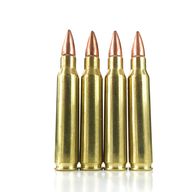
The 5.56×45mm NATO SS109/M855 cartridge (NATO: SS109; U.S.: M855) with standard 62 gr. lead core bullets with steel penetrator will penetrate about 38 to 51 cm (15 to 20 in) into soft tissue in ideal circumstances. As with all spitzer shaped projectiles, it is prone to yaw in soft tissue. However, at impact velocities above roughly 762 m/s (2,500 ft/s), it may yaw and then fragment at the cannelure (the crimping groove around the cylinder of the bullet).[29] These fragments can disperse through flesh and bone, inflicting additional internal injuries.[30]
Fragmentation, if and when it occurs, imparts much greater damage to human tissue than bullet dimensions and velocities would suggest. This fragmentation effect is highly dependent on velocity, and therefore barrel length: short-barreled carbines generate less muzzle velocity and therefore lose wounding effectiveness at much shorter ranges than longer-barreled rifles.[31]
Proponents of the hydrostatic shock theory contend that the shockwave from a high-velocity bullet results in wounding effects beyond the tissue directly crushed and torn by the bullet and fragments.[32][33][34] However, others argue that tissue damage from hydrostatic shock is a myth. Critics argue that sonic pressure waves do not cause tissue disruption and that temporary cavity formation is the actual cause of tissue disruption mistakenly attributed to sonic pressure waves.[35]