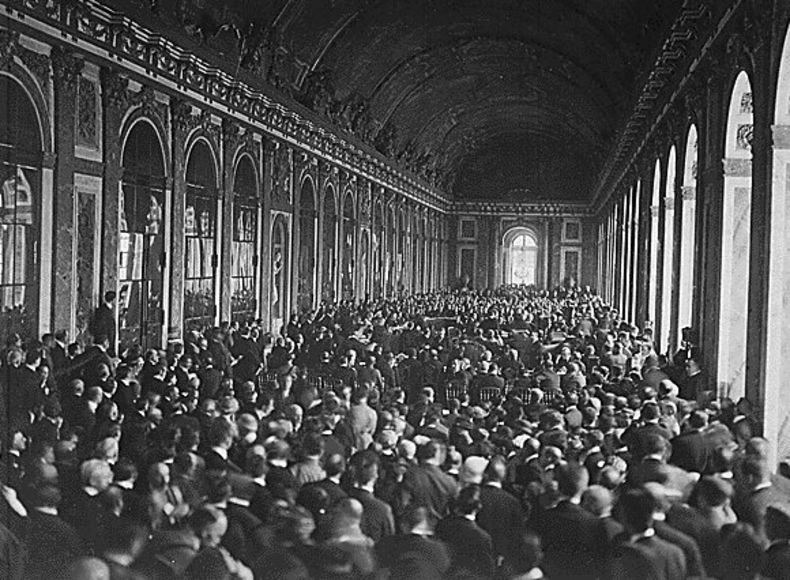
The 23rd of August, 1918, was perhaps the blackest day for the nations of the Atlantic world. It was then that the French president Raymond Poincaré announced the surrender of France. At the city of Versailles, once the seat of France's greatest kings, was where the Germans decided to hold peace negotiations. The British and American people, too, had suffered millions of casualties with little to show for it. Over the course of seven months the heads of state of these nations met numerous times in this city, eventually signing the Treaty of Versailles that would end WW1. It resulted in the following:
- French, British, Belgian and Portuguese possessions in Africa would be transferred to the German Empire to form the Imperial Domain of Mittelafrika, the largest colonial administration in history.
- Specifically: French Western Africa, French Equatorial Africa, Gambia, Portuguese Guinea, Sierra Leone, Gold Coast, Nigeria, the Congo, Angola, Nyasaland and Northern Rhodesia.
- Additionally, Germany was promised Southern Rhodesia, Uganda, British East Africa, Sudan and Egypt. They were never able to consolidate these lands due to the First Colonial War and, in the case of Egypt, their defeat in the West Asian War.
- South Africa was to annex Bechuanaland and become a client state of Germany, though in practice the South Africans never did much but pay lip service, and actively sabotaged German efforts in Africa.
- French and British Indochina would be seized by Germany to form the The Imperial Domain of Indochina.
- British New Guinea would be annexed by Germany to form the The Imperial Domain of Kaiser-Willhelmsland.
- British India would be annexed by Germany to become the short-lived Imperial Domain of Hindustan.
- France would become a monarchy ruled by a Hohenzollern king.
- The Austro-Hungarian Empire would militarily occupy the nominally independent states of Serbia, Greece and Romania, resulting in the formation of the short-lived Greater Habsburg Empire.
- Japan would hand over Qingdao back to Germany.
- Italy would militarily occupy Nice, Savoy, Corsica, Dauphine and Provence up to the Rhone river.
- War reparations would be paid to Germany, Italy, the Greater Habsburg Empire and the Ottoman Empire, primarily from the French territory occupied by Italy.
- The latter two members of the Central Powers collapsed soon after, and their share of the reparations were absorbed by Germany.
The disproportionate peace deal stripped France and Britain of almost all of their colonial holdings, placing most of the world under the German heel. However, the remaining great powers did not stay content, and came together to harass Germany through a joint policy of containment, supporting a number of anti-German proxies across the world.
This period is parallel to WWI - The Russian Civil War and Brest-Litovsk.
Next: The Red Orchestra