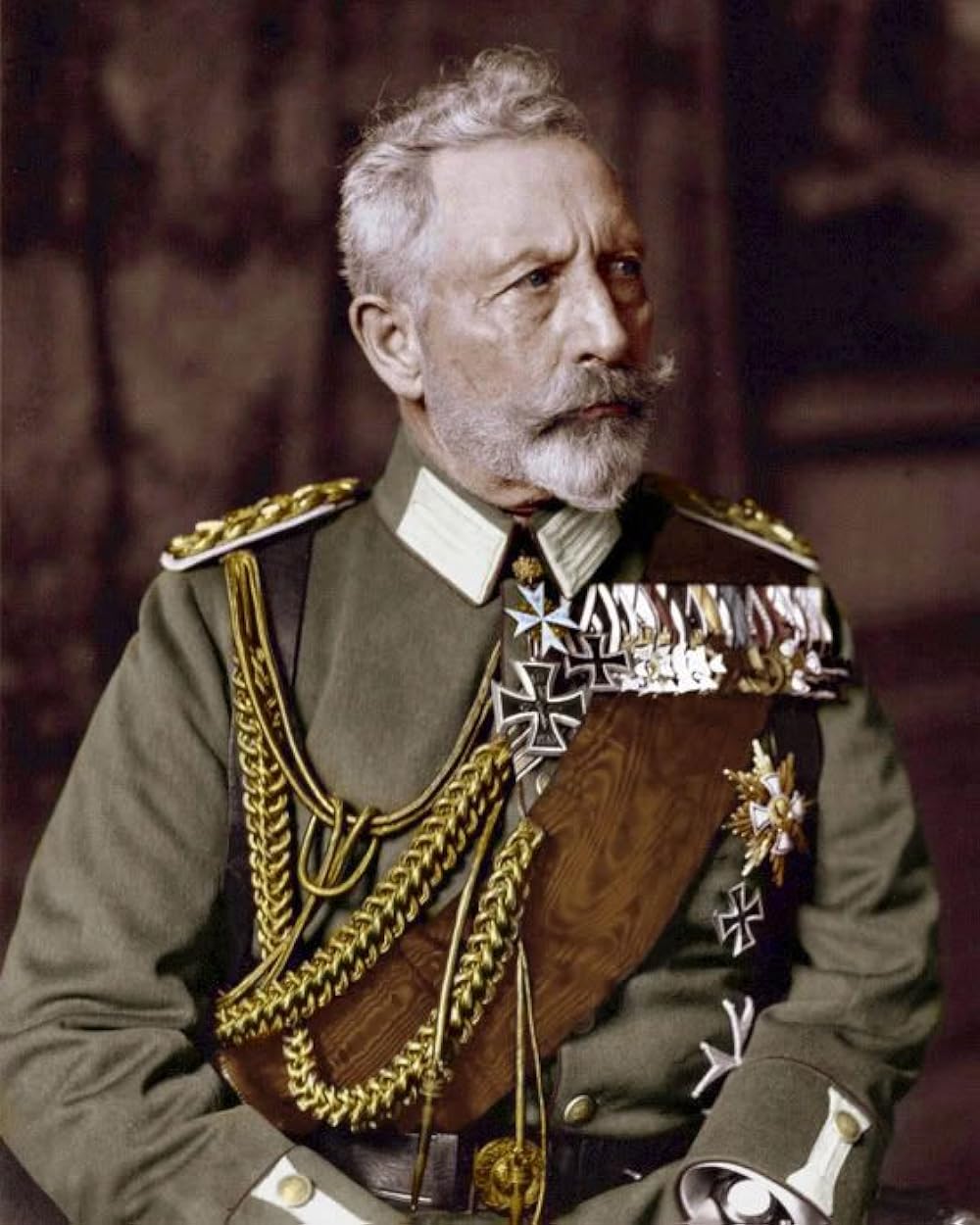
(1859 - 1941)
Kaiser Wilhelm II, born Friedrich Wilhelm Viktor Albert on January 27, 1859, was the German Emperor from 1888 until his death in 1941, a member of the Hohenzollern Dynasty. From an early age he showed an impulsive, quick-tempered and stubborn disposition which would plague him for the rest of his life, though Germany's excess of capable statesmen and officers would allow this country to survive despite its lacking leadership. These facts overshadowed his great intellect and fascination with science and technology, being educated at the University of Bonn and heavily promoting the development of German education. His reign began with the dismissal of Otto von Bismarck and was characterized by his aggressive foreign policies, aiming to establish Germany as a world power.
Wilhelm’s misguided foreign policies contributed significantly to the fragmentation of Europe into opposing alliances, which eventually led to World War I. Despite his title as Supreme War Lord, his role in the conduct of the war is controversial, with some historians arguing that he was controlled by his generals as evidenced by the Generals' Conspiracy. This event was followed by the Velvet Revolution, which transformed Germany into a constitutional monarchy and severely limited the Emperor's powers. Regardless, Germany's rise as hegemon of Europe had left it diplomatically isolated and extremely unpopular amongst the non-German population of Europe. Throughout the 1920s and 1930s the world was shaken by communist revolutions in a period known as The Red Orchestra, during which Germany's power waned while the Soviet Union rose into the spotlight. Resentful towards democracy, Willhelm II saw in Adolf Hitler's NSDAP the opportunity for democracy to become a force of German strength, nationalism and imperialism. As such, the NSDAP enjoyed a degree of support from the Kaiser throughout the 1930s.
In 1939, World War II began. An older and wiser Willhelm II chose not to repeat his past mistakes, leaving the Empire's administration to his civil servants and the war effort to his generals. The Hohenzollern monarch instead embraced his role as a leader of the German people by touring the front, broadcasting speeches and helping pass legislation which could help the war effort. On the 28th of August 1941 he perished from a serious pulmonary disease, with his eldest son being crowned as Kaiser Willhelm III.