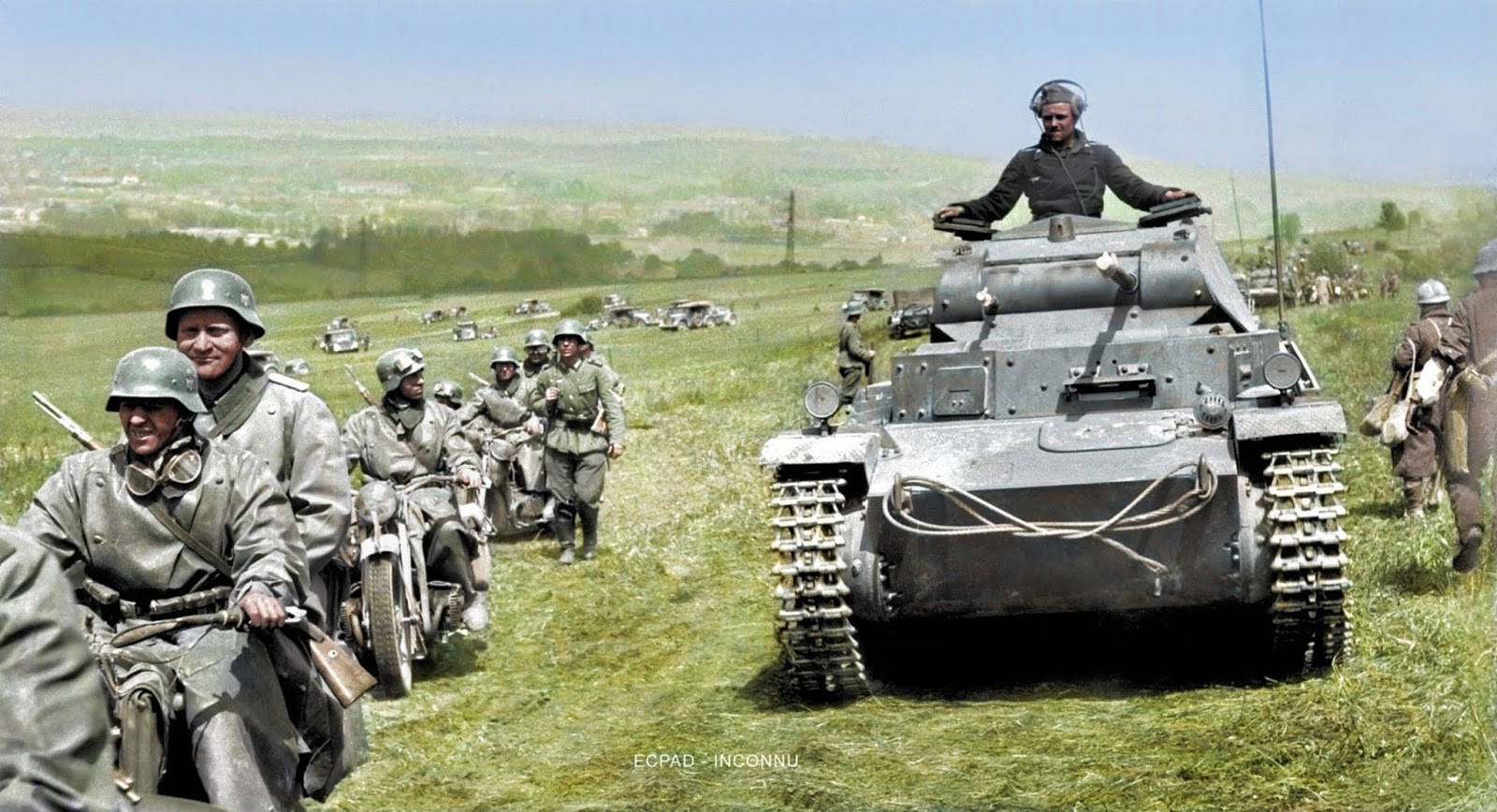
In December of 1939, the French Armée Mécanisée was unexpectedly withdrawn from the Battle of the Rhine, severely limiting the offensive capabilities of the Premiere Group d'Armées. These troops were regrouped, rearmed and resupplied in preparation for a major armoured thrust meant to cut off Eisenpakt forces in the west, which would destroy 30% of the alliance's forces and thus ensure victory for the Comintern. On the 15th of January, German lines were broken along three points which would coalesce into one single mass and move northwards, parallel to the river Rhine.
Months prior, at the Third Battle of Tannenberg, Germany's pride was mauled in battle with the Soviets; Panzergruppe "Kleist" under the command of Marshal Ewald von Kleist suffered 30-60% casualties in battle with the Soviet 1st Guards' Tank Army, which came off worse. All 8 surviving Panzerdivisione (out of 10) were transferred to Frankfurt to undergo replenishment; by January of 1940 this force had regained its original strength by training two new divisions. When French armour broke through German lines in preparation for a mass encirclement of forces in the west, Panzergruppe "Kleist" found itself in a critical position and moved to engage. Two Panzer Corps of three divisions each moved north to engage them head-on, while Panzerkorps "Guderian" (with 4 divisions) crossed the river Rhine and used Mainz as its staging ground.
On the second week of January, the Armée Mécanisée had gotten as far as Cologne, but the bulk of its forces remained in the area around Coblenz. It was the 15th when Panzergruppe "Kleist" engaged; its two northernmost Panzer Corps tied down France's units and forced them to commit even more assets, in collaboration with local Deutsches Heer infantry divisions. Panzerkorps "Guderian" followed through on General Erich von Manstein's plan (then Chief of Staff for Klein's unit), attempting to deliver a backhand blow on the overextended French Red Army.
The six days of fighting that followed were brutal, but decidedly more so for the French. Guderian's Counteroffensive represents the purest form of manoeuvre warfare seen during World War II as infantry and towed artillery played a secondary role; motorised troops, tanks and aerial bombardment took the stage. By the 19th of January, Guderian's forces were successful in cutting off the French, and though beset on all sides by breakthrough attempts, continued their assault. The last two days of this operation were a carnage for the Armée Mécanisée as they began to run out of fuel, ammunition and lost communications with high command.
As a result of Guderian's Counteroffensive, the Armée Mécanisée was completely destroyed, and with it, some 70% of France's mechanised assets. Besides this, a number of French Red Army infantry divisions and aerial units were lost in the fighting. This battle is widely considered to be a turning point in World War II; from certain victory for the Comintern to an undecided state.