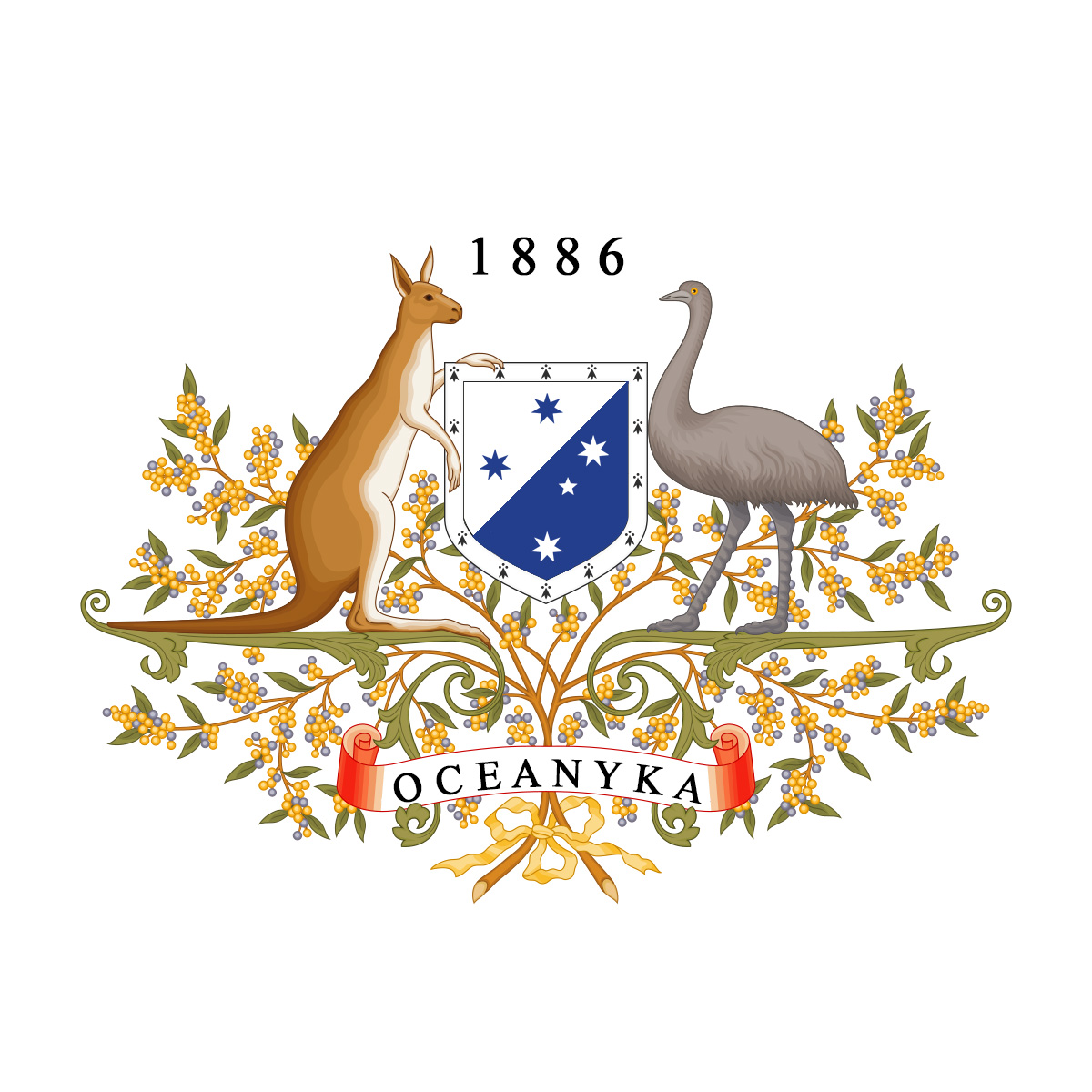

The Right, Just and Honourable,
COUNCIL OF THE OCEANYKAN FEDERATION
The Oceanykan Council is the supreme, unicameral government organism of the Oceanykan Federation. It is made up of 400 representatives from across the continent, each of which represents roughly a million citizens. These are not necessarily geographically bound, but rather the property of an individual, polity or association, who has gained them through petition or challenge, claiming to represent a different bloc. Said owner is known as a consul, who will appoint a representative to serve as a Representative of Council (RC). Even amongst themselves, not all members are equal, and plays amongst themselves are not uncommon. Most power is concentrated around the major factions, of which the City-State of Cestlep takes the crown as the wealthiest and most populated. Representatives usually band into parties with similar ideological positions.
All groups, corporations, nations, cultures, polities, federations and political unions of relevance are classified into three types:
- Disenfranchised, meaning they possess no seats on the Council.
- Enfranchised, meaning they possess a fair number of seats on the Council, relative to the number of people they represent or their power.
- Overenfranchised, meaning they possess more than their fair share of seats.
Disenfranchised groups and persons will usually request the transfer of a seat from an overenfranchised Sovereignty, perceiving weakness. This can happen in two ways:
- Through petition, in which the Oceanykan Council's judgement will decide whether to transfer said seat to the disenfranchised Sovereignty or not.
- Through challenge, which may occur in a number of ways: duel, competition, democratic elections, or war.
There is a third, more rare option. Every Decennial Census the Council may expand itself to adjust for population growth, and disenfranchised factions may compete amongst themselves for representation.
Its constitutional powers are the following:
- Elect the President of the Oceanykan Federation (who holds executive authority) from amongst its members and end their term at will.
- Pick the Chief of Defence and approve of all Major General, Lieutenant General and General of the Army or equivalent promotions.
- Declare war on a foreign nation, and if it is in the defence of Oceanyka's territorial integrity, declare Article 5 invoking collective defence.
- Select a Governor of the Federal Bank from amongst the organisation's own senior bankers or those of major private banks.
- Choose the High Court's seven Justices from amongst Oceanyka's senior lawyers and judges.
- Review, debate and approve or reject any modifications to the Polity Tax and the Department of the Treasury's federal budget.
- Allow a new Sovereignty to join the Council through a process of petition, should new seats be created, or a previous holder renounce it.
- Reform the Oceanykan Constitution through supermajority vote.
- Collectively debate national issues and act as a dispute resolution organism between competing Sovereignties or Yeomen.
The Oceanykan Council in 1965

In Oceanyka, the left wing is characterised by alignment towards the East, greater openness to the rest of the world, and ambitions to centralise some of Oceanyka's power (for example, by strengthening the Armed Forces). The right wing is characterised by alignment towards the West, increased xenophobia and either conservatism or calls for decentralisation. In 1965, the Council's 400 seats were aligned as follows;
- The Oceanykan Peoples' Party has 143 seats. It forms a minor majority within the Council, and currently controls the Presidency. It was founded by Alan Redfort in the early 1960s as a loose centre-left coalition against the incumbent Constitutional Party, which was successfully ousted by arms and purged in 1961. Over the years, it has moved to become Oceanyka's mainstream left wing party, championing the development of relationships with the Soviet Union and the strengthening of federal forces. Much of its support comes from Oceanyka's industrial city-states, as many see the OPP as a successor to the defunct Labour Party.
- The Constitutional Party has 72 seats, and enjoys a great deal of prestige as the founder of the Oceanykan Federation. It is a centre party, advocating for closer ties to Germany and the United States, and opposes any further strengthening of federal forces. The party suffered an enormous decline in its moral foundation during and after the Civil War, resulting in growing decadence and unrest. In 1961, much of the its leadership was purged by the Oceanykan Peoples' Party and their revolutionary allies. In the following years, it reorganised itself, re-purged its most corrupt elements, and established itself as the strongest opposition to the OPP, adopting a vanguardist ideology for the mid-1960s: Australian Neo-Liberalism.
- The National Party of Oceanyka has 54 seats. It is mainly composed of nationalists, feudal lords, tribal societies and other conservative elements. The party advocates for increased isolationism, the abolition of the Red Fleet, the defunding of the OPA and rolling back much of the Oceanykan Constitution. It is, therefore, the country's strongest right-wing party and the most vocal opposition to the current government.
- The Revolutionary Party has 21 seats. It is an extreme left-wing party, mainly composed of praxis-oriented Trotskyites within Oceanyka's urban centres. It split off from the federal coalition during the early stages of the Civil War, creating a three-sided conflict. Due to the destruction of the Natalist Home Front, a ceasefire was agreed upon as an alternative to total war between the almighty Constitutional Party and the much smaller, but much more zealous Revolutionary Party. It lost much of its following to Redfort's OPP.
- The Federal Guards' Party has 32 seats. It is an extreme centre party, committed to the restoration of Oceanyka's golden era under an original interpretation of the Constitution, sympathetic to neither reformism nor reactionarism. The majority of its support comes from Federal Army veterans and pro-western warlords, as well as veterans from the Civil War.
- The Neo-Natalist Home Front has 17 seats. It is an extreme right-wing party, successor of the rebel organisation that begun the Oceanykan Civil War. The NNHF champions the mass mobilisation of Oceanykan militias and tribes to exterminate foreign influence, and proposes extremely isolationist policies. It calls its party ideology "National Anarchism". Though it was all but exterminated during the Civil War, the party has made a comeback as reactionary elements mobilise against Redfort's OPP. Its base of support lies in fascists, ultranationalists and totalitarian polities.
- The National Self-Defence League has 61 seats. It is a neutral-pragmatic party, dedicated solely to the protection of the Council's weaker factions and their interests. This way, an otherwise irrelevant part of the federation becomes an influential, often decisive factor in national politics. Their base of support lies mostly in rural communities, nomadic groups and ethnic enclaves.
As is stipulated in the Constitution, the Speaker of the Council is a senior member of the Constitutional Party, being an opposition party.