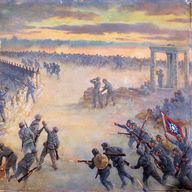
On the 7th of July 1937 near Wanping, a walled town just outside Beijing, Japanese and Chinese troops clashed during a night training exercise. A Japanese soldier went missing, prompting his commander to demand entry into Wanping to search the town. The refusal by Chinese forces escalated into gunfire at the Marco Polo Bridge (Lugouqiao). While small incidents between Chinese and Japanese troops had been common since the Japanese Invasion of Manchuria, this skirmish spiralled into full-scale hostilities neither side could contain, and it became baptised in the press as the Marco Polo Bridge Incident. Within weeks, Japanese reinforcements from Korea and Manchuria launched a major offensive against northern China, while Chiang Kai-shek’s Nationalist government declared China’s determination to resist.
So began the Second Sino-Japanese War, which though at first separate, eventually became a theatre of World War II. It remains one of the largest and most brutal conflicts of the 20th century. Japan’s strategy aimed to crush Chinese resistance swiftly, capturing key coastal cities such as Shanghai, Nanjing, and Guangzhou. Instead, the war bogged down into a prolonged struggle across vast territory, marked by atrocities including the Nanjing Massacre and widespread scorched-earth campaigns. Chiang Kai-shek’s Nationalist government, however, was actively opposed to the Chinese Communist Party under the leadership of Mao Zedong, who refused to offer any support. The conflict became increasingly internationalised, with The United States of America and The German Empire supplying the Chinese nationalists, while the Chinese communists and Japan enjoyed support from The Union of Soviet Socialist Republics.
The war ended on the 15th of July 1940, when Chiang Kai-Shek was assassinated, and his successor junta voted to make peace with Japan in the Treaty of Shanghai. Japan occupied a number of coastal cities and forced the National Revolutionary Army to downsize. In reality, the Japanese Empire had originally sought to occupy all of China, but they were talked into backing down by their Soviet allies, who believed China could better serve the East's interests as a communist state. As such, the Chinese Civil War resumed, with this new phase being known as the Chinese Communist Revolution. By February of 1943, the city of Canton fell to the People's Liberation Army, and China was reorganised as a Marxist-Leninist state, The People's Republic of China, which joined the Eurasian Axis and participated in fighting across the world.