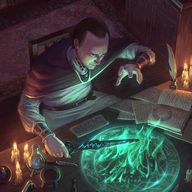
Sorcery is defined by Psionic Theory as the use of otherworldly energies, Psions, to perform some kind of work in realspace. Its study and practice are divided into two broad categories:
- Magic, also known as primitive sorcery, is mainly based around the unmodified human perspective as captured by our senses and intuitions. It contains three subcategories:
- Primal Magic, or shamanism, focuses on the natural world; what the body can see, hear, smell, touch and taste, and normally revolves around concepts so foundational to human existence that they have become ingrained in our genetic code. Because its mastery relies on the conjurer's keen understanding of the ebbs and flows of nature, alongside its harmonies and cycles, it depends on the WIS attribute.
- Theurgical Magic, or theurgy, involves contact with Living Dreams, be they a multitude of minor spirits, or powerful Pseudogods, and borrowing their power to influence realspace. Because its mastery relies on the conjurer's ability to commute with and convince entities beyond our realm, it depends on the CHA attribute.
- Goetic Magic, or goetia, is the most dangerous subcategory, as it employs raw currents of psionic energy and coerces incomprehensible entities beyond the Anthropospheric Layer into existence as an Eldritch Creature 👾, more often than not with unpredictable results. Since the caster's mind cannot understand what they're actually employing, extreme concepts such as eternity, death, insanity and ecstasis are often used as a conceptual medium. Because its mastery relies entirely on the conjurer's ability to resist the maddening influence of The Dreamspace laid bare, it depends on the DET attribute.
- Thaumaturgy, also known as scientific sorcery, employs the principles of empirical science and Psionic Theory to influence realspace in predictable and measurable ways. While it is the most versatile of sorceries, thaumaturgy is also the most difficult to master, as aside from an understanding of sorcery itself, it also requires an extremely deep understanding of the field of science that corresponds to whatever work is to be done. Therefore, it depends on the INT attribute.
A third, minor form of sorcery exists in the form of Cantrips. This concept encompasses the most basic skills of a spellcaster, employing weak psionic currents to perform extremely basic work, including accessing and modifying one's own Psionic Engine. Cantrips do not consume Memory and do not require specialisation.
All three subcategories of magic and thaumaturgy are divided, for their study and practice, into Aspects, a sort of specialisation. Magic Aspects are horizontally organised and can be learned independently of each other, while thaumaturgy, which demands an increasingly holistic and systemic understanding of reality itself, is vertically organised. Therefore, some Aspects of thaumaturgy may require a degree of competency on the preceding order of systems.
Refer to Sorcery Rules for a practical guide on how to employ sorcery in an RPG setting.