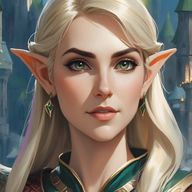
Elvenkind: Origins and Rise
In the earliest years of the First Age, as the Titanic influence faded, the first elves emerged—born from the lingering magic left behind by the departing Titans. These beings appeared within the heart of Lunora, amidst the primal chaos of the Great Weald. This vast, ancient, tropical wilderness harbored fierce and unyielding life, where predatory plants, venomous creatures, and immense dinosaurs dominated the landscape. A place that consumed all that lacked strength, it seemed inhospitable to mortal life.
Yet, from this unforgiving cradle, the elves arose—graced with an intrinsic mastery over arcane forces. While other mortal races struggled to survive, the elves thrived, seamlessly bending magic to their will. They did not merely endure; they transformed the world around them.
Magical Civilization
The elven cities became unparalleled marvels of magical architecture:
- Elen'Vara – The Floating Capital of the High Elves
“A kingdom upon the clouds, a marvel untouched by time—until pride summoned its fall.”
At the height of elven supremacy, Elen'Vara stood as the shimmering heart of the Valarith—High Elven society. Suspended above the vast canopy of the Great Weald, Elen'Vara was a city that defied the laws of nature, hovering effortlessly among shafts of eternal sunlight. Its foundation was not made of stone, but of pure arcane energy, weaved by the greatest spellweavers of the First Age. Towers of crystalline glass spiraled skyward, refracting light into cascading rainbows that danced upon the clouds. Marble bridges arched through thin air, connecting floating districts where gardens of silver-leafed trees and sapphire blossoms flourished without soil.
For centuries, Elen'Vara floated untouched by mortal hands, its barriers impermeable, its elegance unmatched. But in the Year 278 of the First Age, its sanctity was shattered. What began as mere whispers of unrest grew into an unstoppable force as human barbarians, emboldened and unified under the rallies of conquest, turned their gaze to Lunora. War erupted, and Elen'Vara became the focal point of the human siege.
The city crashed into the heart of Lunora with the force of a thousand storms, reshaping the very earth upon which it fell. What was once smooth plains became a jagged mountain range—now called the Shattered Peaks. Elen'Vara, once the symbol of elven invincibility, was entombed beneath stone and myth, its spires broken and its memory fading into legend. The fall of Elen'Vara marked the end of High Elven dominance and the turning point of the war, as human forces surged across Lunora, emboldened by their victory. - Lythanor – The Last Bastion of the First Age
“When Elen'Vara fell, Lythanor became the torchbearer of elven pride...until that light was snuffed out.”
Amid the ashes of Elen'Vara’s fall, the last great elven city of the First Age, Lythanor, became a refuge for those who survived the cataclysm. Nestled in the heart of Lunora’s eastern highlands, Lythanor was not suspended in the clouds like its predecessor, but anchored upon cliffs that overlooked the treacherous waters of the sea that would later become known as the The Imperial Bay. It was a city built for war—a bulwark of marble and ironwood, its towers bristling with wards of protection and fortresses lined with obsidian glyphs of defense.
Where the wilderness resisted, the elves did not combat it with blade or spear. Instead, they whispered to the elements, coaxing nature into harmonious existence. This mastery over both civilization and wilderness was seen as a divine purpose—an order inspired by Diion, the god of nature and balance. The elves viewed themselves as chosen custodians, weaving magic into the world’s very fabric.
The Valaer: Warrior-Caste
Among the first elves were the Valaer, the warrior-caste who embodied their supremacy. Clad in shimmering veils of arcane light rather than armor, they guarded the elven domains with both grace and terror. A mere gesture from them could conjure blazing orbs of energy, reducing threats to ashes without a drop of blood spilled. To the elves, primitive weapons were relics of a less enlightened era—a past they had surpassed.
Hubris and Dominion
Believing themselves the apex of mortal evolution, the elves saw no equal. They flourished in their magical supremacy, unaware that their pride would one day sow the seeds of their own downfall. For now, Lunora thrived under their dominion, its skies alight with floating palaces and its forests brimming with magic. The elves believed their reign to be eternal, but could not foresee the coming storm that would fracture their unity.
Elvenkind: The Great Divergence
Elvenkind, descendants of the Titanic influence and bearers of ancient magic, have long held dominion over Lunora. From their inception in the Great Weald to their splintering into distinct subraces, their civilization stands as a testament to both unity and divergence. The elves have since separated into several unique cultures, each representing a facet of their once-unified glory.
High Elves (Valarith)
“We are the inheritors of divine will, the sculptors of order, the keepers of purity.”
The Valarith are the eldest of all elven subraces, tracing their lineage back to the dawn of the First Age. They consider themselves the rightful custodians of Lunora, interpreting the will of Diion, the god of nature and balance. Their cities are radiant marvels of architecture—floating citadels sculpted from marble, suspended in shafts of eternal sunlight. These cities, adorned with shimmering spires and intricate runes of protection, serve as centers of magical learning and arcane discipline.
Culture and Beliefs:
The Valarith revere the concept of arcane purity. To them, magic is both sacred and absolute—an unblemished thread that weaves through reality. They believe that deviations from this purity are blasphemous corruptions that must be purged. This belief is reflected in their societal structure, which values order, discipline, and tradition above all. Their governing bodies are known for their protracted debates over divine signs, often taking decades to reach a consensus.
Stagnation and Legacy:
Despite their mastery of magic, the Valarith’s rigid adherence to structure has led to stagnation. Their obsession with perfection stifles innovation, and their reluctance to adapt has left them increasingly isolated from the changing world. They are often blamed by other elves for the emergence of Half-Elves, a result of their centuries-long peace and interactions with humanity—a decision still hotly debated among their ranks. Though the acceptance of Half-Elves has grown in recent ages, many Valarith elders view it as a dilution of their once-unblemished bloodline.
Shadow Elves (Umbraith), now known as Dark Elves
“In the shadows, we find truth. In darkness, we find strength.”
The Umbraith, or Dark Elves as they are more commonly known, represent a stark contrast to their Valarith cousins. They believe that true mastery of magic lies not only in light and creation but in darkness and entropy. Their cities are hidden beneath Lunora’s shadowed canopies and deep within caverns carved by ancient magics. In these twilight realms, necromancy, shadowcraft, and soul-binding are commonplace—practices deemed heretical by the Valarith.
Culture and Beliefs:
Once devout followers of Diion, the Umbraith have largely turned away from higher powers, embracing self-determination and personal ambition. Their society is fiercely competitive, with status earned through cunning, mastery of shadow magic, and ruthless political maneuvering. Among their ranks, strength and wit are the only true currencies. Betrayal and sabotage are not merely tolerated; they are expected as rites of passage.
The Umbraith’s abandonment of Diion and their increasing reliance on dark magic has given them a sinister reputation. Their enclaves are shrouded in secrecy, and they are known to deal in forbidden artifacts and cursed relics. Outsiders rarely tread into Umbraith territory without good reason—and even fewer return.
The Wild Elves (Therannis)
“The world breathes, and we breathe with it. To walk its paths is to feel its soul.”
The Therannis, or Wild Elves, are the embodiment of Midora’s primal essence. Rejecting the hierarchies and political strife of their kin, they dwell deep within the untouched wilderness. Masters of druidic rites and primal spirits, the Therannis live in seamless harmony with nature. Their settlements are hidden amongst colossal trees and ancient glades, where the whispers of nature guide their every step.
Culture and Beliefs:
The Therannis hold a near-religious reverence for elementals and entities tied to nature, seeing them in every tree, river, and breeze. They believe that magic is best experienced in its rawest form—untamed, unbound, and pure. Their rituals often involve communing with nature spirits, calling upon the earth, wind, and sky to aid them in their guardianship of the wilds.
The Second Divergence:
As centuries passed, the Therannis split into two distinct groups:
- Wood Elves: Those who remained in the mortal realms, continuing their druidic traditions and guardianship of the Great Weald.
- Veloren Elves: A more enigmatic offshoot that retreated deeper into the magical wilds, emerging only in recent years.
The Veloren Elves
“We are the echoes of Drekk, the horned watchers of the wild paths.”
The Veloren Elves are shrouded in myth and mystery, believed to have descended from the moon Drekk. Unlike their Therannis kin, the Veloren are marked by antler-like horns that adorn their heads—elegant and intricate, varying in size and shape. Their lithe forms possess an ethereal grace that hints at their celestial origins.
Exodus from the Wilds:
The Veloren lived in isolation for millennia, dwelling within enchanted forests that lay closer to the raw essence of magic. Recently, they have been seen emerging from their secluded realms, seeking refuge in the cities of Rivermond to escape the abyssal corruption spreading through the Stormwoods. Some have also been found traversing the wilds of Vikholm, their motives cloaked in secrecy.
Their arrival has sparked intrigue and fear among mortal communities, who view them as living relics of Lunora's distant past.
Sea Elves
“The tides are our domain. We are the echoes of the deep.”
The Sea Elves are the most enigmatic of the elven subraces. Legends speak of a union between Umbraith and Therannis elves who took to the seas for reasons lost to history. Elven scholars still debate the circumstances of this departure, though the result was the birth of the Sea Elves—a secretive and fiercely territorial people.
Culture and Beliefs:
Sea Elves are known for their deep connection to the ocean's magic, mastering water manipulation and seafaring like no other. Their cities are hidden beneath enchanted reefs and within colossal coral fortresses, warded by powerful illusions and tidal barriers. Mortals rarely encounter them, and those that do often speak of mysterious encounters with ethereal figures gliding through the water, vanishing before they can be approached.
Their society is bound by strict maritime traditions, and they are known to view outsiders with suspicion, if not outright hostility. To them, the sea is both sanctuary and dominion, a world where only the strong survive.
Elvish Dialects
Elven culture is ancient and widespread, resulting in the evolution of distinct dialects tied to their respective subraces and regional practices. These dialects, though sharing a common root, have diverged significantly over millennia, reflecting the unique lifestyles, beliefs, and environments of each Elven kin. Despite their differences, those fluent in one Elvish dialect can often understand the basics of another with careful listening and context.
Valari
(Spoken by the Valarith - High Elves)
Valari is the most traditional and refined of the Elvish dialects, holding tightly to the ancient scripts and linguistic structures that date back to the early ages of Lunora. The language is characterized by its melodic tone and strict grammatical rules, making it ideal for incantations, scholarly texts, and formal declarations. Among the Valarith, Valari is considered the purest form of Elvish, symbolizing their connection to the arcane. It is the primary language used in their enchanted ivory towers and marbled cities, often inscribed into the very stones of their architecture.
Valari also serves as the language of diplomacy and law in the Nagan Empire, where its elegance and precision are prized. Those outside of Valarith society who wish to trade or negotiate with the High Elves are often required to learn at least a conversational understanding of Valari.
Undera
(Spoken by the Umbraith - Dark Elves)
Undera is a shadowed reflection of its Valari roots, evolved through centuries of isolation and adaptation to the subterranean and maritime environments of the Umbraith. Its tones are hushed and guttural, with a rhythmic cadence that lends itself to incantations of shadow magic and whispered oaths. Unlike Valari’s strict formality, Undera is far more fluid and secretive, designed to be spoken softly or in hushed tones, perfect for stealth and concealment.
The language is heavily utilized in the clandestine ports of the Vache Kingdom, where Dark Elves dominate the shadows of trade and maritime dominance. It also includes a specialized cant for seafarers and smugglers known as Shadowtongue, an offshoot of Undera that incorporates nautical terms and cryptic phrases.
Many Umbraith are also versed in Undercommon, a necessity for trading with subterranean races and navigating the shadowed paths beneath the world. Despite this external influence, Undera remains fiercely protected and is rarely taught to outsiders.
Sylvan
(Spoken by the Therannis - Wild Elves)
Sylvan is the primal tongue of the Therannis, reflecting their deep bond with nature and the spirits of the wild. The language is lyrical and flowing, designed to mimic the sounds of rustling leaves, babbling brooks, and birdsong. Sylvan is also the preferred language for druidic rites and spirit communion, believed to hold an innate power to soothe beasts and manipulate the flora around them.
While it shares roots with Valari, Sylvan has diverged greatly over time, incorporating regional dialects unique to different groves and forest enclaves. Its written form is rare, often etched into living trees or sung into existence through magical runes. Many Therannis shamans and druids consider the spoken word in Sylvan to be sacred, only used during rituals or in times of spiritual significance.
Sylvanni
(Spoken by the Therannis - Veloren Elves)
Sylvanni is a rare offshoot of Sylvan, unique to the Veloren Elves. It carries the same fluidity of Sylvan but is layered with celestial and arcane intonations, reflecting their mystical connection to the moon Drekk.
Unlike standard Sylvan, Sylvanni incorporates elements of moon-phase symbolism and star-based navigation, often making it a poetic and cryptic language. It is primarily used in Veloren rituals and celestial observances, and its written form is inscribed with enchanted ink that glows faintly under moonlight.
Those who study Sylvanni often remark on its hypnotic cadence, claiming that listening to it spoken aloud evokes a sense of tranquility and mysticism. It is a closely guarded tongue, rarely spoken outside Veloren communities.
Thalassian
(Spoken by the Therannis - Sea Elves)
Thalassian is the aquatic dialect of the Sea Elves, shaped by the ebb and flow of tides and the rhythm of ocean currents. Its structure is fluid and rhythmic, mimicking the natural cadence of waves. Thalassian is uniquely suited for underwater communication, carrying clearly even in submerged environments.
Its written form is often inscribed on shells, coral tablets, or even tattooed upon skin using bioluminescent ink. Sea Elves employ a form of sign language alongside Thalassian, which they call Waveweaving, allowing them to communicate silently through hand gestures beneath the water's surface.
The language is rarely heard by land-dwellers, as Sea Elves remain elusive and territorial. However, those few who have learned it often find its melody hauntingly beautiful, reminiscent of whale song and distant storms.
A Legacy of Division
Thus, the elves fractured—not through war, but through ideological divergence. Each faction established boundaries defined by their beliefs, evolving into distinct cultures. Yet, despite their separation, they all faced a growing threat from beyond their borders, as the world around Lunora stirred with ambition and envy.
Elvenkind, once united under divine purpose, now stood divided—each branch clinging to its own vision of magic and destiny. As external forces encroached upon their lands, they would be tested not just by the world, but by the consequences of their own choices.