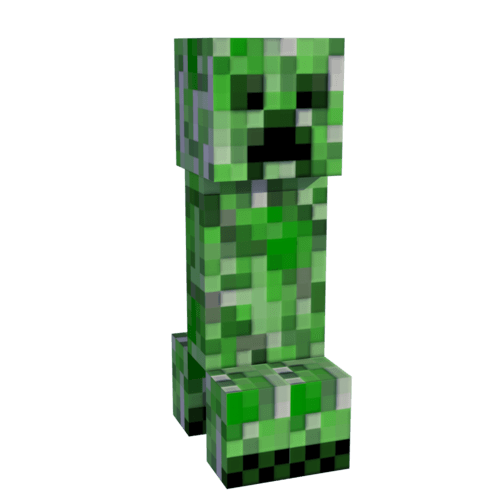
Creepers are non-sapient mold-based organisms who, when not in pursuit of other living things, behave similarly to extremely stupid cats (that is to say, curious and frequently in the way). Like many species of conventional molds and fungi, they reproduce via spores that are ejected explosively from their bodies in all directions, the true purpose of the classic creeper explosion. This is facilitated by the naturally-occurring gunpowder reserves stored in their bodies, which can be ignited at will via the activation of glands that produce a sort of chemical accelerant–a process comparable to an adrenaline spike in other species, albeit much more destructive. When a fully-mature creeper is ready to spore, it instinctively tracks down other organisms, attempting to catch them in the blast radius so that the baby creepers they spawn have a fresh, ample source of nutrients (a.k.a. the recent corpse of an unfortunate adventurer) to absorb from.
Adult creepers can subsist almost entirely on moisture, but young creepers are extremely fragile, unable to move quickly or defend themselves, and often the extra nutrients from organic matter means the difference between dying early or surviving until adulthood. Creepers also have a catnip-like draw for felines, and the fragility of newly-spawned creepers means that they are frequently gnawed to death by enthusiastic cats. This has ingrained all creepers with an instinct to flee from any feline they see.
On exceptionally rare occasions, a creature that survives a creeper blast may find themselves embedded with viable spores that will attempt to feed on them as they grow, despite the unfortunate host still being alive. When this happens to regular non-sapient mobs (e.g. cows), the animal usually dies and the creeper life cycle proceeds as normal. When this happens to sapient species, though, it may be another story entirely.
No one’s entirely sure why it happens–perhaps it’s a product of ambient magic, as sapient species are the only ones capable of harnessing this ephemeral energy for enchantments, or perhaps it’s something else–but spores embedded in sapient species occasionally begin taking on traits of their host, the most notable of these being sapience of their own.
Only a tiny fraction of the spores reach full viability due to a number of factors, from their own fragility (often dying out even under ideal growth conditions) to measures taken by the would-be host to rid themselves of them. Spores that do embed are often dealt with via amputation or cauterization of affected limbs, as the stress of playing host to a baby part-creeper tends to kill the aforementioned host.
Left to grow uninterrupted, these spores become Creeperkin: intelligent, self-aware hybrids of creepers and their host species.