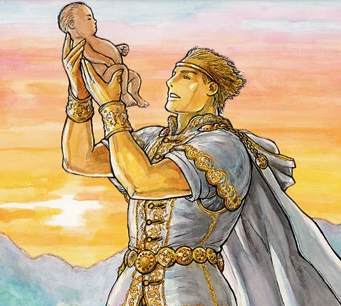
Lathander (pronounced: /lɑːˈθændɛr/ lah-THÆN-der) was a Faerûnian greater god with a vast portfolio including birth, renewal, spring and youth, as well as athletics, self-perfection, vitality and creativity. The Morninglord was symbolized by the rising sun, but rather than being the god of the sun itself, he was the god of dawn, which represented the potential of a new day. A god of hope and beginnings, Lathander's name was invoked at the start of new endeavors, whether sealing a new deal, or setting out on a new journey.
Some saw the Commander of Creativity as the neutral good aspect of Amaunator but the two were considered separate deities again after the Second Sundering.
Offer prayers to Lathander, and his light will shield thee.
— A statue in Idyllglen
Description
During his numerous visits to the Great Mother's Garden, Lathander appeared as a giant of a man, to match the size of his lover, Chauntea. His visage radiated bright shine of the morning sun and his hair burned with flaming orange-red fire. Lathander appeared as a handsome young slender muscled human man. His preferred clothes were a set of colorful robes of reds, pinks, and yellows. A red and golden sash embraced the god's waist. He wore golden sandals and left scorch marks everywhere his feet touched the ground. Lathander often floated and liked to materialize in a glorious spectacle of dawn sun beams. His radiant face darkened akin to solar eclipse when the god was angered or upset.
Personality
Despite being among the oldest of Faerun's gods, Lathander nonetheless retained the cheery hopefulness of youth. His was an eternal optimism, a constant willingness to focus on hopes for the future rather than wallow in the failures of the present.[13] He was a doggedly determined god who encouraged proactive altruism and constant reevaluation of the old ways. Exuberant and friendly, his interests laid in vibrant life (regarding both birth and nature), and conversely urged the destruction of the corrupted mockeries of life that he saw the undead as.
Though liked for his many positive qualities, Lathander also had a reputation for displaying the flaws common to the young, such as zealotry, vanity, and excess. Though enthusiastically altruistic and only slightly vain, it was said by his critics that his aggressive do-gooder mentality often prevented him from taking more sensible courses of action. His headstrong conceit could blind him to the consequences of his actions as in his idealistic crusades he simply attacked directly and hoped for the best, ignoring the ramifications.
Worshipers
I shall let all who dwell in dark feel your holy dawn, Morninglord. Hear my prayer.
— A basic prayer to Lathander.
Novices in the Lathanderian faith were called the Awakened, while clerics were known as Dawnbringers. The full priests took a new name in his service when they were ready to signify that Lathander personally recognized and accepted them. This new name could either be used instead of their old name or simply used only when addressing other Dawnbringers and when in solitary prayer. Titles used by Dawnbringers (in ascending order) were: Dawngreeter, Dawnlord, High Dawnlord, Dawnmaster, Morninglord, High Morninglord, Mornmaster, High Mornmaster, and Sunrise Lord. Specialty priests were also known as morninglords. All followers were required to be of neutral to good alignment.
All of Lathander's clergy respected art, liberty, nature, and culture; promoted betterment of oneself; and strove to bring hope to their followers and others. Many of these followers worked in various creative arts. They were intolerant of evil, especially undead and inaction that caused evil to prosper. Most ceremonies of Lathander were held at dawn and actions and contracts agreed to at sunrise were said to be blessed by him. Funerals, among his followers, were held at dusk, and followed by a wake that lasted until dawn.
Some followers of Lathander insisted that he was in fact the reincarnation of Amaunator, the Netherese god of the sun, which was known as the Risen Sun heresy. Others took this heresy further, claiming that he would take up the mantle of the lawful neutral Amaunator again, and that the transformation from deity of the morning to sun god was imminent.