1. Creatures

Giant Dragonfly

Terrain: Forests

Frequency: Rare

# Appearing: 1-6

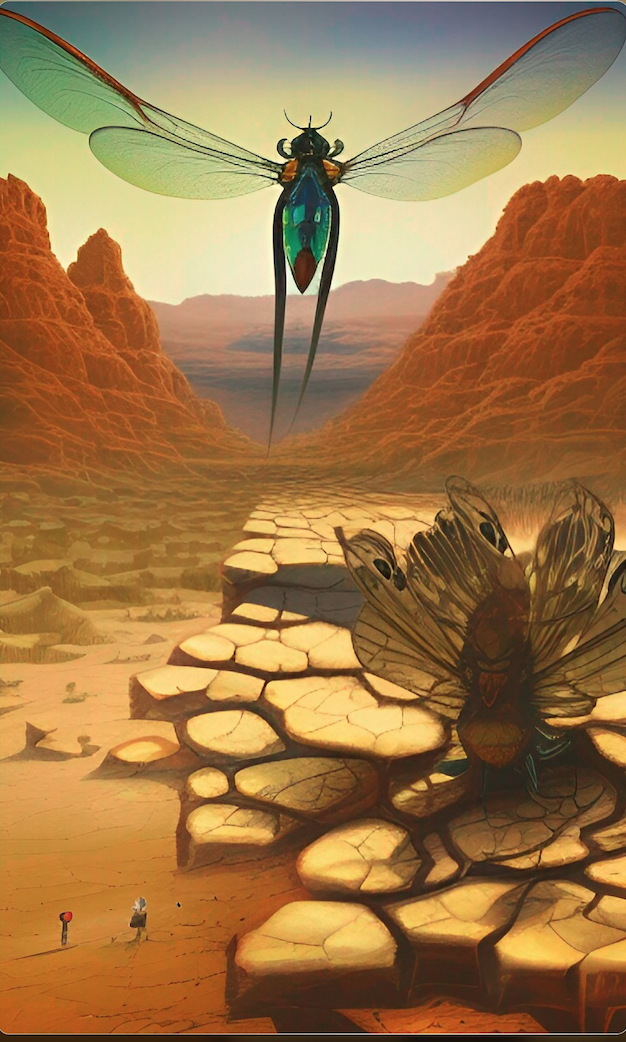
Giant dragonflies, like their smaller counterparts, are swift and deadly aerial hunters. While their smaller cousins are generally beneficial, the giant variety is a dangerous predator that attacks any creature its size or smaller. Adult giant dragonflies are famous for their brilliant metallic colors; common hues are green, blue, and gold. Stripped and spotted individuals have been reported. All adult giant dragonflies have two identical pairs of transparent wings that show dark veins in an sparkling amber membrane. A dragonfly's six legs are long and delicate, so the insect can at best balance lightly on a tree branch or other perch. The legs are tightly bunched where they join the body, but spread out at angles so the dragonfly can clench them together to form a large basket.

Kanka is built by just the two of us. Support our quest and enjoy an ad-free experience for less than the cost of a fancy coffee. Become a member.

Combat

A giant dragonfly's four wings enable it to hover and to dart with blinding speed. When attacking creatures of small size, a dragonfly scoops its victim into its leg basket and devours it in midair. When attacking larger creatures, a dragonfly darts in to bite with its mandibles.

Habitat/Society

 Since they tend to attack and devour anything they see, giant dragonflies do not form organized groups. Nevertheless, several of them hunting in the same general area may attempt massed attacks against less agile opponents. After such a gang attack, however, any crippled dragonflies are likely to become the next victims.

Ecology

Giant dragonflies mate and breed on the wing and near water, where they prefer to hunt. However, they are strong fliers and often are encountered over dry land, miles from water. Generally, they prey on other flying giant insects, but they take warm-blooded prey when they can get it. Giant dragonflies cannot tolerate freezing temperatures, but they are found in nearly every non-polar climate except deserts. In tropical areas, giant dragonflies tend to be even bigger. These larger specimens use the statistics in parentheses. Giant dragonfly eggs hatch in 12-20 days, depending on the temperature. Once hatched, a dragonfly remains in larval form for about a year. In temperate climates, the larvae hibernate through the winter, emerging as adults the next spring. A giant dragonfly's wings have no special value, but its glittering, metallic skin is highly prized in some areas for use in apparel and decoration. Magically preserved skin can bring up to 600 gp per square foot (a typical specimen yields six square feet of skin; tropical specimens can yield about eight square feet).

Larvae

Dragonfly larvae are sometimes called nymphs. These creatures are every bit as voracious as the adults, but they are flightless and completely aquatic. They are poor swimmers, however. Instead they lurk on the bottoms of lakes or ponds, hiding in burrows, weed beds, or fallen debris and waiting to ambush prey. Their abdomens are equipped with organs that can expel a powerful jet of water once every two rounds. When jetting out of cover to the attack, a nymph surprises victims 50% of the time. Dragonfly nymphs are armed with mandibles even more formidable than those of adults. Furthermore, these mandibles are covered by a rubbery, liplike organ when not in use; so even if the nymph is spotted before the attack, it often appears to be an inoffensive, toothless creature.