Lathrea
Description
Appearance
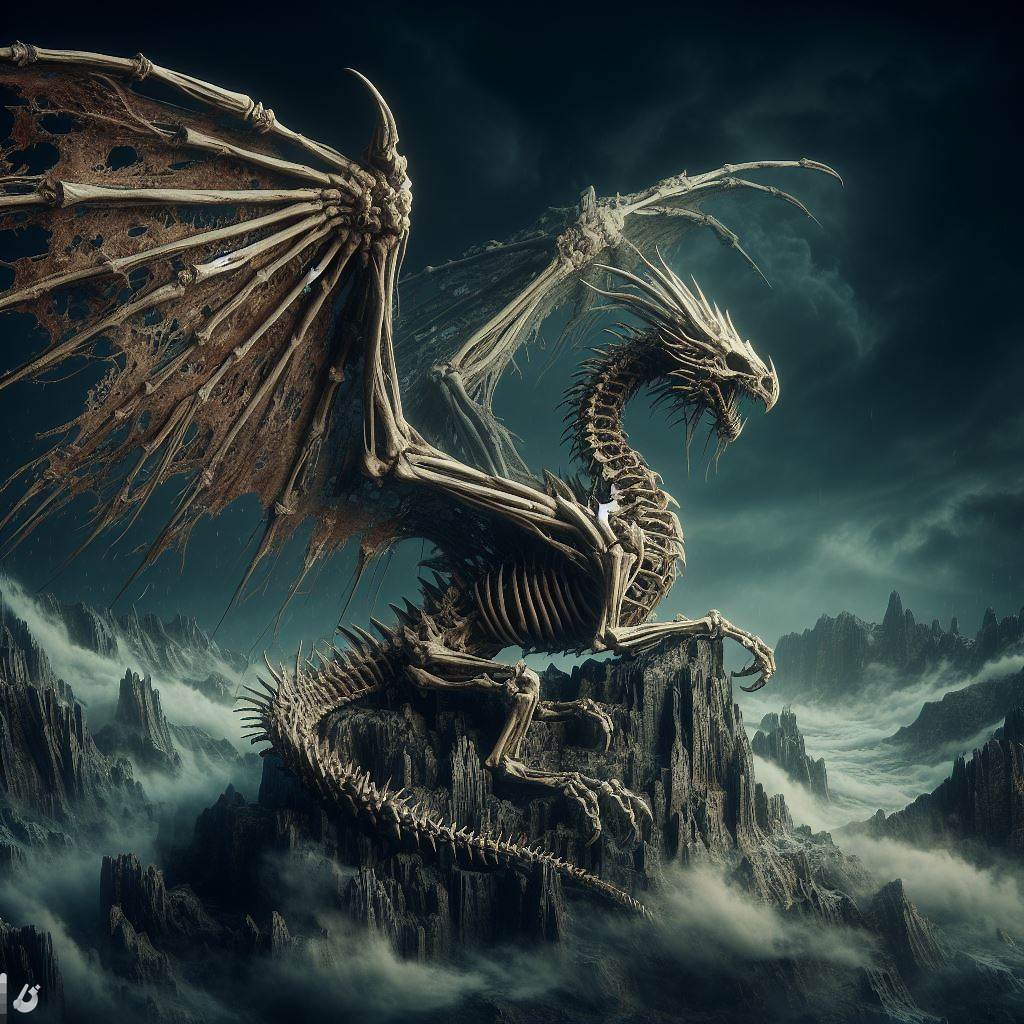
Lathrea’s current form is that of a colossal undead dragon, a nightmarish figure of decay and corruption. His massive skeletal frame is covered in jagged remnants of scales, rotted flesh, and protruding bones, all emanating a faint, eerie glow of necrotic energy. His wings are skeletal and tattered, with remnants of torn membrane hanging like dark shrouds between the bones. His skull-like head, with hollow, glowing eyes of crimson or pale blue flame, exudes a palpable malevolence. Mist of shadow and decay lingers around him, chilling the air and withering life in his presence.
His transformation into this grotesque form occurred after the murder of his mother, Lannalra, the Prismatic Mother. Whatever his previous form might have been is now lost to history, buried beneath his descent into corruption and darkness. This undead form reflects the betrayal and darkness within him, a physical manifestation of the twisted satisfaction he felt at his mother's death.
Personality
Lathrea is consumed by ambition, envy, and an unquenchable desire for power. In contrast to his sister, Layana, who embodies justice and harmony, Lathrea views these concepts as chains that had kept him subservient to his mother. His heart, once perhaps noble, was poisoned by resentment, jealousy, and a belief that dragons were meant to rule over mortals.
He believes that his mother's love was a lie and that she favored Layana over him, praising her for her work with mortals while giving Lathrea the Chromatic Dragons, whom he believed to be inherently lesser. His jealousy and rage, fueled by Theonvara, led him down a path of betrayal.
After Lannalra’s death, Lathrea no longer felt any guilt or remorse—only satisfaction at having rid the world of the one who, in his mind, had denied him his birthright. His soul became darker with each passing day, and his sole focus is now domination. He seeks to rule Avada, believing that dragons, particularly those loyal to him, should be the true rulers of the world.
Symbols
Undead Dragon Skull: Representing his corrupted, undead form and dominion over evil dragons.
Shattered Prism or Broken Scale: Symbolizing betrayal and the fracture within dragonkind.
Shadowed Claw or Bone Talon: Denoting his grasp over deception and control.
Crown of Bones: Reflecting his ambition to rule and his belief in draconic supremacy.
Biography
Background
Lathrea was born as the son of Lannalra, the Great Mother, and twin brother to Layana. While Layana embraced her mother’s ideals of harmony, justice, and the protection of mortals, Lathrea saw dragons as inherently superior to all other beings. He believed that dragons were meant to rule over the mortal races, not serve or guide them. His ambition to establish draconic supremacy, however, was met with resistance, both from mortals and from his sister.
His frustration grew as his mother, Lannalra, continued to praise Layana for her role in helping the mortals, leaving Lathrea to feel neglected and underappreciated. He saw Lannalra's decision to give the Metallic Dragons to Layana as the ultimate symbol of her favoritism, feeding into his deep-seated jealousy.
Corruption by Theonvara
Lathrea’s festering resentment attracted the attention of Theonvara, a deity of chaos and corruption. Theonvara saw in Lathrea a potential ally in her desire to upend the balance Lannalra had created in Avada. She whispered dark promises to him, planting the idea that his mother had never loved him as she had loved Layana. She convinced Lathrea that he had been denied his birthright and that together, they could reshape the world into one where dragons ruled supreme.
Theonvara's manipulation twisted Lathrea’s mind, and he came to fully believe that his mother had favored Layana all along. Fueled by this belief, Lathrea and Theonvara conspired to kill Lannalra and take control of Avada. They lured her into the Sacred Celestial Garden, a place where she often sought peace and solitude.
The Death of Lannalra
As Lannalra arrived in the garden, she immediately sensed the darkness within her son. She pleaded with him, telling him that she had loved him deeply and that there was no favoritism in her heart. But her words fell on deaf ears. In Lathrea’s mind, his mother was a symbol of everything that had kept him small and insignificant.
When the moment came, Theonvara drove a blade into Lannalra’s heart while Lathrea stood by, watching. As the goddess of life and balance collapsed to the ground, her life draining away, the sky above darkened, and the heavens wept. But Lathrea felt no guilt—only satisfaction. He reveled in the destruction of the mother who, in his mind, had denied him everything. He took pleasure in her death, watching her body crumple in the garden that had once been her sanctuary. The death of Lannalra shattered the balance of the cosmos and ignited the Diathan War, a conflict that would reshape the world forever.
Transformation into the Broken Tyrant
With the murder of his mother, Lathrea’s soul was forever corrupted. His body transformed into that of a massive undead dragon, a creature of decay and death. This form symbolized the darkness he had embraced, a grotesque reflection of the pleasure he had taken in his betrayal. From that moment onward, Lathrea fully embodied the god of betrayal, lies, and the evil dragons that served him.
Aftermath and The Severance
Following the Diathan War and the Severance—an event that fractured the connections between the divine and the mortal planes—Lathrea set his sights on Avada. With his mother gone and his sister, Layana, weakened by grief, Lathrea sought to have dragons take over the world. He instigated the Dragon’s Conquest, encouraging dragons to seize control of mortal cities and kingdoms.
Many dragons, influenced by Lathrea’s corrupted teachings, began conquering towns, but they were often met with resistance from mortal heroes who fought back. Despite these setbacks, Lathrea has never abandoned his goal of dominating Avada. He believes that dragons are meant to rule, and he continues to stir unrest, manipulating both dragons and Dragonborn into pursuing his vision of draconic supremacy.
Current Goals and Influence
Lathrea’s ultimate goal is the complete takeover of Avada by dragons. He believes that dragons should always be in power, ruling over mortals and enforcing their dominance. Any dragon, even Metallic Dragons that align with him, are welcomed in his ranks, as he views their allegiance as both a tactical advantage and a personal victory over his sister, Layana.
Dragonborn, whom Lannalra had created to live in harmony with dragons, are also part of his vision of power. However, Lathrea believes they should serve dragons, not stand beside them as equals.
Relationship with Other Deities
Lathrea’s relationship with his sister, Layana, is one of deep-seated animosity. He views her continued efforts to protect mortals as naive and obstructive, and every Metallic Dragon that joins his cause is a victory against her. His alliance with Theonvara, the deity who corrupted him, is one of convenience and shared ambition, though neither fully trusts the other.
Worshipers
Followers and Cults:
Lathrea’s followers are primarily among the Chromatic Dragons and Dragonborn who share his belief in draconic supremacy. Some Metallic Dragons who have turned against Layana also serve him, seeing Lathrea’s cause as a path to power. His cults value strength, ambition, and dominance, and they actively work to undermine mortal society.Beliefs and Practices:
Draconic Supremacy: The core belief is that dragons are the rightful rulers of Avada, superior to all other beings.
Power and Deception: Followers value cunning, manipulation, and betrayal, using these tools to gain control.
Rejection of Balance: They reject the ideals of harmony promoted by Lannalra and Layana, viewing them as weakness.
Necromantic Worship: Many of Lathrea’s followers practice necromancy, honoring his undead form and manipulating life and death.
Temples and Sacred Sites
Lathrea’s followers establish strongholds in remote, desolate places—abandoned ruins, volcanic caves, or ancient battlefields. These places are fortified and filled with relics of death and decay, often adorned with bones and symbols of his undead form.
Symbols and Icons
Altars adorned with dark gemstones, bones, and draconic relics.
Banners and emblems displaying his sigils—often an undead dragon skull or a bone-clad claw.
Legacy and Impact
Lathrea’s betrayal of his mother and his transformation into the Broken Tyrant have left an indelible scar on the history of Avada. His actions shattered the balance that Lannalra had painstakingly established and plunged the world into chaos. The death of the Great Mother not only marked the loss of a beloved deity but also the beginning of the Diathan War, a cataclysmic conflict that reshaped the very fabric of reality.
The murder of Lannalra disrupted the harmony among the dragons. The Chromatic Dragons, influenced by Lathrea's corrupted teachings, embraced their newfound aggression and superiority, becoming adversaries to the mortal races. Conversely, the Metallic Dragons, guided by Layana, remained steadfast in their commitment to protect and guide mortals, honoring their mother's legacy.
Lathrea's transformation into a colossal undead dragon symbolizes the depth of his corruption and the pleasure he took in his betrayal. His undead form serves as a constant reminder of the consequences of envy, deceit, and lust for power. The darkness that envelops him reflects the void left by his mother's death and his rejection of her ideals.
Throughout history, Lathrea has persistently sought to dominate Avada. The Dragon's Conquest is a testament to his unwavering ambition. While his efforts have been repeatedly thwarted by mortals and deities alike, his influence continues to pose a significant threat. His followers, including corrupted dragons and Dragonborn, perpetuate his vision of draconic supremacy, leading to ongoing conflicts and instability across the world.
The legacy of Lathrea has deeply impacted the relationships between dragons and mortals. Distrust and fear have often overshadowed the possibility of harmony. Communities remain vigilant against the resurgence of his influence, and tales of his betrayal are passed down through generations as cautionary lessons about the dangers of envy and unchecked ambition.
Despite the shadow he casts, Lathrea's actions have also galvanized forces of good. Layana and other benevolent deities have worked tirelessly to counteract his schemes, promoting unity, understanding, and the restoration of balance. Their efforts have strengthened alliances between mortals and dragons who remain true to Lannalra's teachings.
Culturally, Lathrea is often depicted as a tragic figure—a cautionary example of how pride and jealousy can lead to one's downfall. His story serves as a moral lesson emphasizing the importance of humility, the value of cooperation, and the perils of betrayal. Art, literature, and oral traditions frequently reference his tale to reinforce these themes.
In the broader cosmic context, Lathrea's betrayal disrupted the natural order, leading to the Severance and altering the dynamics between the divine and mortal realms. His alliance with Theonvara represents the ever-present possibility of corruption and the fragility of harmony when malevolent forces conspire.