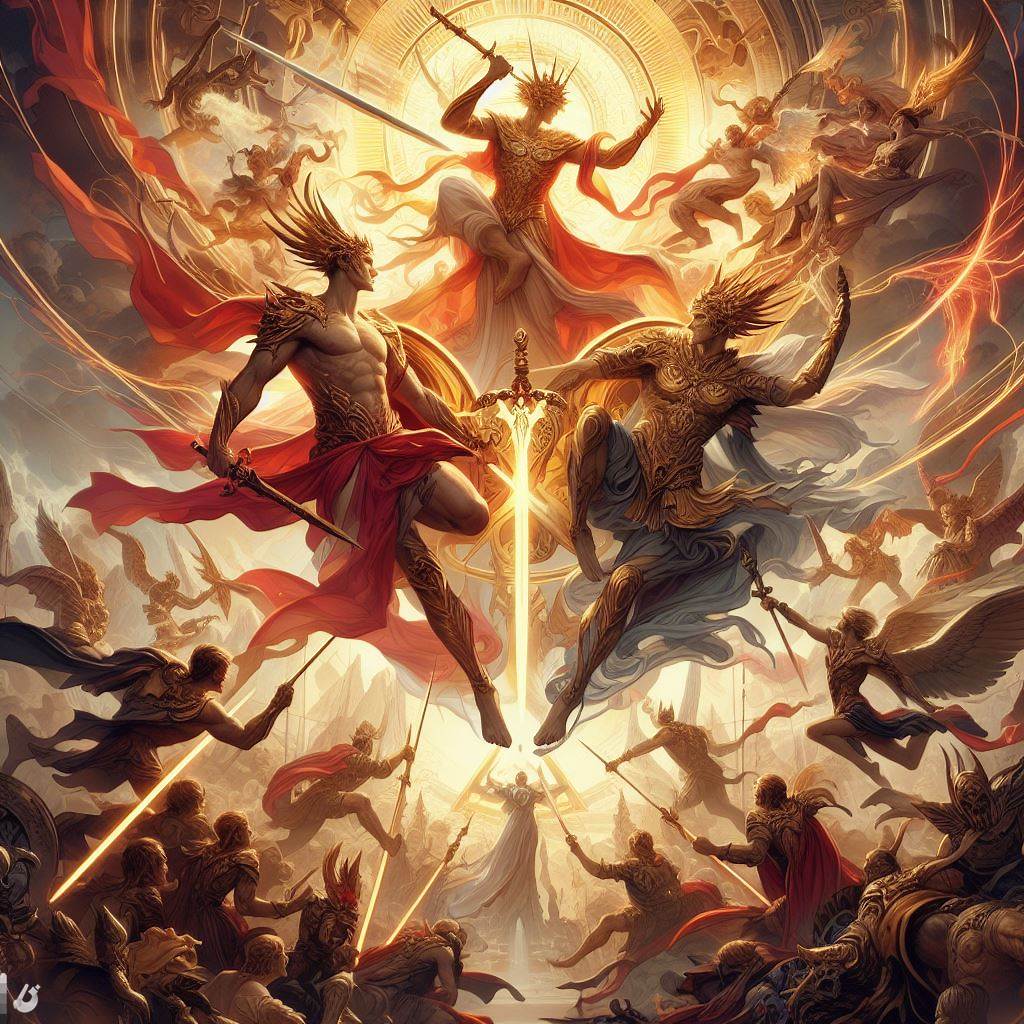
The War of Divinity: The Fall of Theonvara and the Sundering of Avada
In the ancient cosmos, where the gods of Avada ruled over all existence, a fateful event ignited a war that would reshape the world forever. At the heart of this conflict was Theonvara, a powerful god, consumed by ambition and a lust for dominion over all realms. Opposite him stood Lannalra, the radiant goddess of life and balance, whose wisdom and compassion had long tempered Theonvara’s darker nature. Together, they once maintained a delicate equilibrium between the forces of creation and destruction. But this balance was shattered in an instant.
The Betrayal of Theonvara
Theonvara, ever the master of manipulation, knew that if he were to rise above the other gods and remake the cosmos in his image, he needed an ally—someone close to Lannalra, someone who could be twisted into betraying her. That someone was her son, Lathrea. Long overshadowed by his sister, Lanalra, Lathrea harbored deep resentment toward his mother, convinced that she favored his sibling, leaving him unacknowledged and underappreciated.
Seizing upon this bitterness, Theonvara approached Lathrea in secret, sowing seeds of doubt and envy. "Your mother has always held your sister above you," he whispered. "You, who possess the strength and vision to reshape the world, are left forgotten. You deserve to stand as a true god, not in the shadow of Lannalra's favoritism. Together, we can destroy her and reshape the world as it should be—with you reigning supreme.”
Lathrea, already consumed by years of jealousy, embraced Theonvara’s words with open arms. He did not hesitate. He craved the power and recognition that had long been denied him. Fueled by his festering hatred for his mother, he joined Theonvara's plot without remorse.
The two conspired to lure Lannalra into a trap, and when the time came, they confronted her in the sacred celestial garden where she often sought peace and solitude. Lannalra, sensing the darkness within her son, pleaded with him to reconsider. She told him that she had loved him deeply, that there was no favoritism in her heart. But Lathrea, his soul already poisoned, cared nothing for her words. In his mind, his mother was a symbol of everything that had kept him small and insignificant.
When Theonvara drove his blade into Lannalra’s heart, Lathrea felt no guilt—only satisfaction. He watched with cold eyes as his mother’s life drained away, her body crumpling to the ground. As the goddess of life and balance died, the sky darkened, and the very heavens seemed to weep, but Lathrea reveled in her demise. He was glad to have rid the cosmos of the mother who, in his mind, had denied him his birthright.
With Lannalra gone, Theonvara offered Lathrea a reward for his loyalty. Using forbidden magic drawn from the Abyss, Theonvara transformed Lathrea into something more powerful and more terrible than he had ever dreamed. No longer just a god of envy, Lathrea was reshaped into a new entity: a dark god of evil dragons, embodying the destructive and corrupting forces of the ancient draconic spirits. His divine form twisted and mutated, becoming a massive undead dragon, a hulking beast of bone and shadow, whose very breath spread death and decay.
Now reborn as a force of utter malice, Lathrea took flight, terrorizing the heavens and the mortal world alike. He commanded legions of dark dragons, creatures of immense power and cruelty, who ravaged the lands of Avada at his command. He had no remorse for his mother’s death, only delight in his newfound strength and the fear he could instill in gods and mortals alike.
With Lathrea transformed into the undead dragon god, and Theonvara unleashing demons from the Abyss, the world of Avada was plunged into a darkness from which it would never fully recover.
The Rise of the Diathan
In the wake of Lannalra's death and the rise of Theonvara’s chaos, it was her daughter, Layana, who first rose to confront the betrayal. Grieving the loss of her mother and furious at her brother, Lathrea, for his treachery, Layana vowed to restore balance to the shattered world of Avada. As the goddess of justice, balance, and guardian of the good dragons, she knew it fell to her to lead the charge against the forces of darkness that now threatened all existence.
Layana’s wrath burned bright, but her heart was tempered by her deep sense of righteousness. She became a symbol of hope for the remaining gods, a beacon of defiance against the growing tide of evil. In her fury and sorrow, she transformed into her truest and most powerful form—a giant Adamantine Dragon, the embodiment of indestructible justice and the protector of all noble dragons. Her shimmering, metallic scales reflected the light of the heavens, and her presence on the battlefield was awe-inspiring, her roar shaking the very fabric of the divine realms.
Clad in this magnificent form, Layana led the Diathan, the gods of order, light, and balance, in their war against Theonvara and her corrupted brother, Lathrea. Her leadership united the pantheon, and she became the rallying force for the Diathan’s resistance. Together, they fought to protect Avada from the darkness that had engulfed it.
Her struggle was the most heartbreaking. Layana knew she would have to face her brother, Lathrea, now a monstrous undead dragon, twisted by Theonvara’s dark magic. Though Lathrea was once her beloved sibling, she could not forgive him for his role in their mother’s murder or the destruction he now wrought as the god of evil dragons. The battle between Layana and Lathrea became one of legend—a clash of titanic forces, where balance fought against corruption, and justice clashed with greed.
Where Lathrea spread death and decay with his every move, Layana's presence brought light and hope, and she rallied the noble dragons under her banner to aid in the fight. Her forces of good dragons soared alongside her, clashing with Lathrea’s legion of undead, their roars filling the skies with thunder. Layana's adamantine form was unyielding, her purpose unshakable, as she led her fellow gods in wave after wave of battle against the forces of darkness.
Under Layana's leadership, the Diathan surged forward. The war was brutal, and the devastation immense, but her presence on the battlefield gave her allies strength. Every swing of her claws and every breath of her radiant fire drove back the abyssal demons and dragons twisted by Lathrea’s power. For every piece of Avada that fell to ruin, Layana and the other Diathan fought to reclaim what could still be saved.
Though the war was far from over, Layana's courage and resolve became the shining light that guided the Diathan through the chaos. The forces of good, though outnumbered and under constant assault, refused to falter, for as long as Lanalra’s adamantine wings soared above them, they believed they could win. She was not just a goddess of balance and justice, but a living symbol of hope in the darkest hour of Avada.
The Chains of the Abyss
The war between the gods once thought to be a swift conflict, raged on for 150 long years. Theonvara, now known as The Hungering Void, alongside his dark ally Lathrea, sought to bring all of Avada under their control. But they were not alone in their conquest. The Odelates, gods of chaos and destruction, were divided. Some, corrupted by the promise of power, joined Theonvara's cause, unleashing unspeakable horrors across the world. Others, however, chose to side with the Diathan, the gods of order, balance, and justice, recognizing that if Avada fell to the dark gods, there would be nothing left for them to rule.
The war reached every corner of existence. Mortal kingdoms crumbled, civilizations were burned to ash, and the heavens themselves trembled under the clash of divine powers. The alliance of Theonvara and the Odelates against the Diathan stretched the conflict far beyond what any could have predicted. As dragons fought in the skies and demons poured from the Abyss, the very fabric of reality seemed to fray.
Layana, the daughter of the fallen goddess Lannalra, led the Diathan in their struggle. Her form as a giant Adamantine Dragon became a symbol of hope for those who fought for balance and justice. Alongside her stood Ortal Fire-Mane, the god of fire and the forge, whose hammer forged weapons that could strike even the gods themselves. Together, they pushed back against Theonvara and his legion of demons, but the war was brutal, and both sides paid a heavy price.
The Creation of Deanosis
As the war dragged on, it birthed something new and terrible. The constant exposure to the horrors of divine conflict, the endless bloodshed, and the nightmare of a world ravaged by unchecked power gave rise to a new god—a being forged from the collective nightmares and fears of mortals. Deanosis, the god of terror and madness, emerged from the suffering of Avada. Neither fully aligned with the Odelates nor the Diathan, Deanosis embodied the war's psychological toll, feeding on the fear and despair of mortals and lesser gods alike.
Deanosis moved like a shadow, his influence creeping into the minds of mortals, corrupting dreams into endless nightmares. Even the gods were not immune to his power. Wherever the war went, Deanosis followed, thriving on the suffering and chaos. Neither side could control him, and his presence only further escalated the violence, pushing the war to even darker, more twisted extremes.
The Binding of Theonvara and Lathrea
In the final years of the war, Layana and Ortal Fire-Mane devised a desperate plan to end the madness. Knowing that Theonvara and Lathrea were at the heart of the chaos, they focused their efforts on these two corrupted gods. The battle for their capture was unlike any other—a cataclysmic clash between the forces of justice and destruction.
Layana, in her adamantine dragon form, fought her brother Lathrea in a brutal aerial duel, their roars shaking the heavens. Meanwhile, Ortal wielded his forge-born hammer against Theonvara, whose endless hunger for power consumed everything around him. With every strike of his hammer, Ortal unleashed divine flames that scorched even Theonvara’s corrupted form.
After a battle that seemed to last for centuries, Layana and Ortal succeeded. Just as they had chained Theonvara to the Abyss, they now cast Lathrea into the same dark prison. The two betrayers, once the architects of Avada’s downfall, were locked away in eternal torment, their power sealed beneath the cosmic chains that no force could break.
The Fall of the Forgotten Goddess
As the war between the Diathan and the Odelates reached its zenith, even the forgotten goddess of death, who had long remained neutral in the affairs of the gods, was drawn into the conflict. Realizing that the delicate balance between life and death was at risk of being destroyed by the chaos and bloodshed, she took up arms alongside her fellow Diathan. Determined to preserve the natural order, the goddess of death became a fierce warrior, fighting to ensure that life and death maintained their sacred cycle amidst the horrors of war.
With each battle, the goddess of death wielded her power with precision, guiding the souls of the fallen to their proper rest and ensuring that neither the living nor the dead tipped the scales too far. Her role was critical to maintaining the fragile balance that held the universe together. Her presence on the battlefield was a reminder that death was not the end, but a part of the eternal cycle that connected all things. But as the war dragged on and the divine conflict escalated, her position as the guardian of death attracted the attention of darker forces.
Sorentas, once a loyal cleric of the forgotten goddess, had grown twisted by the horrors of war. The terror and chaos around her ignited an unquenchable thirst for power. In secret, Sorentas delved into forbidden knowledge, seeking the strength to transcend her mortal form and control the realms of death and undeath. She believed that the goddess of death had failed to use her power to bring an end to the war and saw an opportunity to seize control of death’s mantle for herself.
In a dark ritual steeped in ancient and forbidden magic, Sorentas ascended to godhood. She became the goddess of the Undead and secrets, a being of terrifying power who sought to break the natural cycle of life and death. With her newfound strength, Sorentas confronted her former goddess in a battle that would decide the fate of death itself.
The forgotten goddess of death, though weakened from the endless fighting, stood firm against Sorentas’s onslaught. She fought not only for herself but for the balance she had sworn to protect. Their clash was titanic, shaking the very foundations of the divine realms as they waged war for control over the fate of the dead. Sorentas, however, had become something dark and unnatural. She wielded the power of undeath, raising fallen souls as her twisted army, corrupting the natural order the goddess of death had fought so hard to preserve.
In a moment of betrayal, Sorentas used the knowledge she had gained from centuries of service to her goddess to strike a fatal blow. The forgotten goddess, weakened and surrounded by the horrors of undeath, fell, her divine essence dissipating into the void. With her death, Sorentas claimed dominion over the realm of the dead, twisting it to her will, and raising herself as the new goddess of the Undead and keeper of dark secrets.
The Ascension of Allishae
But all was not lost. Among the forgotten goddess’s followers was Allishae, her most devoted cleric and protector. Witnessing her goddess's fall filled Allishae with both sorrow and fury. The natural order had been shattered, and Sorentas’s reign of undeath threatened to upend everything her goddess had stood for. In her grief, Allishae prayed to the Diathan for guidance, and her devotion was answered. In a moment of divine intervention, Allishae herself ascended to godhood, taking her place as the new goddess of death.
Allishae embodied the balance her fallen goddess had fought for. She restored the natural cycle of life and death, ensuring that no soul would be trapped in undeath or forgotten in the chaos of war. But her ascension also meant confronting Sorentas, who had taken the realm of death and twisted it into a mockery of what it once was.
Allishae knew she could not face Sorentas alone. She sought the aid of Silica, the goddess of knowledge, who has a distaste for Sorentas’s domain. Together, Allishae and Silica confronted Sorentas, whose power had only grown more dangerous since her betrayal. Sorentas, now fully entrenched in her role as the goddess of the Undead, raised armies of forgotten souls and guarded her secrets jealously, but she had underestimated the combined strength of wisdom and death.
In a climactic battle, Allishae and Silica outmaneuvered Sorentas, using the very secrets she hoarded against her. Allishae, with Silica’s help, restored the balance of death and stripped Sorentas of her influence over the cycle of life. Finally, they banished Sorentas to a distant, forgotten realm, where her influence could no longer corrupt the souls of the dead. But the damage had been done—the death of the forgotten goddess marked the end of an era, and the scars of Sorentas’s betrayal would forever haunt the divine realms.
Though Allishae had restored balance, the memory of her fallen goddess remained. Her ascension was bittersweet, for she now carried the weight of death on her shoulders, tasked with continuing the sacred work of maintaining the natural order in a world forever changed by war.
The Aftermath: A World Reborn
With Theonvara and Lathrea imprisoned in the Abyss and Sorentas banished, the war finally came to an end. But Avada was forever changed. The land had been scarred by 150 years of divine conflict, with entire cities reduced to dust and countless lives lost. The very essence of the world had been twisted, and mortals lived in constant fear of the nightmares that still haunted them—the lingering influence of Deanosis, whose power would never fully fade.
Knowing that they could not allow such destruction to happen again, the Diathan took one final, decisive action. They created a physical barrier around Avada, a divine shield that would prevent any god—Diathan or Odelate—from ever directly touching the world again. This barrier, woven from the remnants of the divine power used in the war, separated the mortal realm from the divine. The gods could no longer walk among mortals, nor could they interfere as they once had.
Yet even with this barrier, the influence of the gods remained. Mortals still carried the divine spark within them, their prayers and devotions reaching the gods beyond the veil. The Diathan continued to guide their followers, ensuring that balance and justice would persist, while the Odelates—though barred from the world—whispered their dark temptations into the hearts of those who would listen.
Though Avada had been brought to the brink of annihilation, life endured. The world, scarred but not broken, began the slow process of healing. Mortals rebuilt what they could, forging new civilizations from the ashes of the old. But the memory of the war, and the fear of the gods’ return, lingered like a shadow over everything.
The gods watched from beyond the barrier, their power diminished but their influence was ever-present. Theonvara, Lathrea, and the Odelates plotted in their prisons, while the Diathan worked in silence to maintain the fragile balance that had been won at such great cost. Avada, though free from the direct touch of the divine, would forever carry the scars of a war that reshaped both heaven and earth.