/src/w/18576/legacy/d0dec7df-1542-5fdc-9166-54290bc26d7a.jpg)
An enormous species of tree that dominates the world of Bodue. They generally grow to about eight miles, with the average width of their canopy and root system at about four miles.
The name "Boduan" is an exologism into Bem Nomei (Gehaarunomei) by Samsari explorers who, lacking the prejudices of most Samsaric entities, considered the trees to be the dominant lifeform of the planet. The Haaru at least don't generally disagree with this, though other races might consider it a misnomer.
Anatomy
Heartwood
The heartwood is highly vascular, and crucial to the tree's survival. "Don't cut your heartwood" is a phrase in many Haaru cultures, meaning variously: "Don't kill your golden goose," "Find another way, you're not desperate yet," or "Don't fuck things up for everyone else."
Fully grown Boduan have a major (central) heartwood and a few outlying minor heartwoods surrounding it. They are alternatively referred to as paleo- and neo-vasculature.
Sapwood
The sapwood incorporates a high degree of minerals, making for a consistency somewhere between ash wood and basalt. For this reason, it is relatively difficult to work, but can be used in applications normally filled by either wood or stone that do not require either extreme of rigidity. It is not uncommon to see its wood used in brick rather than plank form.
Bark
Root
Maw
Main Article: Lomoi Maw
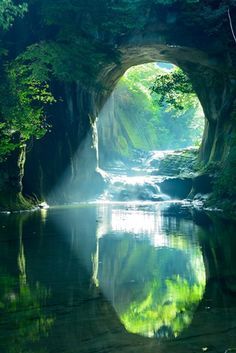
A Boduan Maw with accumulated water and resident minor flora. Don't expect any sunlight on a forest surface, though.
Boduan develop Maws, hollows in their trunk that lead straight through to their root system. This allows passage of water to their roots, to prevent death by dehydration in the Rootlands where tightly adjoining neighbors' roots would otherwise prevent water from reaching the soil. Maws never reach to the Heartwood however, which at this level is encased in a particularly stony bark.
In practical terms, a Maw is a frequently flooded cave. They are often quite large, and may be home to any number of flora and fauna. In particular, Randi (Fairystool)s are a common sight, rarely in numbers sufficient to light the whole chamber in their pastel pink and blue glows.
Geophores & Follicles
Main articles: Geophore, Follicle
Geophores are fruits that hold undigestible minerals and other excrement, and usually Munoyik (Chalice Cap) spores. A geophore develops within the sapwood as a bundle of collected material, and as it grows and moves toward the surface its outer layer develops into what will become the Follicle. The Follicle is a relatively soft, spongy version of bark that hardens into normal bark as the Geophore is extruded. The fruit gradually grows like a zit and is eventually expelled from the bark, usually leaving the Follicle as a sizeable hollow for a few years. The follicle gradually flattens itself into the surface of the bark and disappears. The entire process takes anywhere from two to twenty years depending on the size of the fruit.
Many geophores break apart during extrusion, releasing dirt and spores gradually as the follicle flattens outward into normal bark. Some stay intact and fall to the ground, an impact generally hard enough to be fatal for most creatures hit by it. Still, geophores are relatively light and fragile, having a consistency something like compacted ashes. There are rumors that, depending on the local geology, Boduan can spit out gemstones instead of geophores. Just rumors, I'm sure.
Seeds
Boduan seeds are designed to float down rivers, an appropriate strategy for a species whose proliferation creates them on a disastrous scale.
TODO: Wouldn't they just end up in lakes? How to get them to disperse rather than to accumulate in one spot for a whole basin? There needs to be a mechanism for them to find actual soil to take root in.
Branches
See also: Branchland