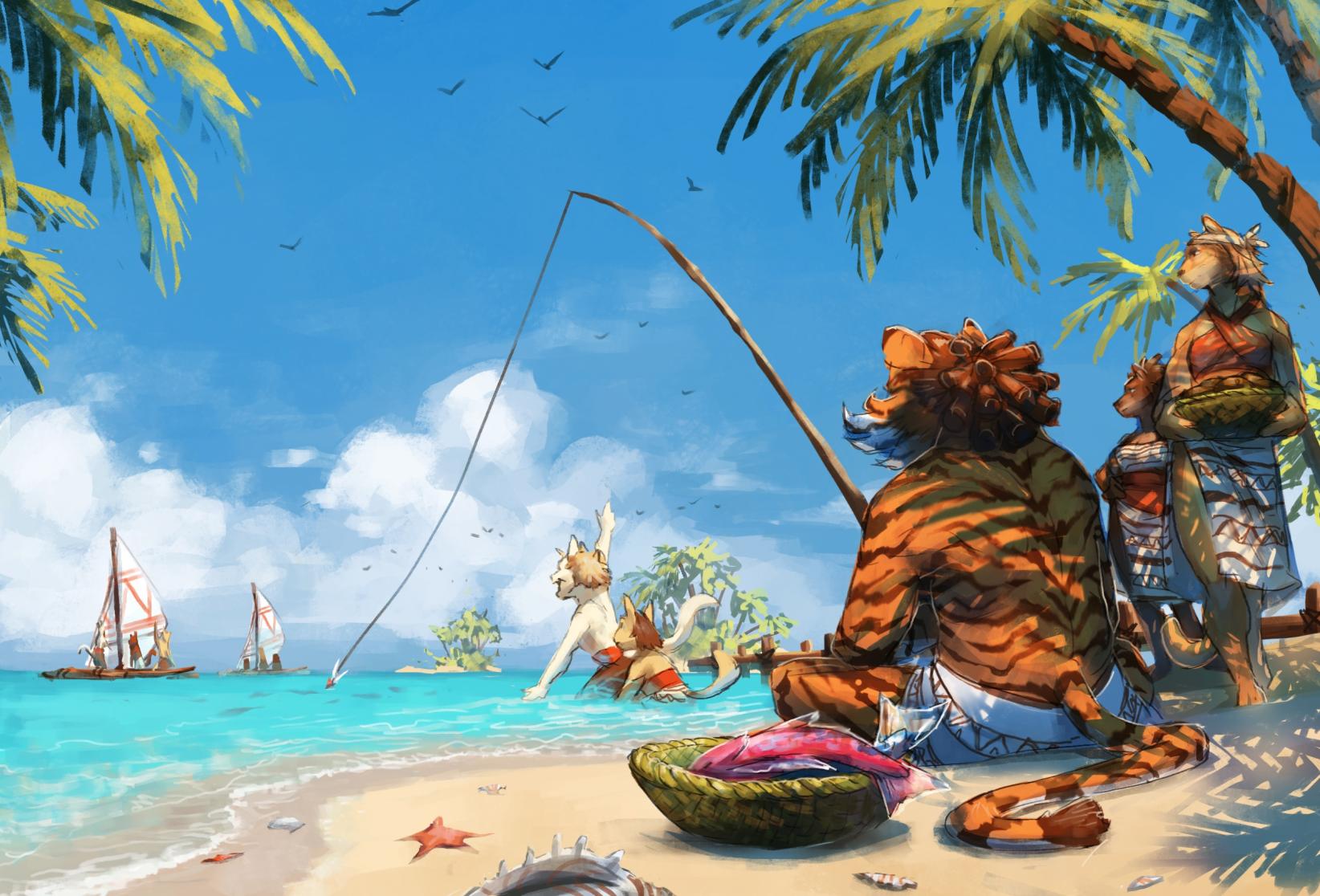
The Feline Isles of Al’ar are a remote archipelago of over three hundred volcanic islands. Al’ari are predominantly feline—most are cats, and the non-cats pick up some of their traits while living there. Deep green jungles and the dark blue sea give the homeland a natural beauty that is the envy of all the Beast World.
Untouched beaches and lively dock towns come to mind when the average person hears this homeland’s name. The temperature is warm year-round; the seasons are a cycle of dry sun and harsh storms. Hurricanes pass through the southern half of the archipelago in the wet season, high winds scattering the seeds of Al’ar’s fruit trees. They scatter any unprepared cats, too.
Al’ar is about 25,000 square miles in total land area (counting islands with at least one dock town). Just over one million people call themselves Al’ari, and they live along 2,600 miles of surround- ing coastline. Species other than felines and humans are a tiny minority.
Lively Docks, Unspoiled Land
Al’ari Pirhouans believe the world is a gift from the Beast Mother. They leave nature with as few permanent alterations as possible. People live in cities built on long wooden docks along the isles’ sandy beaches. Tent and hammock dwellings stretch inland, but stone structures are exceedingly rare. When islanders fell trees, they pay careful attention to replanting. They only mine the littoral caves formed naturally in ocean-side cliffs.
To avoid permanent changes to the land, the Al’ari take a unique approach to agriculture. They explore their home islands, encouraging the growth of wild crops and expansive mangroves. With care, wild-sown crops yield plentiful forage in their own time. The neat rows of farmland in Allemance and Arneria are unfamiliar to an islander, but the crop rotation and nitration techniques necessary to cultivate Al’ari forage farms are used to aid conventional farms as well.

Al’ari cuisine certainly doesn’t suffer for this approach. Root vegetables such as sweet potato and cassava are staples of their diet, accompanied by a wide range of jungle-native fruits and tuna. These foods are enhanced by robust spices unique to Al’ar’s tropical climate. Sugarcane grows on Al’ar’s largest islands, and Al’ari rum is a favorite everywhere in the world.
Sailing Home Waters
Houses in a dock city often have sparse furnishings and little storage. An Al’ari home is mainly a shelter from rain and insects. Spending more than a few daylight hours indoors attracts rumors one is hiding an illness (or a mistress). Tools, unfinished fabrics, and anything else vulnerable to the elements are the most common furnishings. The Al’ari sleep on their roofs, under open sky when- ever possible. This habit follows them elsewhere, which makes them easy to spot in delver caravans at night.
Al’ari settlements are on docks, but Al’ari life is lived on a boat. The clear waters are decorated with tiny vessels, whose sails fly a rainbow of colors and patterns. A newborn Al’ari can swim before they can crawl, can sail before they can walk, and can build a boat before they can read.
The shipwright’s art is a lifelong pursuit. At least once a season, boats are replaced and their old materials are repurposed. The design and decora- tion of each one expresses its builder’s whims and momentary fascinations.
The Al'ari Sailboat
An Al’ari sailboat is a light wooden sloop built for two people, made to glide through glassy waters and choppy tides. They can be sailed alone and stored away in a few minutes. It is a vehicle, companion, work tool, and art project. The most refreshing nap is one taken on the tide. No fish is as filling as one brought from the sea to the kitchen.
Not every Al’ari boat is a slender personal wave runner. Some families combine their efforts to build transcontinental schooners, whose wide sails and tall masts carry them to Arneria on voyages lasting six months or more. Al’ari families take season-long journeys to trade spices, textiles, and other goods with foreign homelands. The crew is usually one to three families, but sometimes a band of adventurous young friends plan their own voyages to win some new fineries to wear.
Two Homes
Al’ari settlements uproot and relocate twice a year, in a practice known as the Storm Voyage. Docks are pulled up and huge migratory ships are built from their timber. Once finished, the vessels carry everything to the settlement’s second location. The destination is usually a completely different island. The timing of this journey depends on the settle- ment, but all Storm Voyages follow the beginning and end of the dry season: during May or June, then again in November or December.
The Storm Voyage is borne of necessity. Al’ari foraging is at the mercy of a wild growing season, and a dock town’s migration gives the island time to recover from sustaining a large population. The migration of sea life has adapted to match these sailing patterns, which helps the Al’ari resist the complacency that leads to overfishing.
Of course, the most important reason for the Storm Voyage is in the name. Hurricanes tear across Al’ar during the wet season, which would nullify a city built on docks. The storms are more manageable along the northern islands, so every year a tide of colorful sails washes onto their beaches. The Al’ari circle their waters this way, with sails like a school of colorful fish skimming the surface.
This journey is a centuries-old tradition. Legend has it that the oldest Al’ari homes contain timber from the first Storm Voyages. The name Al’ar itself is derived from al-isar, which translates to “child of the typhoon” in Old Al’ari.
A Boulder Pushed
The semi-annual voyage and dock town reconstruction is two weeks of intense labor. From sunrise to sunset, every healthy citizen helps to build the ships. Traveling Al’ari with necessary skills are often called home for the task, and join their communities in the back-breaking effort of moving an entire city across the sea.The semi-annual voyage and dock town reconstruction is two weeks of intense labor. From sunrise to sunset, every healthy citizen helps to build the ships. Traveling Al’ari with necessary skills are often called home for the task, and join their communities in the back-breaking effort of moving an entire city across the sea.
An Al’ari saying about the value of work goes, “a boulder pushed an inch rolls a mile.” When the Storm Voyage is finished, its maelstrom of effort subsides. Al’ar settles down into a leisurely joie de vivre. By narrowing their work to one tough month, the Al’ari earn eleven more months of easy living with the sun and sea. They spend long afternoons in casual study, walking among the mangroves, or perfecting their fishing technique.
The rhythm of the Dungeon delving life comes naturally to beasts and brethren from the Feline Isles. An Arnerian might be frustrated by its short bursts of effort and excitement, followed by months of idle inaction. For the Al’ari, it’s hardly a change in pace at all.
Pondering Time
The typical Al’ari spends hours by themselves every single day. They might spend this time pearl diving, climbing inland trees, or simply observing the rain from underneath a canopy. Grasping this alone time is an important part of understanding the Al’ari perspective on work, religion, and family. Even a flighty, chattering kitten learns the value of quiet moments of contemplation.
This thoughtful rhythm makes Al’ar a home- land of great philosophical minds. They regard metaphysics and the study of self with the same importance as mathematics or arcanist studies. Philosophers who publish insightful work enjoy privileged opportunities in Al’ari society. Long, waterproof scrolls of philosophical poetry, treated with wax and seed oil, are one of the few perma- nent possessions an Al’ari carries with them from year to year.

Tidal Temperament
An impermanent nature runs throughout all Al’ari culture. People wander from island to island, adopting other villages’ habits and traditions as they go. As their saying goes, “the sea is never truly still.”
Some people think centuries of isolation from other species led to Al’ar developing a culture closer to the tendencies of quiet-minded cats. Others have noticed similarities between Al’ari society and their surrounding ocean waters. Its people are inspired by both.
continued on page 128...