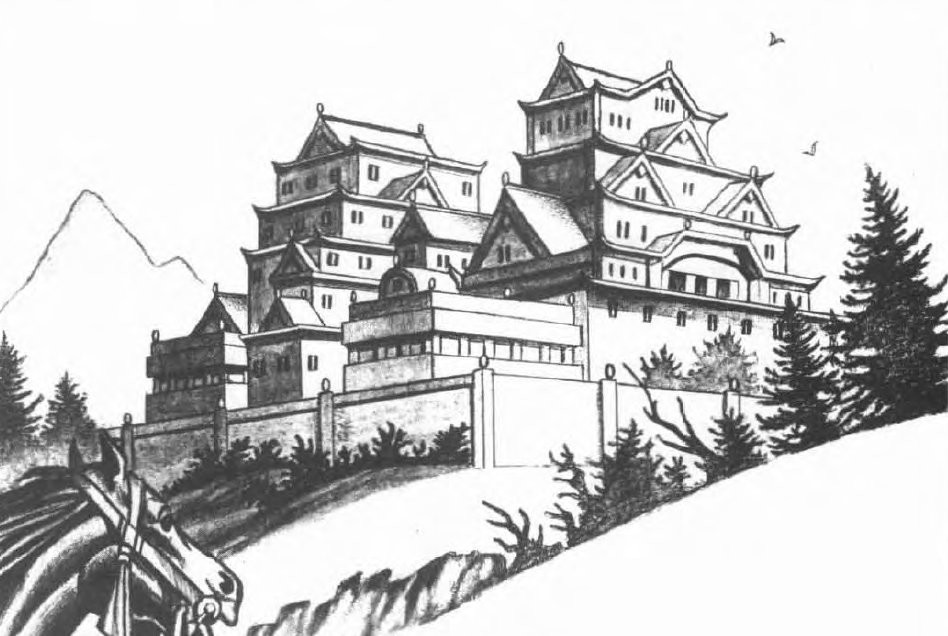
One might expect the personal defenders of the Imperial line might have a powerful military installation for their home, but in reality Kyuden Seppun – often called the “Second Home of the Hantei” – is a nigh-indefensible palace. Although it is built at the high point of a hill, it lacks the high walls and fortified keep of a traditional castle. Instead, Kyuden Seppun is a sprawling estate of several conjoined smaller estates (or yashiki). These various estates, built over time by different Seppun daimyo, gradually fuse together into a truly magnificent and wondrous residence. Thus it is little wonder that Kyuden Seppun is a frequent choice for the Emperors of the Hantei line to host their Winter Court.
Despite its beauty, Kyuden Seppun is not a place of grandiose pomposity or excessive displays of wealth. Instead it is a serene, reverent, and quiet place, one where violence is almost unheard of and guests are treated to a far more enlightened experience than many first expect. The Seppun are a deeply religious family with equal roles as priests and soldiers, and have always treated their ancestral home as a place that calls first and foremost on their roots in the priesthood. Thus, while a military garrison is always present here, it is relatively small and kept largely out of sight from guests. Most of those guests, even the most stuffy or worldly, depart with a sense of inner peace and speak glowingly of their time here.
The Four Temples
True to the religious roots of the Seppun family, Kyuden Seppun is surrounded by a quartet of temples called Daikandaiji, Yakushiji, Asukadera, and Kawaradera. These four temples are named in honor of four sayings by Shinsei and thus each reflects particular elements of the Shintaoist faith. Retirement to these temples is a popular choice not only among the Seppun but any individuals of high status and political pull. Consequently, these four temples have always had a certain appeal to political figures seeking advice and guidance from the Brotherhood, and the more politically-minded monks of the Brotherhood likewise tend to gravitate here.
The Grave of Seppun
Located within walking distance of Kyuden Seppun, this is one of the few locations in the Empire to be exempted from the rule of cremation imposed after the first appearance of the Bloodspeaker Iuchiban, the sacrosanct Grave of Seppun has stood inviolate through all the centuries from her death to modern times. No enemy has ever despoiled the Grave, even during the worst of crises, and rumors abound that the site is watched over by the spirit of Seppun herself, a shade strong enough to dissuade any who might desecrate her remains.The stately but small tomb is covered in frescoes depicting the stars as they were seen when the Kami fell to earth, along with various other religious iconography. A small path connects it to the Seppun estates, winding through groves of willow trees. Visitors are not common, but those who do come are deeply pious and respectful.
The Seppun Gardens
This term is used to describe not a “garden” in the conventional sense, but rather the entire region in the vicinity of Kyuden Seppun. No farming is conducted so close to the Seppun estates, but the lands are still tended well, creating the tone and appearance of a vast lightly manicured park. Aside from their vast expanse and semi-natural beauty, the Seppun Gardens are known mainly for the statuary that can be found within them. One new statue is commissioned each time a Seppun daimyo is appointed, and thus over time they slowly multiply. Only very rarely is anyone foolish enough to cause harm to these statues, and pilgrims visit them to honor the servants of the Emperor and reflect upon their history.