Recent History
The Wood Elves of the modern Empire originate from the Tiran contingent that accompanied the High Elven army during the Siege of Mor'Koc. At the time, they were not recognised as a distinct people; Tiran administration categorised them simply as rural High Elves, valued for their stealth, woodland skills, and reliability as hunters and foragers. When the Tiran army established its encampment around the capital, the Wood Elves withdrew into the Mor Woods, supplying themselves independently and maintaining only limited contact with the main force.
When the Siege collapsed, and the entire Tiran army was taken prisoner, the Wood Elves alone avoided capture by remaining in the forests. Negotiations were conducted through their envoy, and when the Imperial authorities offered terms, the Wood Elves declined repatriation. Instead, they remained in
Mor'Koc and accepted Imperial citizenship. Tiran chroniclers describe this decision as “a wound to the kingdom’s strength,” as it removed a substantial proportion of their fighting-age rural population.
Their integration proved unexpectedly smooth, as their skills aligned closely with Imperial military and administrative needs.
General Description
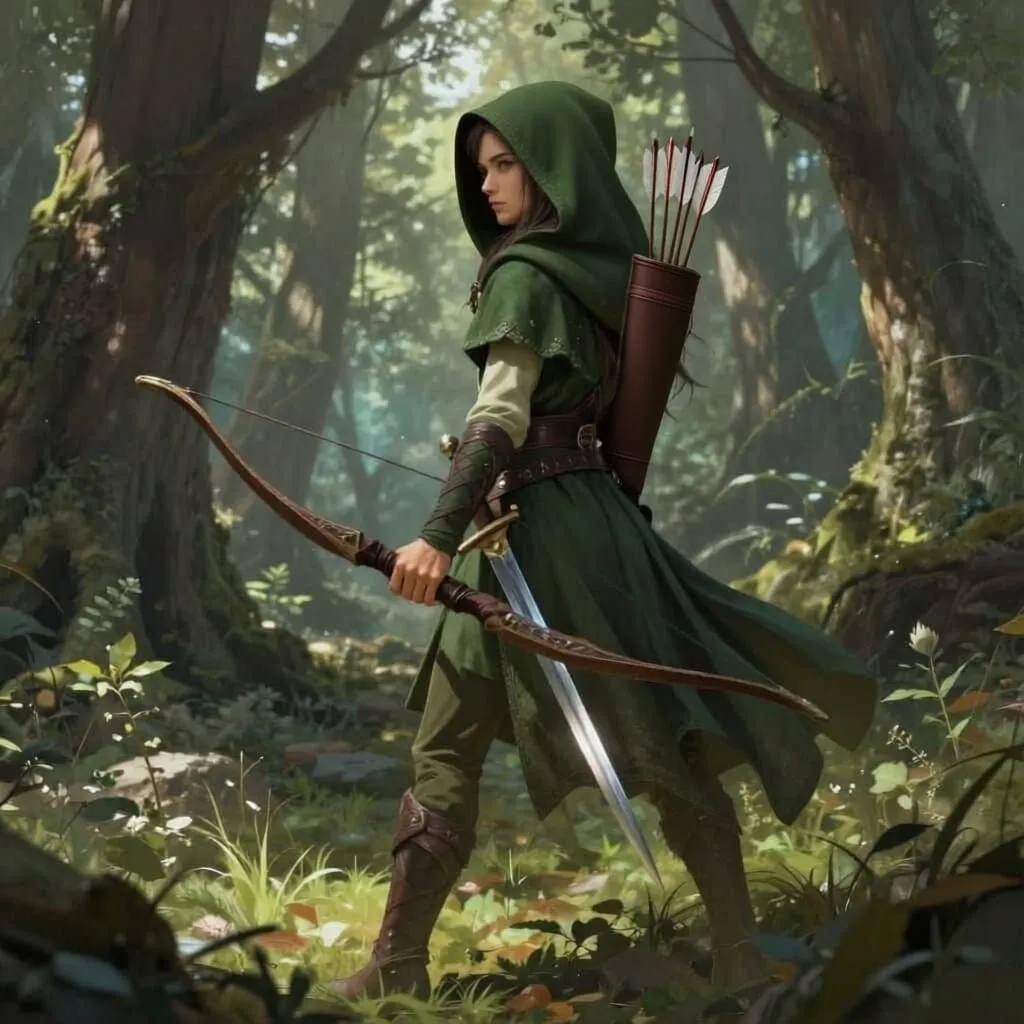
Wood Elves descend from Tír’s woodland and agricultural populations. Generations of outdoor labour lend them bronze-toned complexions, contrasted by characteristic black hair and green eyes—traits associated in traditional Elven folklore with forest clarity and vitality. They are physically similar in stature to their High Elven cousins but generally exhibit greater strength and endurance.
Their movements are notably quiet. Imperial officers remark that a Wood Elf “is only seen when choosing to be seen,” a phrase that has become common in administrative reports.
Culture
Wood Elven society values practical competence above lineage or ornament. A person’s standing is measured by their ability to hunt deer, track silently, provide for a household, and understand the rhythms of the forest.
Upon reaching adulthood, each Wood Elf traditionally crafts a personal longbow and a matching long knife. The bow is expected to last a lifetime; the knife serves as a multipurpose hunting tool. To lack either is to be considered—not figuratively but literally—a child.
While both High Elves and Wood Elves favour longbows, their approaches reflect their cultures. High Elven bows tend toward courtly ornamentation and magical refinement, often prioritising elegance over field practicality. Wood Elven bows, by contrast, are unadorned tools crafted for endurance and accuracy. High Elven accounts occasionally criticise this as “rustic minimalism,” while Wood Elves frame High Elven bows as “objects to look at rather than use.”
Separation from Tír
Relations between the two peoples were strained long before the Siege. In Tír, Wood Elves formed the rural workforce—hunters, farmers and foresters—while High Elves held urban administrative and noble roles. High Elves viewed this hierarchy as natural; Wood Elves considered it restrictive. During the Imperial Wars, several Wood Elf communities briefly renounced Tiran authority, referring to the conflict as “a madness that devours the soil and season alike.”
Their refusal to return after the Siege cemented the rift. For the first time, they were acknowledged as a people separate from High Elves, both culturally and administratively.
Disposition
To Imperial officials, Wood Elves can appear distant or difficult to integrate into rigid schedules. Their priorities follow seasonal patterns, and they show little patience for authority unearned by skill. Within their own settlements, they are viewed as straightforward, industrious and restrained, with a dry humour that favours understatement over display.
Relationship with High Elves
High Elves continue to claim a more “refined” heritage, a belief seldom endorsed outside Tír. The loss of their rural population after the Siege has left Tír chronically short of food and manpower.
High Elven administrators frequently blame Wood Elves for “abandoning ancient duties.” Wood Elves view the matter differently: they served, they left, and they do not intend to return.
Word count: 632