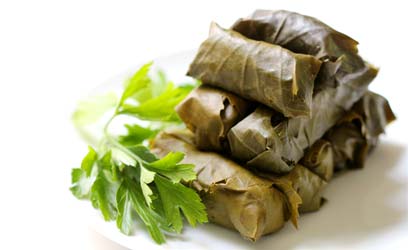
Samor is a staple in the Dappled Haven, a part of restaurant cuisine and home-cooking alike. It is labor-intensive and its different stages often bring families and friends together during the festival times for which it is prepared. There are three key elements to samor.
The first element is an essential part of Strawberry Creed cuisine, udi leaves. Udi is a vegetable grown in the forests surrounding the Dappled Haven. It thrives equally under full sun or the broken shade of a forest floor. In sun, the plant grows low, tight sprays of purple and green leaves the size of thumbnails, tough and inedibly bitter, with stalks of tiny red, pink, or white flowers. Humans in the nearby settlements use it as a decorative garden perennial. When cultivated under specific conditions in the fecund shade of a forest, however, the plant bolts in stalks as tall as an elf and grows masses of tender, sweet leaves of pale green the size of dinner plates. In those conditions, is unlikely to flower and is typically propagated by cuttings. Elves who travel beyond the forest often do not believe it is the same plant.
Young, fresh udi leaves are eaten raw in salads or used as a potherb. Left a little longer to mature, the leaves are fried, steamed, or boiled in soups and stews. The flavour of the leaves is sweet, fragrant, and slightly pungent, like a mixture of baby spinach, sweet neem, and nasturtium flowers. But the true delicacy of udi comes from those leaves which are left to mature until autumn.
Too tough to eat as such, the mature autumn leaves are picked before the first frosts, tied in bundles, and dry-cured over the winter in the cold. When the weather warms in spring, they are laid in piles and allowed to ferment. The piles are continually turned and restacked to ensure consistent fermentation. This process develops spicy aromas in the leaves reminiscent of cinnamon, black pepper, and licorice. Eventually, by the following autumn, the leaves are packed tightly into barrels with salt to age and pickle.
Udi leaves are pickled in this way in two kinds of barrels. Oak barrels reused from wine or spirits (generally purchased from humans) are typically reserved for export or everyday, household use. But the elves also use a special kind of wood for barrels that is almost never sold to foreigners: and if so, at a commandingly dear price. These barrels are made from the watik, a truly unusual tree that grows exclusively in the forests surrounding the Dappled Haven.
The watik tree is parasitic. It springs only from the roots of old-growth oak, pine, cedar, or redwood. The roots of the watik are able to graft themselves onto these trees to absorb the nutrients in their sap, and therefore has no need of chlorophyll; its leaves are ghost-white; its bark is pitch-black; and its wood is ash-grey. In the spring it bears jaundice-yellow flowers, beloved by forest bees and whose essence is used in perfume. The watik’s sap can be tapped and boiled, also used in perfumery as well as cuisine, but the preciousness of the wood makes this product exceedingly rare. Its trunk grows slowly, low, and thick, and takes decades before it is ready to cut and mill. Its heartwood is also prone to a harmless fungal infection called atus that paints streaks of emerald green and sometimes blood red through the wood’s grain, highly valued for woodworking. The elves who tend the watik tree and its various products are part of a communal religious cult within the Strawberry Creed society.
Barrels made of watik staves share the ability of oak to swell with liquid and become watertight. And, like oak, the watik imparts unique flavours to the contents: spicy, sweet, vanilla, tannic elements, which are further intensified by those rare and costly staves infected by atus. Udi leaves pickled and aged in watik barrels are one of the pinnacles of elvish delicacy. The spicy sweetness of the leaves marries with the accents of the watik as if decreed by heaven. The pickled leaves, after years of aging in the watik barrels, are known as yud. Oak-aged udi is known as ilec-yud and its value and taste are considered lower. Udi aged in atus-infected watik barrels is known as watusk-yud and is both rare and greatly valued. Yud are often chopped and served as a condiment (much like kimchi, chutney, or sauerkraut), but for samor the yud leaves are used whole, as a wrapper.
The second element of samor is lutu, known by humans as elf-wheat. The lutu plant is an annual grass that grows natively around ponds and brooks in forest clearings; elves cultivate it in irrigated hilly terraces. The seeds of lutu are used as grain, just like rice or wheat, with a nutty flavour and a pinkish-grey hue – either ground to flour and baked in loaves, or steamed or boiled whole. For use in samor, the lutu grains are sprouted (like malt), baked, cracked, and then steamed into a sweet, aromatic porridge which, properly prepared, becomes dark, vivid pink.
The final element of samor is the filling, of which there are two categories. The most traditional and popular filling is made from a caterpillar used in silk production, the larva of the Sharfuthe moth. It is not the human’s silkworm – rather, a destructive larva that is very carefully managed, as without the imposed constraints of cultivation it could defoliate vast swaths of forest. If it were to ever escape the magical constraints of elvish husbandry, the ecological consequences would be disastrous. Its silk is softer and more lustrous than human silk, although not as strong. The plump white Sharfuthe larva are pan-roasted for consumption; they have a flavour and texture like almond butter or marzipan.
The second category of samor filling is a phenomenon of the current Strawberry Creed’s youth, and while very popular, is considered frivolous and immature by the older generation of elves. It is a paste called fasook made from fruit blossoms and honey, often blending monofloral honeys with the same blossoms – such as apple blossom honey with apple blossoms. Fasook-samor does not have the protein content of traditional samor, nor the old-fashioned taste, but young Strawberry elves relish its sweetness.
These are the three key elements of samor: yud, malted lutu, and a filling of Sharfuthe larvae or fasook. The filling is rolled in the lutu and wrapped in a yud leaf, and then steamed, perhaps a bit like a cabbage roll or dolma. Samor is polarizing to members of other races – the spicy-salty taste of the yud, the roasty sweetness of the lutu, and especially the traditional larval filling can present an odd combination of sweet and savoury flavours, particularly to the human palette. Nevertheless, to a Strawberry Creed elf in the Dappled Haven, samor is the quintessential taste of home.