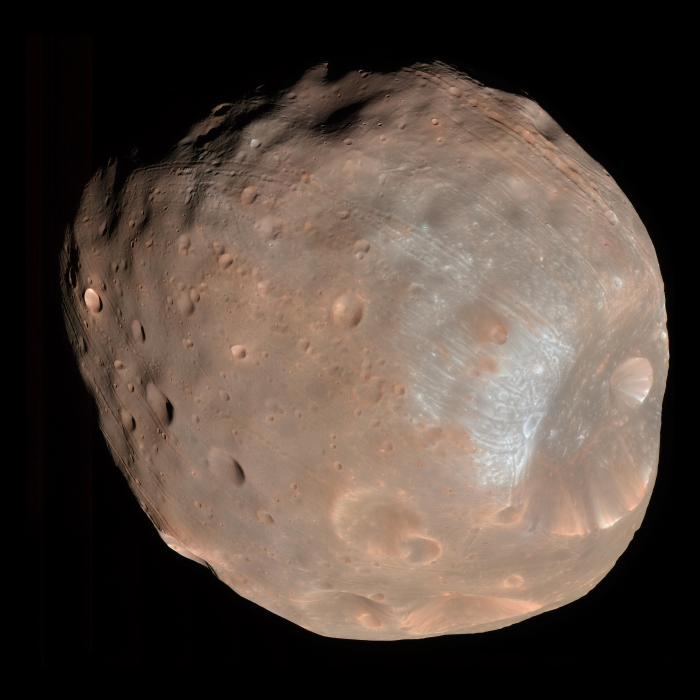
Phobos has a diameter of 22.2 km (13.8 mi) and a mass of 1.08×10¹⁶ kg
Phobos orbits closer to Mars, with a semi-major axis of 9,377 km (5,827 mi) and an orbital period of 7.66 hours;
If viewed from Mars's surface near its equator, a full Phobos would look about one-third as big as a full moon on Earth. It has an angular diameter of between 8' (rising) and 12' (overhead). Due to its close orbit, it would look smaller when the observer is further away from the Martian equator until it completely sinks below the horizon as the observer travels closer to the poles; thus Phobos is not visible from Mars's polar ice caps.
Speedy Phobos rises in the west, sets in the east, and rises again in just eleven hours.
Phobos is tidally locked, always presenting the same face towards Mars.
Since Phobos orbits Mars faster than the planet itself rotates, tidal forces are slowly but steadily decreasing its orbital radius. At some point in the future, when it falls within the Roche limit, Phobos will be broken up by these tidal forces and either crash into Mars or form a ring
Total lunar eclipses of Phobos happen almost every night.