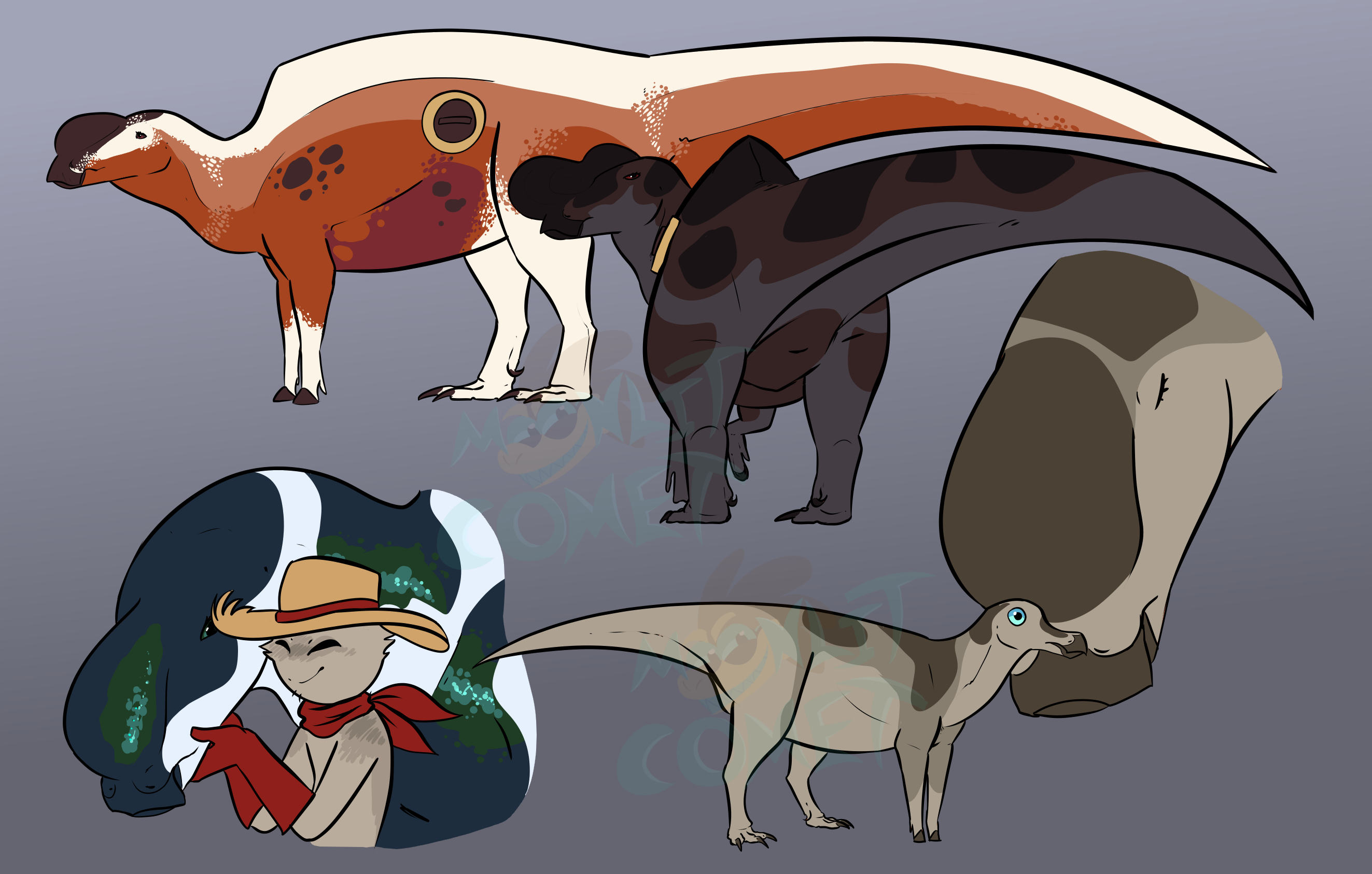
Due to the lack of large ruminants that evolved on Aurus, stickfigures instead use domesticated edmontosaurs [colloquially referred to as honks or honkers, sometimes playfully referred to as cows] for the purpose of egg, leather, and meat production. Because their chosen farmed megafauna is non-mammalian, they have no easy access to milk and instead collect “milk” from large phorusrhacids.
Honks are well-mannered animals with bright and playful personalities, though their enormous size and skittish nature means they are still dangerous and can harm someone not equipped to handle them. They are commonly paired with smaller farm animals such as pheasants, geese, griffons, and ducks to herd together and protect each other.
Much like in real-world cows, some honks are given a medical cannula for
the sake of health monitoring and research. This has strongly positive
effects on the ease of medical treatment, despite the ethical debates
brought forward by animal rights activists.
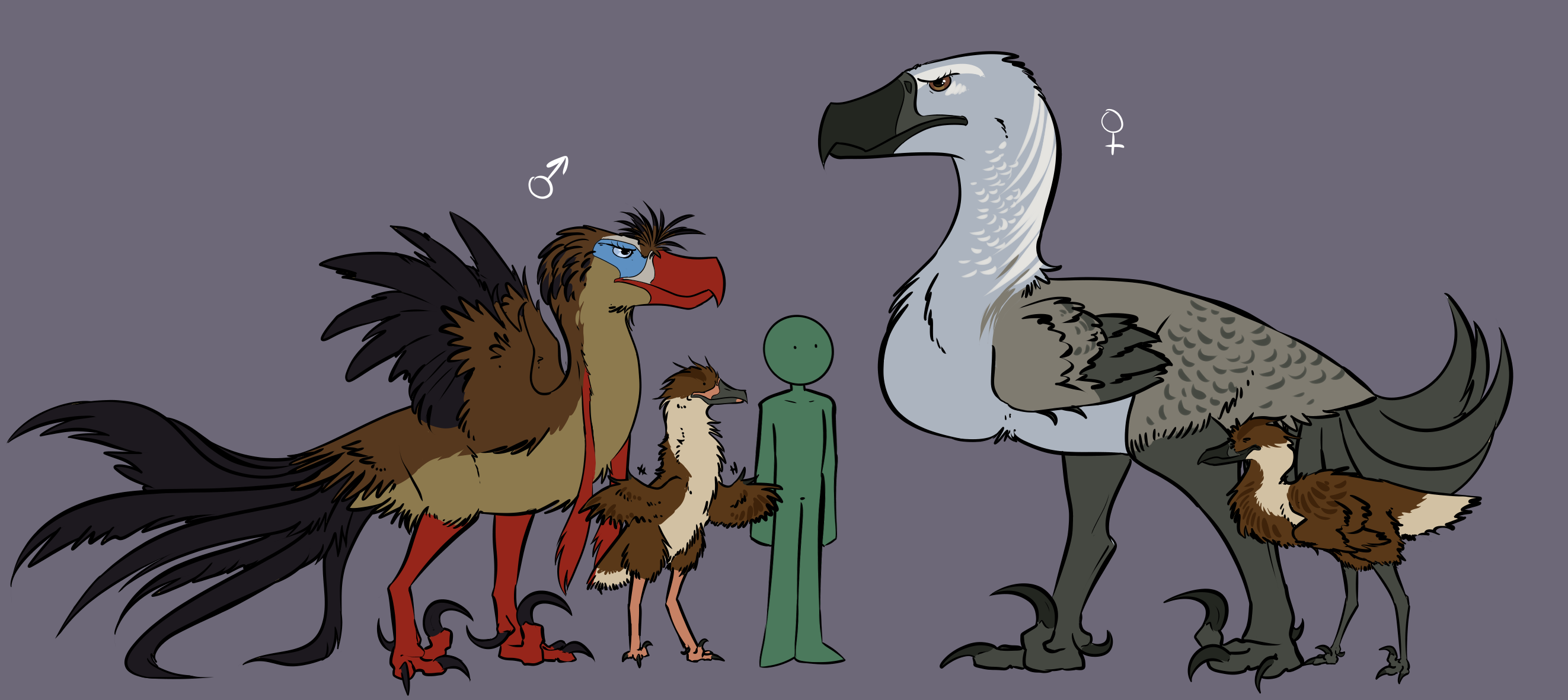 Instead of cows or any sort of mammalian species, stickmen in Cenara use large domesticated terror birds - known as “sicklephants”, but
also affectionately referred to as churds or jigglenecks - to produce
large amounts of edible crop milk, which can be used as a cheese-like or
butter-like substance. They are noble and intimidating animals which
aren’t to be taken lightly, and are one of the main livestock animals
raised in Drustown. Their crop milk, aka “bird cheese”, is very rich and
fatty, unlike the milder sweet mammal milk we are used to on earth.
Instead of cows or any sort of mammalian species, stickmen in Cenara use large domesticated terror birds - known as “sicklephants”, but
also affectionately referred to as churds or jigglenecks - to produce
large amounts of edible crop milk, which can be used as a cheese-like or
butter-like substance. They are noble and intimidating animals which
aren’t to be taken lightly, and are one of the main livestock animals
raised in Drustown. Their crop milk, aka “bird cheese”, is very rich and
fatty, unlike the milder sweet mammal milk we are used to on earth.