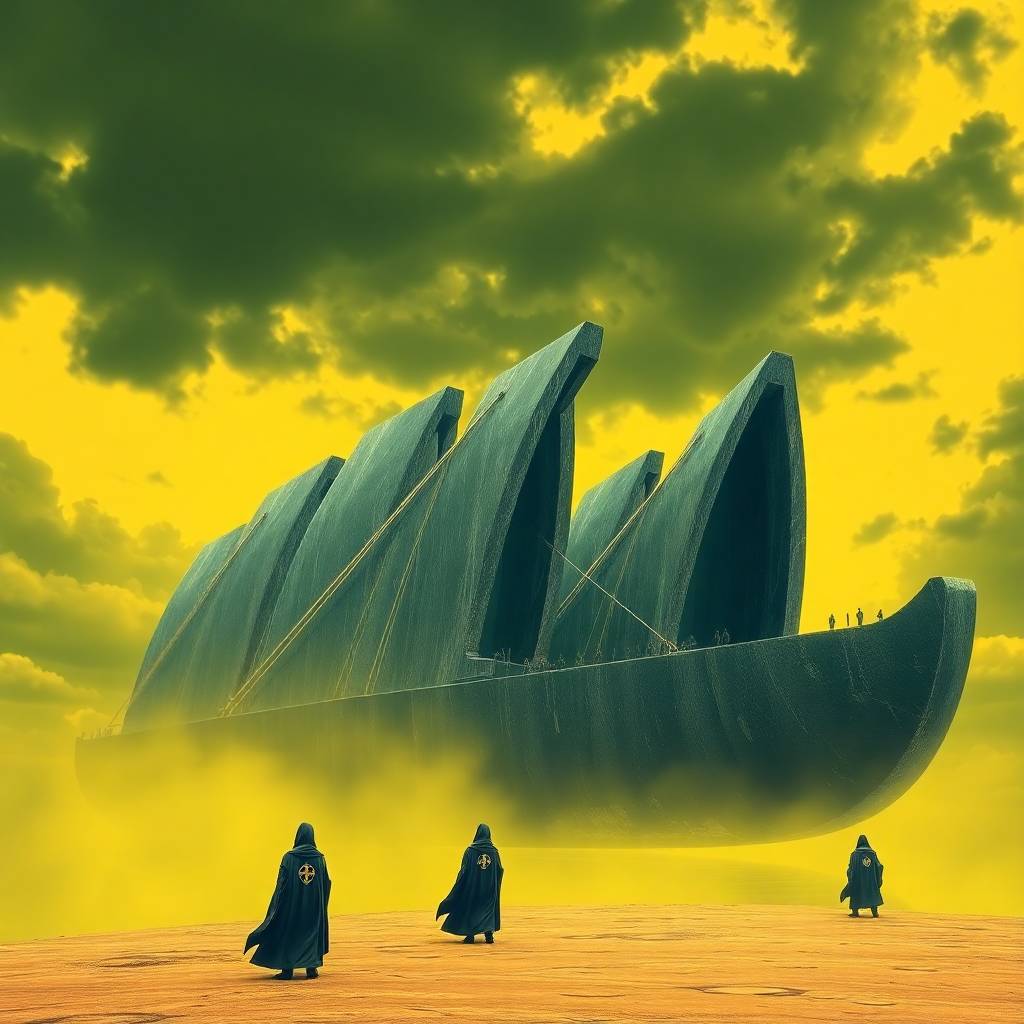
Behold, the grand floating palace, some say fortress of Songborne.
It is from here that the Empire of Miradorium is ruled.
Emperor Haran Seadar rules from on-high, this floating fortress the perfect symbol of his mighty power.
Songborne is the home of the imperial court of Emperor Haran Seadar.
Each of the empires six High Born Families send ambassadors to the court to win the emperor’s favour and play the great game of power.
Songborne hangs in the yellow sky, its battlements swept over by the vaporous green clouds of Miradorum. It is held aloft by an army of ‘whisperers’ who chant a secret, silent song known only to the royal line of the Seadars. It is the source of their power, allowing the palace to float menacingly over the kingdom.
Seadar's also has an armada of sky barges used for imperial travel, bringing goods to and from the floating palace and in times of war aiding the armies of the Seadar against their foes both foreign and domestic.
Inside the fortresses thick, red walls, rages a war of words, a web of plots and game of imperial politics played for the highest stakes.
Whilst the high born families call the kin they send to Songborne ambassadors, it is also acknowledged that they are, at the same time, hostages of the imperial family.
There are rumours that the fortress itself is alive and that certain ‘whispers’ can commune with it. They say the walls themselves call out for power, for dominion for Songborne's supremacy.
Humiliating another ambassador at court might be cause for a duel but losing the favour of the emperor means certain death and probably an unpleasant death at that.
Welcome to the imperial court, ambassador, the highest position in the land and the one from which the fall is greater than any other both literally and metaphorically.
Will the interests of your family thrive under your stewardship or will you fall from grace?
They say that Songborne is 'high above and far from mercy'.
Here, power isn't held, it is performed.
Every glance, every word, every silence - calculated.
The Imperial Court is a crucible of ambition, where high born families duel not only with swords, but with glances, gossip, and the cruel precision of a well-placed phrase.
The highborn families live and die by the whims of the Emperor. To win his favour is to command the tides of fate: to receive lands, titles, and decrees that bend the law itself. To lose his attention, or worse, his trust, is to be left adrift in a sea of predators, unmoored and already sinking. The outcome could be deadly.
Every audience with the Emperor is a performance. Every law he passes is a verdict on the future of your family.
And every High Born at court is watching, waiting, weighing who might rise and who must fall.
Rhetoric is a blade sharpened daily. Social encounters are battles in miniature, fought over goblets of wine and beneath chandeliers of starlight. A clever jest can destroy a career. A well-placed insult, delivered with exquisite grace, can undo a rival in moments.
When humiliation becomes too great to bear, when words cut too deep, custom demands satisfaction. Duels are rare, but sacred. They are sanctioned by the court and the Church alike, performed with elegance and finality. A duel may end in death, exile, or disgrace, but it always ends with an answer to the insult. In Skyborne, some wounds must be avenged in blood.
Over all this presides the Church of Zera, cloaked in purity and divine law. Her morality shapes the outer life of the court: marriages arranged to please doctrine, sins confessed in whispers, public virtue performed like theatre. But beneath the white robes and hymns lies another kind of power, calculating, watchful, and merciless. The Church can excommunicate, denounce, or disappear those who step too far from her teachings, yet they are not above playing the same games as the High Born families.
The truth is plain to those who dare to see: Skyborne is a place of masks and mirrors. Beneath every gesture lies a hidden meaning. Behind every compliment, a blade. Political assassinations are not spoken of, but they are understood to happen from time to time. A fall from a balcony. A sickness no surgeon could cure. A letter that should never have been opened.
This is where your story begins. Welcome to the great game of the Imperial Court.
The religion of the Empire of Miradorum is Zeranism. This is the central and origin myth of that religion and the official church of the state. It is recounted in this section from the The Mallan (The Book of the Child).
In Songborne, magic is mostly subtle, rarely spectacular (Songborne itself being the greatest exception), and always uncertain. It allows you to ‘commune’ with the forces of the world not command them.
The Chants of Zera
Magic in Miradorum comes from the Chants of Zera. These are said to be fragments of the songs the goddess Zera, the divine Sister & Mother, sang when she gave birth to the world.
These chants do not command nature—they commune with it. The earth, the wind, the beasts—these things are listened to, not ruled.
There were once more chants, but their verses are lost to time, buried in ruins, forgotten by the mystics, or hoarded by things that remain veiled.
The four surviving chants are know as:
The Beast Murmurs – A chant that soothes or rouses the instincts of beasts. It may coax birds from trees, frighten hounds, or enrage a herd—but never makes them speak or obey like men.
The Stone Tongues – A chant to feel what stone has seen. It grants impressions, echoes of emotion, symbolic visions—never a clear tale. A wall may show the fear it once absorbed, or a cracked arch the grief of its collapse.
The Ember Songs – A chant to stir the breath of flame and warmth. It might encourage a dying fire or draw heat from coals, but not kindle fire from nothing. It can heighten passion or dread in those nearby.
The Wind Calls – A chant to harmonise with the sky. It might slow rainfall or quicken the wind’s whisper, scatter mist, or thicken fog—but never tear open the heavens. It may deepen the weeping of a storm, or hush the edge of one.
These Chants are wielded by those called ‘Whisperers’. These are rare individuals attuned to the world enough to commune with it.
Chants in Songborne ask the natural world to respond—and sometimes, it does. Other times, the sky remains silent, the stone unmoved, the beast enraged.
Even those who do not have the rare gift of the Whisperers can have small effects if they chant on mass. Therefore the church maintains Houses of Zera across the land of Miradorum where nuns and monks can be employed to chant to the benefit of the paying High Born family.
To use the Chants is to risk disappointment, and yet to do so well is to evoke awe in a court obsessed with power and perception. A misjudged chant might embarrass your high born family line. A timely one might elevate it to the highest levels, who knows? Perhaps even to the throne itself.
Songborne does not float by wind but by song, an ancient, voiceless chant that thrums beneath the skin of the yellow sky. It is kept aloft by the Order of Silent Chanters, a cloistered order whose voices have been silenced, offered to the palace itself. Few have ever seen one with their own eyes. They dwell in the catacombs hollowed into the underbelly of the floating rock, far beneath the gilt splendour of the throne above. There, in the endless dark, they breathe the chant that keeps the fortress of Songborne, the imperial palace from falling to the earth below.
The chant is not heard. It is felt in the bones, in the walls, in the air itself. And some say that over centuries of ceaseless invocation, it has changed Songborne. That the fortress listens now. That it has awakened.
The Emperor, they say, speaks to the fortress. And it answers. Songborne shifts for him, walls bend, halls reshape, shadows move with malice or mercy. In times of danger, it is said the palace has defended him, or devoured his enemies whole.
But power, once awakened, does not always stay loyal.
There are those brave heretics who say Songborne has a will of its own. That it chooses its allies. That a skilled Whisperer, one who has studied the resonance of the chant and fed their soul to its rhythm, may court the palace’s favour. They may command it just like the emperor. But in secret. In defiance. For their High Born families honour or pure personal ambition.
Songborne is not merely a palace. It is a power.
Not only does the emperor have a grand floating palace that makes its way of the skies of his empire at a leisurely pace, he also has a small navy of sky barges. Made of deep polished granite, broad with flat bottomed hulls, these sky barges ferry supplies to the palace as well as tribute from the High Born families and other parts of the empire. They come in a variety of sizes, smaller barges for ferrying important passengers to Songborne and other diplomatic tasks, much larger barges ferry great mounds of cargo. In times of war they are used to support the armies of the emperor. They are all piloted by the Silent Monks of Songborn who also keep the palace aloft and are otherwise almost never seen outside of the deep catacombs beneath the palace in which they live and where they are instructed on the arts of the secret silent chant. The barges are mored in their harbour in Songborne.

When a Seadar speaks, reality reshapes itself to accommodate their words. When they gesture, fortunes collapse or rise. His silence carries more weight than other rulers' proclamations.
Their court doesn't contain advisors, it contains apex predators who've learned that serving the dynasty is more profitable than competing with it. Scholars who rewrite history between breakfast and lunch. Advisors who negotiate with one hand while signing execution orders with the other.
Skyborne itself defies physics as casually as its Imperial family defy opposition.
The floating fortress doesn't just hover above the realm, it looms, a constant reminder that the Seadar exist above the natural law.
To catch their attention is to discover whether you're a fellow predator or prey.
Outside of the Imperial family, and certain couriers of the Inner Chamber of the Imperial Court, power in Miradorum resides with the High Born Families.
There are six families and each sends several important and powerful ambassadors to represent them at the Imperial Court in Songborne.
It is at the Emperors court that the real power struggles between these powerful families are played out.
All six houses may attend meetings of the Outer Chamber of the Imperial Court but only the top three houses may send a representative into meetings of the Inner Chamber of the court.
Rooms must be entered and exited in order of status to avoid insult.
The following are the high born families of Miradorium from most to least powerful.
The Church
The Tongs
The Helms
The Sythe
The Bailor
The Player House
The families each have their own sources of wealth and their own conflicts with other families that arise from these that you would know about at the start of the game:
Church
Source of Wealth: Tithes, spiritual authority, religious land holdings, sanctified rituals.
Conflicts:
Helms – Object to the import of foreign beliefs and forbidden relics.
Bailors – Morally and politically opposed.
Tongs
Source of Wealth: Blacksmithing, forges, weaponcraft, enchanted metallurgy.
Conflicts:
Sythe – Conflict over land usage for mining vs. cultivation.
Church – Resent the Church’s restrictions on warfare
Helms
Source of Wealth: Trade, shipping, shipbuilding, maritime enchantments.
Conflicts:
Bailors – Struggle for control over ports, smuggling routes, and pirate influence.
Church – Bring foreign ideologies and contraband into the kingdom, upsetting religious purity.
Sythe
Source of Wealth: Agriculture, food production, enchanted harvests.
Tongs – Territorial clashes over farmland versus mining interests.
Bailor – Resent exploitative loans and debt traps placed on rural producers.
Bailors
Source of Wealth: vice trade, gambling, black markets. Smuggling
Conflicts:
Helms – Compete for dominance of portside influence and shipping lanes.
Church – Religious opposition to their criminal operations.
Tongs – Disputes over black-market weapon distribution.
Players House
Source of Wealth:?
Songborne Floats around the Empire of Miradorium as the season progresses.
SPRING
Session of the Outer Chamber
The Kengar Egg Hunt
Session of the Outer Chamber
The Feast of the Goddess
SUMMER
Session of the Outer Chamber
AUTUMN