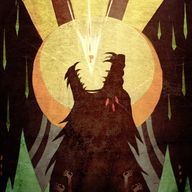
- According to several elf NPCs, Feyndor was "asleep" (or absent in some way) for at least 500 years by the time that the party met him. He was capable of sending a handful of his hounds onto the Material Plane but could not manifest on the Material Plane himself, or answer directly to prayers.
- Feyndor used the body of Triel Khalazza as a vessel after Queen(ie) (a former party member) offered it to him.
- Feyndor may be responsible, at least in part, for the fall and corruption of A'va Edhil.
- When questioned by the party about his abandonment of A’va Edhil, Feyndor refused to answer in any kind of detail. He merely stated that there was more at stake and did not elaborate.
- Feyndor appears to have some command over dreams, as he has been shown to observe them and, to some extent, manipulate them.
- Feyndor’s command of the Shadow Realm has dramatically weakened. He can only protect a small number of travelers, and only for a short time.
- Feyndor claims that his current weakness is due to the partitioning of his essence. He has tasked the party with retrieving at least one "shard" as compensation for his assistance in the fight against Kyldaross.
- According to Maddoc, the pallid elves once considered Feyndor to be a war-like god. The eladrin from Maddoc's community, at least, now seem to reject him as a deity, citing only that they suffered from an action that he took (as the pallid elves suffered from his inaction).
Feyndor, or the "Hound of Radan," as he is commonly referred to in human Irkasian and Targuite folklore, is a six-eyed, wolf-like being who is believed to have aided Radan in collecting the souls of the departed. He plays a larger role in several elven pantheons, where he is considered a god in his own right.
Like much else related to Radan, there is little in the way of original sources that offer details about the Feyndor. He now features only in tales meant to scare small children, and sometimes in the feverish last words of the dying.