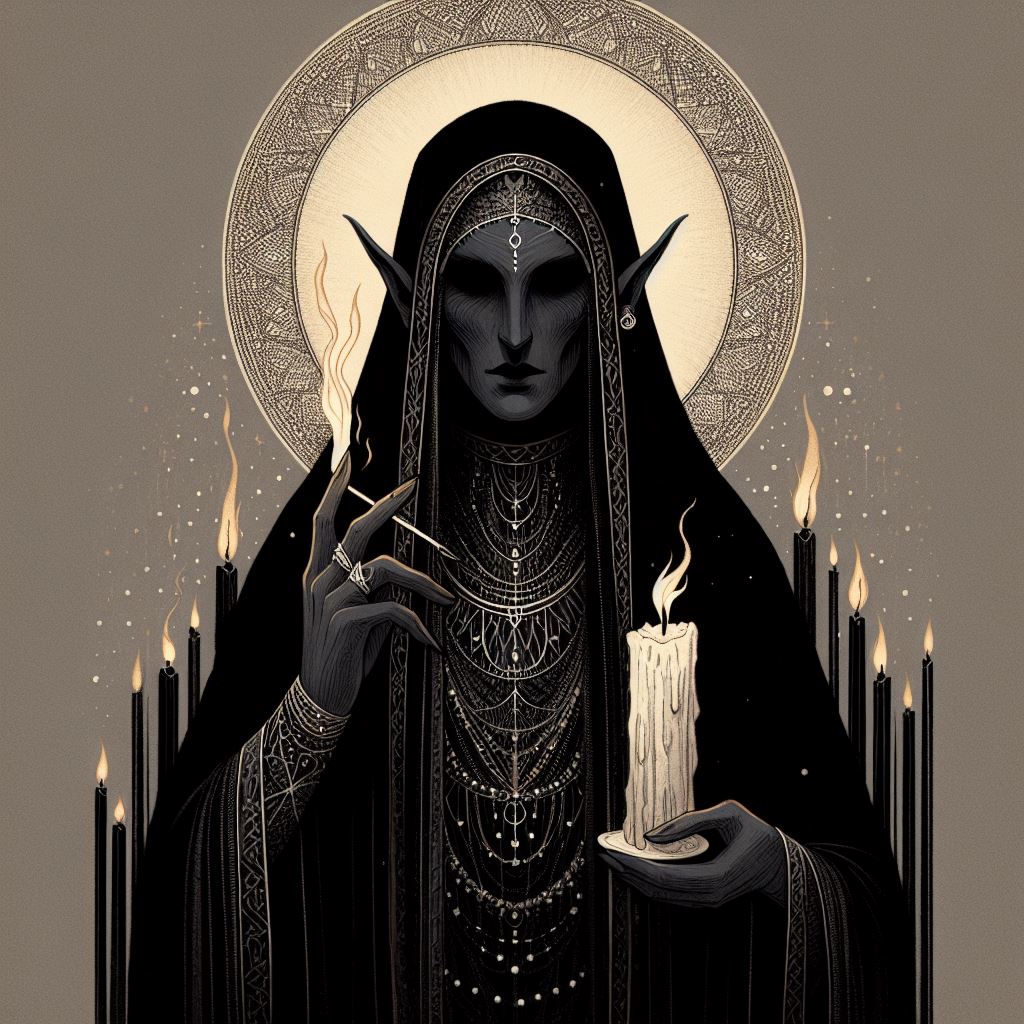
- Radan has been missing for centuries. Attempts by his clergy to contact him have been fruitless.
- Many of Radan's temples have been defaced, if not destroyed outright, in the aftermath of the Century Wars.
Summary
Radan was a god of death, night, winter, and silence and one of the most widely recognized deities of the old faiths. He had a presence in four pantheons, spanning elven and human belief systems. However, human worship of Radan is practically nonexistent in modern times and is highly frowned upon — if not outlawed — in most places; even in the ancient patheons' prime, Radan was more often respected than worshiped.
Though Radan was not traditionally a malevolent god, many still feared him due to his domain. Families sought priests of Radan to help them make offerings after a loved one’s death so that the deceased may have a safe passage into the afterlife.
Historically, human worshippers depicted Radan as a thin drow man in black robes with sparse silver embroidery. He usually wears a veil over his face and holds a freshly lit candle in one hand and a spent one in the other.
History
Worship
- Common offerings included moondrop flowers, candles, and star-shaped items.