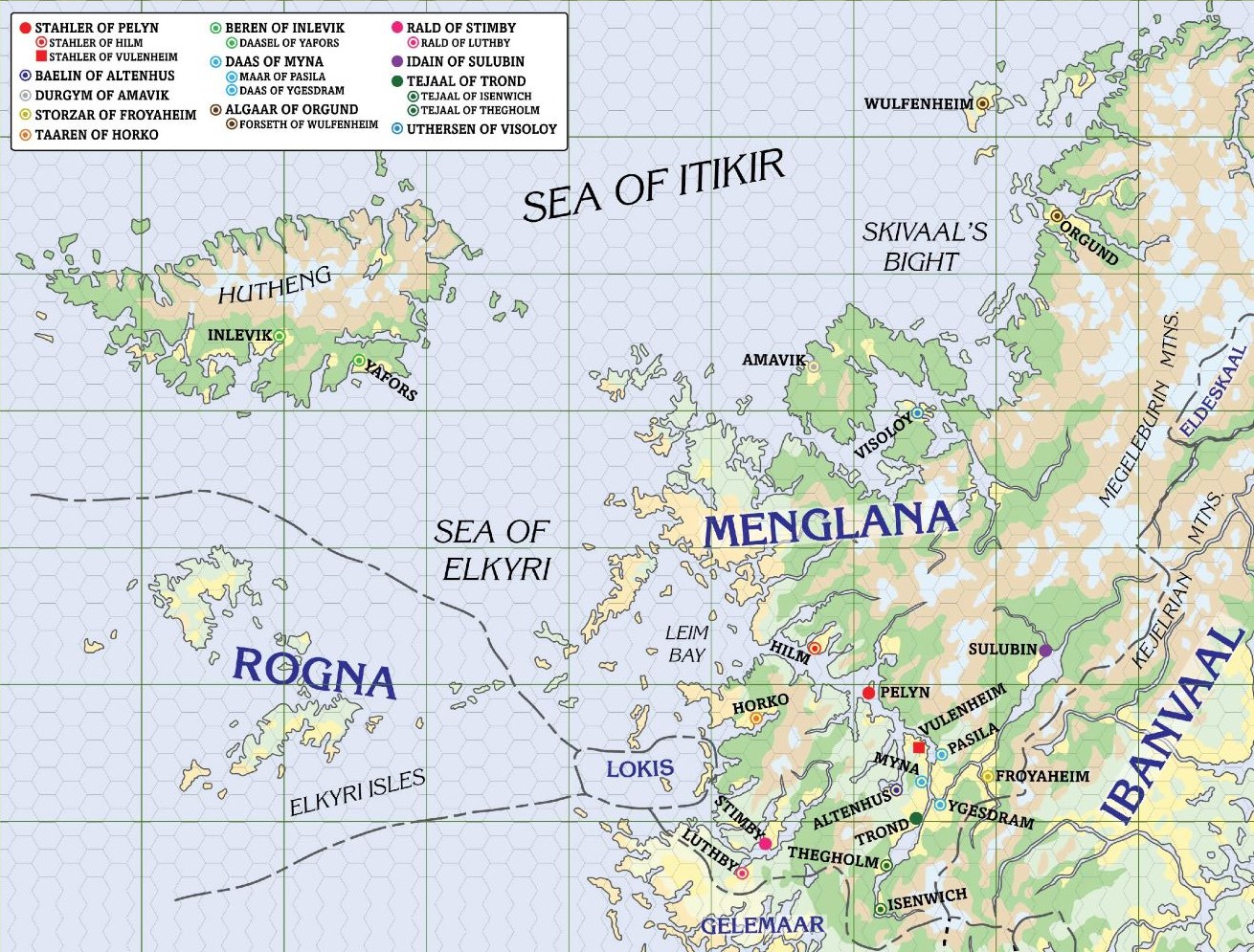
Menglana is a large kingdom in northwestern Ivae, the largest island in the Ivinian archipelago. The kingdoms’s eastern border is with Ibanvaal and Eldeskaal. To the south lie Gelemaar and Gilbenmark, two realms of the Pendragondom of Seldenbaal. On the seas to the west lie the Holy Kingdom of Lokis and the Kingdom of Rogna.
Menglana’s geography is dominated by fjords, mountains, and the sea. It is largely isolated from the rest of Ivae by the inhospitable Megeleburin and Kejelrian mountain chains, natural barriers with few passes.
Good agricultural land in Menglana is at a premium. The exposed western coast has poor soil and few inhabitants. Rich lowlands form irregular fringes around the shores of deep fjords that penetrate far inland. Most Menglanans live within these fjords, fully 70 percent within the majestic Leimenfjord and the Leim and Froya valleys at its head.
The harsh upland regions have few inhabitants, mostly wandering Yarili tribal groups and assorted hunters and trappers. Some areas have fewer than one person for every 30 square miles; the arctic barrens have far fewer. The highlands are reputed to be home to yelgri, dragons, and all sorts of exotic beasts. Occasional expeditions to hunt such creatures for their rare hides are dangerous in the extreme.
Clans from Menglana have planted many colonies throughout western Lythia, including Hutheng, Rogna, and Orbaal. Most were the efforts of lesser clans seeking to escape the shadow of Menglana’s powerful Stahlers. Many of these colonies have become kingdoms in their own right, and although tribute is often claimed by the homeland it is rarely tendered. Only Hutheng, a large island in the Sea of Itikir to the northwest, is a loyal tributary today, and this may soon change.
Menglana has historically dominated western Ivinia but is now seen by many as in decline. The aging King Halrik III is considered weak an ineffective. The kingdom is afflicted by internal division, with factions working to undermine the royal clan and the kingdom itself. Menglana also faces substantial threats from Ibanvaal and Rogna. Many of its tributaries are wavering in their loyalty and the kingdom’s prospects look bleak.
Kings of Menglana
| King | Clan | Years |
| Vulen I | 344-369 | |
| Larleif | 369-405 | |
| Vulen II | 405-429 | |
| Nyerid | 429-451 | |
| Lönn | 451-498 | |
| Odislin | 498-540 | |
| Halrik I | 540-598 | |
| Ujan I | 598-599 | |
| Ujan II | 599-618 | |
| Halrik II | 618-634 | |
| Jansen | 634-688 | |
| Halrik III | 688-present |
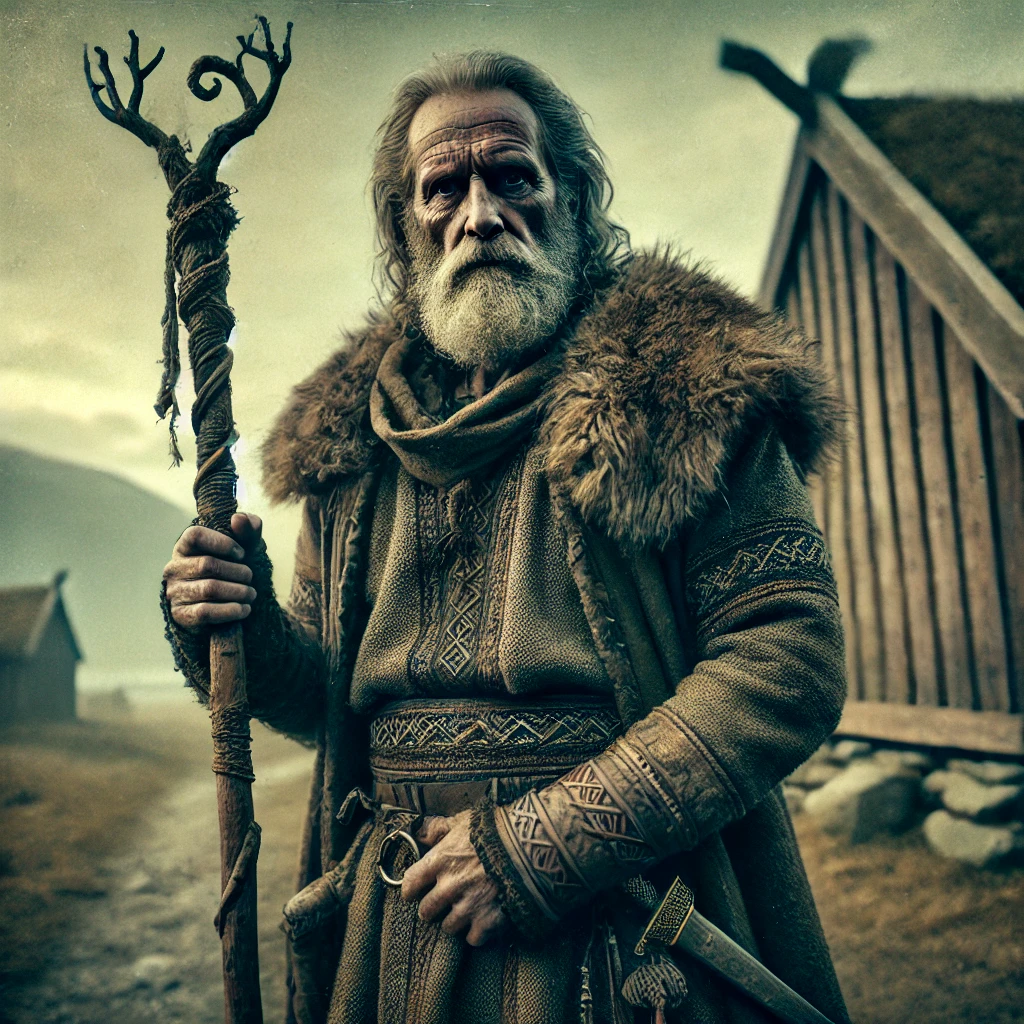 The valhakar of the holding greatclan is entirely responsible for the administration of justice within his thranaal, although most rely heavily on thengs and wyrdsmaan to ensure that justice is fair. Wyrdsmaan are appointed for life, but are subject to banishment for any breach of trust. They must intimately know the laws of the thranaal and take oath to bring to the attention of the valhakar (or those assembled at a theng) any crime they have seen or any “oath-sworn” crime reported to them. A crime is oath-sworn if a suitor has two or more witnesses. A witness may be someone who saw the actual crime or is simply vouching for the plaintiff’s character. Wyrdsmaan do not actually judge a case, although their advice often has considerable weight. They are also employed to witness important legal transactions, such as an exchange or sale of lands, declarations of inheritance or divorce, or other actions that might later be contested. The number of wyrdsmaan in any thranaal varies, a dozen being most common.
 Most disputes on matters related to trade and commerce are handled by the Hirdmaand, which is essentially the Menglanan equivalent of the Mangai. This loosely organized group of individuals and small clans wields subtle but enormous power, conferring local monopolies to its members on most profitable endeavors.