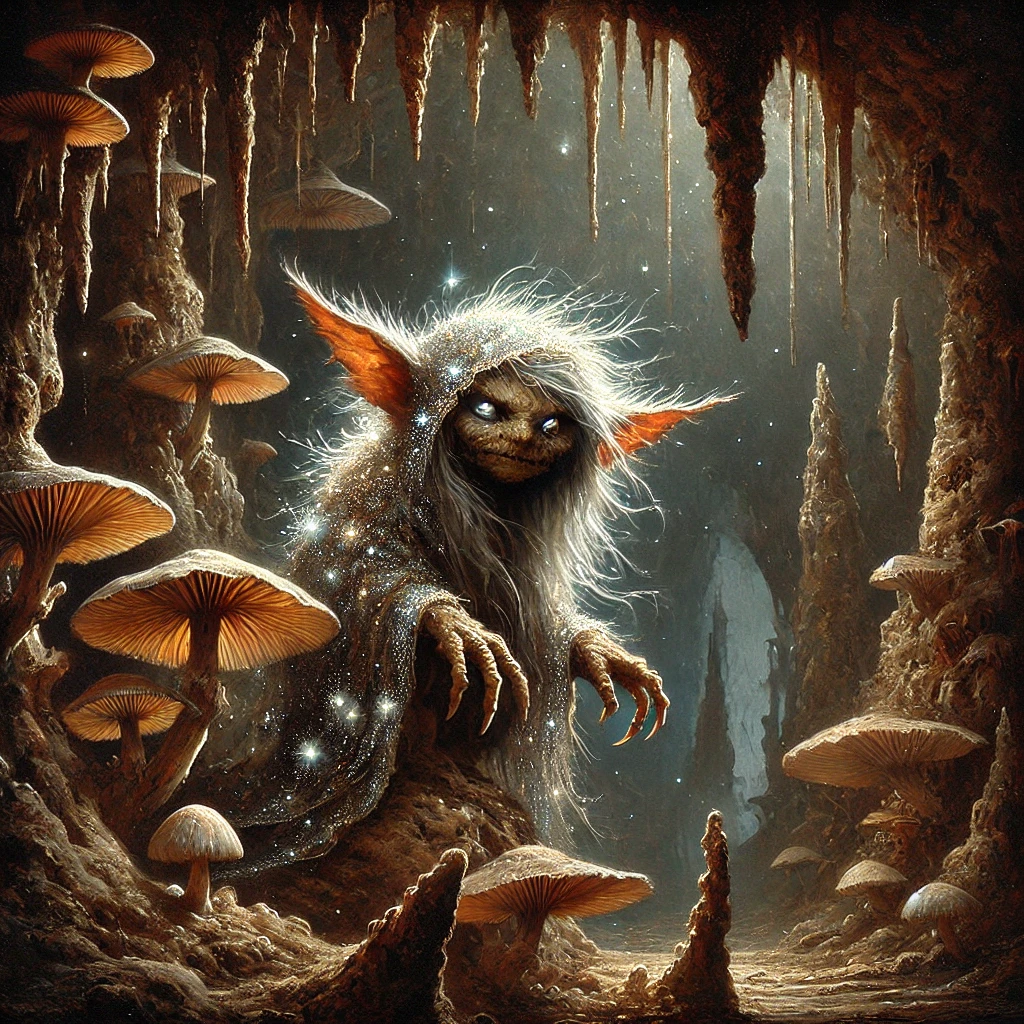
In the veiled places of the world, where the light of the moon meets the roots of ancient trees and the wind whispers through cracks in forgotten stones, there dwell the Tussir (Underfootling). Known by many names—the Underfootlings, the Shard Folk, the Hidden Kin—they are creatures of twilight, secretive and swift, unseen by most who tread the waking world. Their lives are lived in shadows, beneath the gaze of stars, in the glimmer of silver rivers and the echo of strange, mournful songs.
The Shard Folk and Their Forgetfulness
The Tussir, it is said, are ancient beyond reckoning. They were once keepers of all knowledge, born at the dawn of time when the first stars burned in the void. The gods themselves entrusted them with the fragments of creation, shards of forgotten truths and secrets of power. But their memories are fractured, scattered like the pieces of their charge. For every truth they hold, ten are lost to them, and so they wander, lost in the haze of their half-remembered purpose.
Their eyes glimmer with the starlight of the elder days, and their songs are filled with fragments of forgotten wisdom. Yet their songs are riddles and puzzles, for the Tussir remember only glimpses of their once-immense knowledge. Some say their minds were splintered by the burden of their task; others whisper that they betrayed the gods and were cursed to eternal forgetting.
The Nature of the Tussir
The Tussir are small, no taller than a child, with slender bodies that seem to shift and shimmer when not directly watched. Their skin is pale, almost luminous, and their eyes gleam like silver coins. They wear cloaks of woven mist, stars, and shadows, and their laughter sounds like the chime of distant bells.
They are not creatures of malice, but neither are they kind. They are tricksters, watchers, and keepers of the in-between. To see a Tussir is to step into a tale that may end in fortune or calamity, for they are bound to the threads of fate and Fortune herself.
Fortune’s Playthings
It is said that to catch a Tussir is to invite Fortune into your life, but at a perilous cost. If you can trap one of the Shard Folk, they are bound to answer a single question or grant a boon. But beware, for their gifts are like their knowledge—shattered and incomplete. A question poorly asked will yield an answer of riddles, and a boon poorly chosen may twist into a curse.
A farmer once caught a Tussir beneath the roots of an ancient oak. “Grant me wealth,” the farmer demanded. The Tussir sang a song of silver rivers and golden wheat, and the farmer woke to find his fields laden with grain. Yet, come harvest, the grain turned to ash in his hands, and the silver of the river was only moonlight upon the water.
A warrior, bold and brash, once caught a Tussir in the shadow of a crumbling tower. “Grant me victory in all battles!” he commanded. The Tussir laughed, a sound like breaking glass, and sang a song of unending triumph. The warrior won every fight thereafter, but his foes grew fewer, his friends turned from him, and soon he stood victorious over a world that wanted no part of him.
The Tussir’s Haunts
The Tussir prefer the twilight places of the world, where shadow and light dance together. They dwell beneath gnarled roots, in the hollows of old stones, or within glimmering caves where silver veins shine like stars. They are drawn to places where time feels thin, where echoes linger, and where the mortal world brushes against the strange and otherworldly.
It is said that on nights of the full moon, the Tussir gather in secret glades, weaving their songs into the starlight. Mortals who stumble upon these gatherings speak of haunting melodies that linger in their hearts forever, and of dreams filled with visions of things that were and things that might yet be.
The Cautionary Tale of Eirik and the Tussir
Once, long ago, a man named Eirik, greedy for power, sought the Tussir. He wandered the wilds for three years, leaving behind hearth and home, until he found their hidden glade beneath the northern lights. There, he captured a Tussir in a net of woven gold and starlight, crafted by a seer at great cost.
“Tell me the secret to ruling men,” Eirik demanded.
The Tussir stared at him with gleaming eyes and sang a song that filled the night with sorrow. “To rule men, you must know them,” the Tussir said. “To know them, you must lose yourself.”
Eirik dismissed the riddle and used what wealth he had to build an army, conquering his neighbors. Yet as his power grew, he found his heart empty, for he had become a tyrant feared by all, known by none. In the end, he died alone, and the lands he ruled fell to ruin.
The Tussir’s Warning
The songs of the Tussir carry a warning: beware of what you seek, for the answer may be more than you can bear. Their riddles are not meant to deceive but to teach, though few mortals understand this. They are bound to Fortune, and those who encounter them find their lives twisted by her whims, for good or ill.
The Tussir are the Shard Folk, keepers of forgotten truths, wanderers of twilight. To see one is to step into the realm of legend, where shadows hold secrets, and every choice is a thread in the loom of fate.