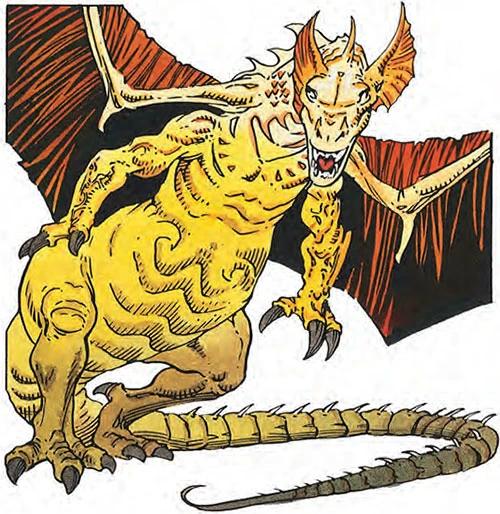
Huge Dragon (Gem), typically Chaotic Neutral |
AC 18 (natural armor) Initiative +1 (11) |
HP 210 (20d12 + 80) |
Speed 40 ft., Fly 80 ft., Swim 40 ft. |
| | mod | save | | | | mod | save | | | | mod | save | Str | 19 | +4 | +4 | | Dex | 12 | +1 | +6 | | Con | 19 | +4 | +9 | Int | 18 | +4 | +4 | | Wis | 17 | +3 | +8 | | Cha | 18 | +4 | +9 |
|
| Skills Intimidation +14, Perception +13, Stealth +6 |
| Resistances Cold, Necrotic |
| Senses Blindsight 60 ft., Darkvision 120 ft., Passive Perception 23 |
| Languages Common, Draconic, telepathy 120 ft. |
| CR 13 (XP 10,000, or 11,500 in lair; PB +5) |
|
Amphibious. The dragon can breathe both air and water. Fabricate (1/Day). The dragon can cast fabricate, requiring no spell components and using Intelligence as the spellcasting ability. Legendary Resistance (3/Day). If the dragon fails a saving throw, it can choose to succeed instead. |
|
Multiattack. The dragon makes one Bite attack and two Claw attacks. Bite. Melee Weapon Attack: +9 to hit, reach 10 ft., one target. Hit: 15 (2d10 + 4) piercing damage plus 3 (1d6) necrotic damage. Claw. Melee Weapon Attack: +9 to hit, reach 5 ft., one target. Hit: 8 (1d8 + 4) slashing damage. Desiccating Breath (Recharge 5–6). The dragon exhales yellowish necrotic energy in a 60-foot cone. Each creature in that area must make a DC 17 Constitution saving throw. On a failed save, the creature takes 35 (10d6) necrotic damage and is weakened until the end of its next turn. A weakened creature has disadvantage on Strength-based ability checks and Strength saving throws, and the creature's weapon attacks that rely on Strength deal half damage. On a successful save, the creature takes half as much damage and isn't weakened. Spellcasting (Psionics). The dragon casts one of the following spells, requiring no spell components and using Intelligence as the spellcasting ability (spell save DC 17): |
|
Change Shape. The dragon magically transforms into any creature that is Medium or Small, while retaining its game statistics (other than its size). This transformation ends if the dragon is reduced to 0 hit points or uses a bonus action to end it. Psychic Step. The dragon magically teleports to an unoccupied space it can see within 60 feet of it. |
|
Legendary Action Uses: 3. Immediately after another creature's turn, The dragon can expend a use to take one of the following actions. The dragon regains all expended uses at the start of each of its turns. |
Claw. The dragon makes one Claw attack. Psionics (Costs 2 Actions). The dragon uses Psychic Step or Spellcasting. Essential Reduction (Costs 3 Actions). The dragon targets a creature or an object not being worn or carried that it can see within 60 feet of it. The target must succeed on a DC 17 Constitution saving throw or take 28 (8d6) necrotic damage. If this damage reduces the target to 0 hit points, it crumbles to dust.
|
|
On initiative count 20 (losing initiative ties), the dragon can take one of the following lair actions; the dragon can't take the same lair action two rounds in a row: Beguiling Whisper. The dragon telepathically whispers to one creature within range of the dragon's telepathy. The creature must succeed on a DC 15 Wisdom saving throw or be charmed by the dragon until initiative count 20 on the next round. A creature charmed in this way obeys to the best of its ability any command the dragon issues that isn't directly harmful to the creature. Cancellation. The dragon chooses an active spell of 5th level or lower that it's aware of in the lair and ends the spell. Negative Energy Infusion. Up to two creatures the dragon can see within the lair must each succeed on a DC 15 Constitution saving throw or take 14 (4d6) necrotic damage. Negative energy then infuses the lair until initiative count 20 on the next round. While the infusion lasts, creatures in the lair other than the dragon can't regain hit points.
|
|
The region surrounding a legendary topaz dragon's lair is altered by the dragon's magic, creating one or more of the following effects: Crystal Profusion. Natural stone within 6 miles of the lair grows plentiful crystal formations and veins of topaz gemstones, particularly underground. Negative Energy. When a creature finishes a long rest within 6 miles of the lair, the creature must first succeed on a DC 15 Constitution saving throw or be unable to reduce its levels of exhaustion or regain spent Hit Dice. Creatures resistant or immune to necrotic damage are immune to this regional effect. Thriving Wildlife. Giant squid are attracted to the sea within 6 miles of the lair, migrating and hunting there in large numbers. Watery Sight. Water within 6 miles of the lair is a conduit for the dragon's psionic presence. As an action, the dragon can cast the clairvoyance spell, requiring no spell components and targeting any body of water in that region.
If the dragon dies, the population of giant squid in the region returns to normal levels over the course of 1d10 days. The existing abundance of crystals and topazes remains, but new ones form at a normal rate. |
Customizing DragonsFTD p33[–]You can customize any dragon's stat block to reflect the dragon's unique character. Minor changes such as those below are easy to make and have no impact on a dragon's challenge rating. Languages. Most dragons prefer to speak Draconic but learn Common for dealing with allies and minions. But given their high Intelligence and long life span, dragons can easily learn additional languages. You can add languages to a dragon's stat block. Skills. Most dragons are proficient in the Perception and Stealth skills, and many dragons have additional skill proficiencies. As with languages, you can customize a dragon's skill list (even doubling their proficiency bonus with certain skills) to reflect particular interests and activities. You can also give a dragon tool proficiencies, particularly if the dragon spends time in Humanoid form. Other Traits and Actions. You can borrow traits and actions from other monsters to add unique flavor to a dragon. Consider these examples: Change Shape. You can decide that a dragon acquires this action at a younger age than usual, particularly if you want to feature a dragon in Humanoid form in your campaign:The dragon magically polymorphs into a humanoid or beast that has a challenge rating no higher than its own, or back into its true form. It reverts to its true form if it dies. Any equipment it is wearing or carrying is absorbed or borne by the new form (the dragon's choice).In a new form, the dragon retains its alignment, hit points, Hit Dice, ability to speak, proficiencies, Legendary Resistance, lair actions, and Intelligence, Wisdom, and Charisma scores, as well as this action. Its statistics and capabilities are otherwise replaced by those of the new form, except any class features or legendary actions of that form. Flyby. The dragon is an agile flier, quick to fly out of enemies' reach.The dragon doesn't provoke an opportunity attack when it flies out of an enemy's reach. Mimicry. Impersonating characters or their allies could be a fun trick for a crafty dragon.The dragon can mimic any sounds it has heard, including voices. A creature that hears the sounds can tell they are imitations with a successful DC 12 Wisdom (Insight) check. Rejuvenation. You might decide that dragons in your campaign, being an essential part of the Material Plane, are nearly impossible to destroy. A dragon's life essence might be preserved in the egg from which it first emerged, in its hoard, or in a cavernous hall at the center of the world, just as a lich's essence is hidden in a phylactery.If it has an essence-preserving object, a destroyed dragon gains a new body in 1d10 days, regaining all its hit points and becoming active again. The new body appears within 5 feet of the object. Special Senses. Most dragons have blindsight and darkvision. You might upgrade blindsight to truesight, or you could give a dragon with a burrowing speed tremorsense.
|
|
| Source: FTD, page 221. |