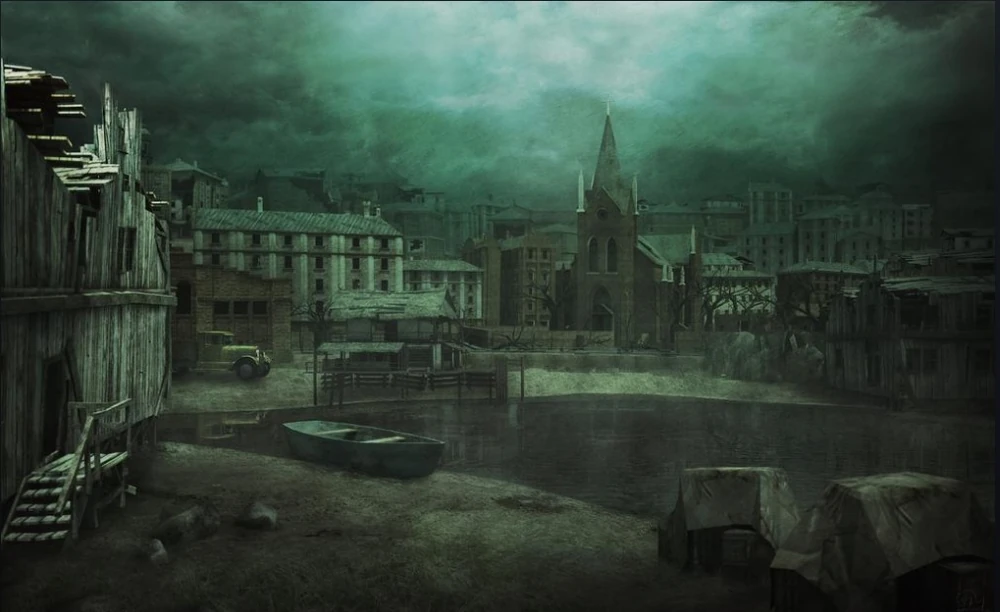
About halfway through the '50s, rising real estate entrepreneur from Boston Barnabas Marsh chose to invest a considerable amount of his capital in a small, dilapidated town at the mouth of the Manuxet river, in Essex county.
Founded in 1643, the settlement grew and prospered into the American revolution thanks to its shipyards, becoming a relatively important coastal location and then a small industrial town at the start of the nineteenth century when a small electricity power plant was built on the Manuxet river.
In 1846, a mysterious epidemic, probably arrived from the one of the Pacific islands via ship, decimated the population, forcing Innsmouth into a spiraling crisis it would never recover from.
During the civil war, the presence of a garrison lead to a short renaissance that, however, ended alongside the hostilities, in 1865. Most of the commercial activities closed and even the railway line connecting Innsmouth to Rowley was abandoned. The only survivor was the gold refinery of Obed Marsh, the only source of revenue for the town other than fishing.
The most recent noteworthy event for Innsmouth dates to February 1928, when federal troops took the town by storm to root out the local smuggling of bootleg alcohol.
In the early ‘60, Barnabas Marsh started his works, renovating the elegant Georgian buildings in the colonial style, with their characteristic “widow’s walks”, to their original specs, while whatever was left of the slums around the docks was razed to the ground to free real estate for luxurious seaside houses.
The hard work and dedication of the Marsh family gave new steam to the rebirth of a town that everyone had left for dead and doomed to rot into a putrid heap of soggy wood and blasphemous superstitions.