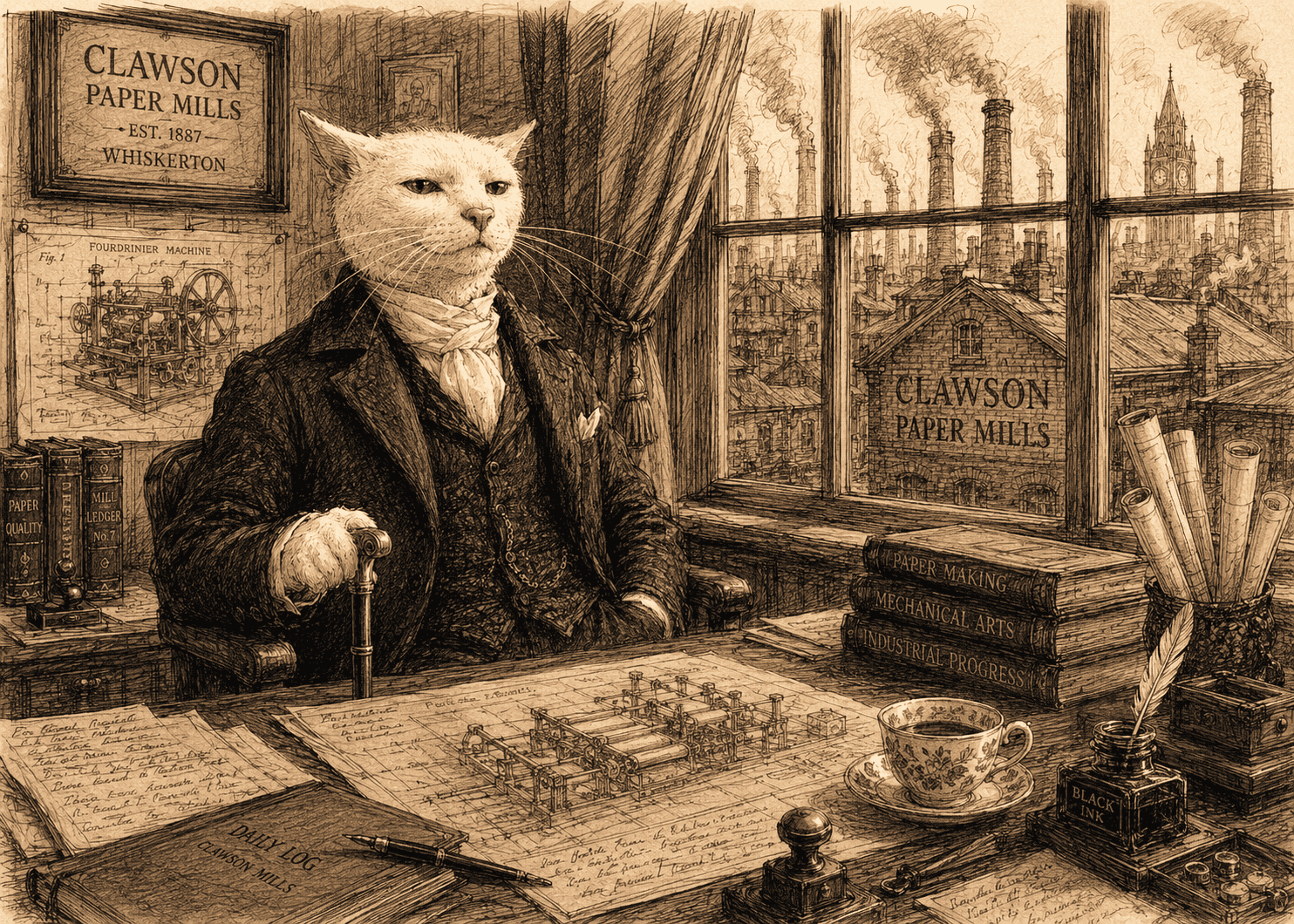
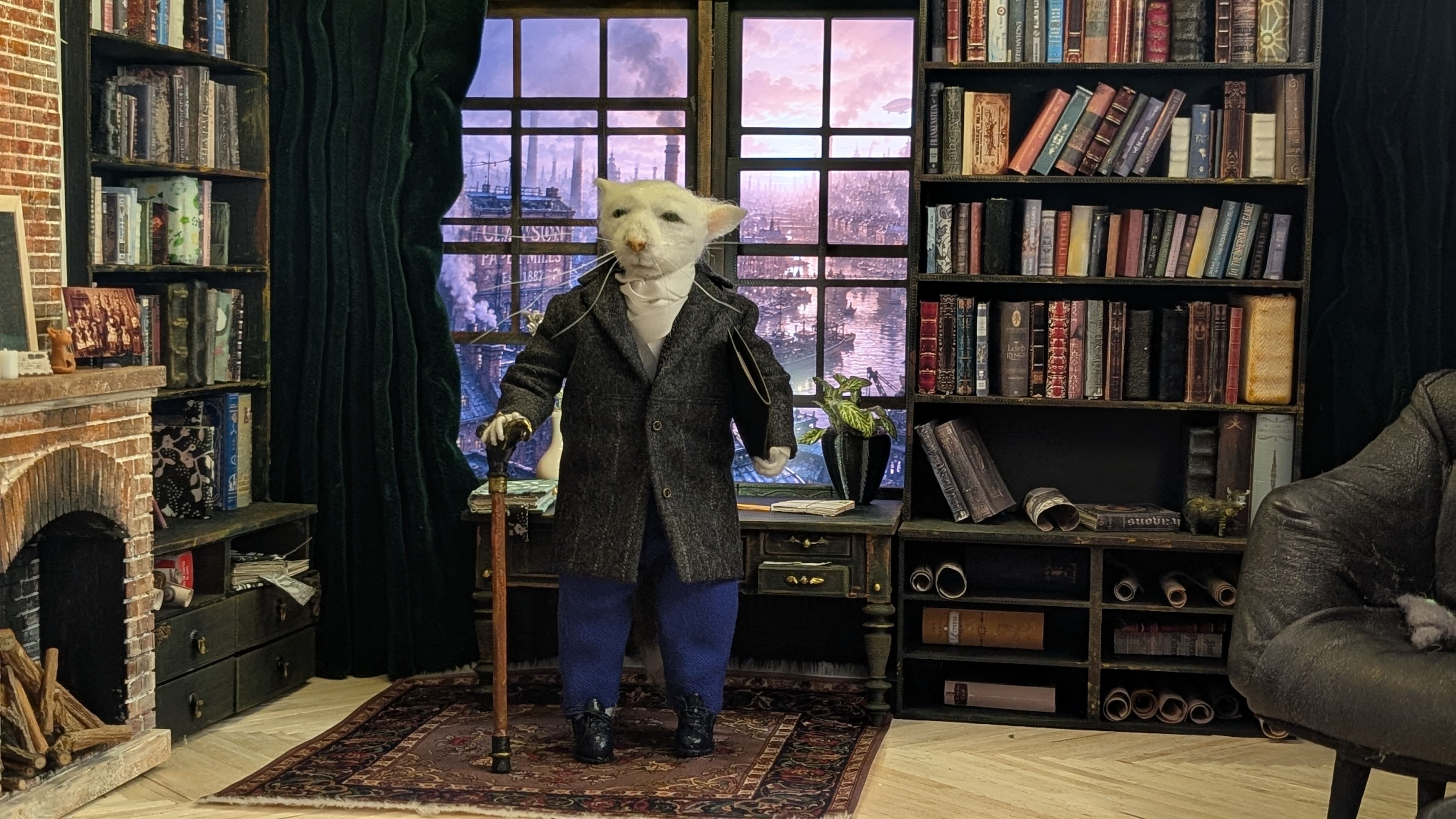
A white cat industrialist of the Copper District, managing proprietor
of Clawson Paper Mills, and a gentleman widely associated with
discipline, paper, punctuality, and the belief that good work should
outlast admiration.
A New Chapter: The Morning Route
The factory whistle sounded at six, as it always had.
Steam rose above the rooftops of the The Copper District while workers crossed narrow streets carrying lunch tins,
soot-darkened gloves, and unfinished conversations from the day
before.
Not long after sunrise, one familiar figure appeared on the morning
route.
A dark coat. A polished cane. Measured footsteps that neither hurried
nor slowed.
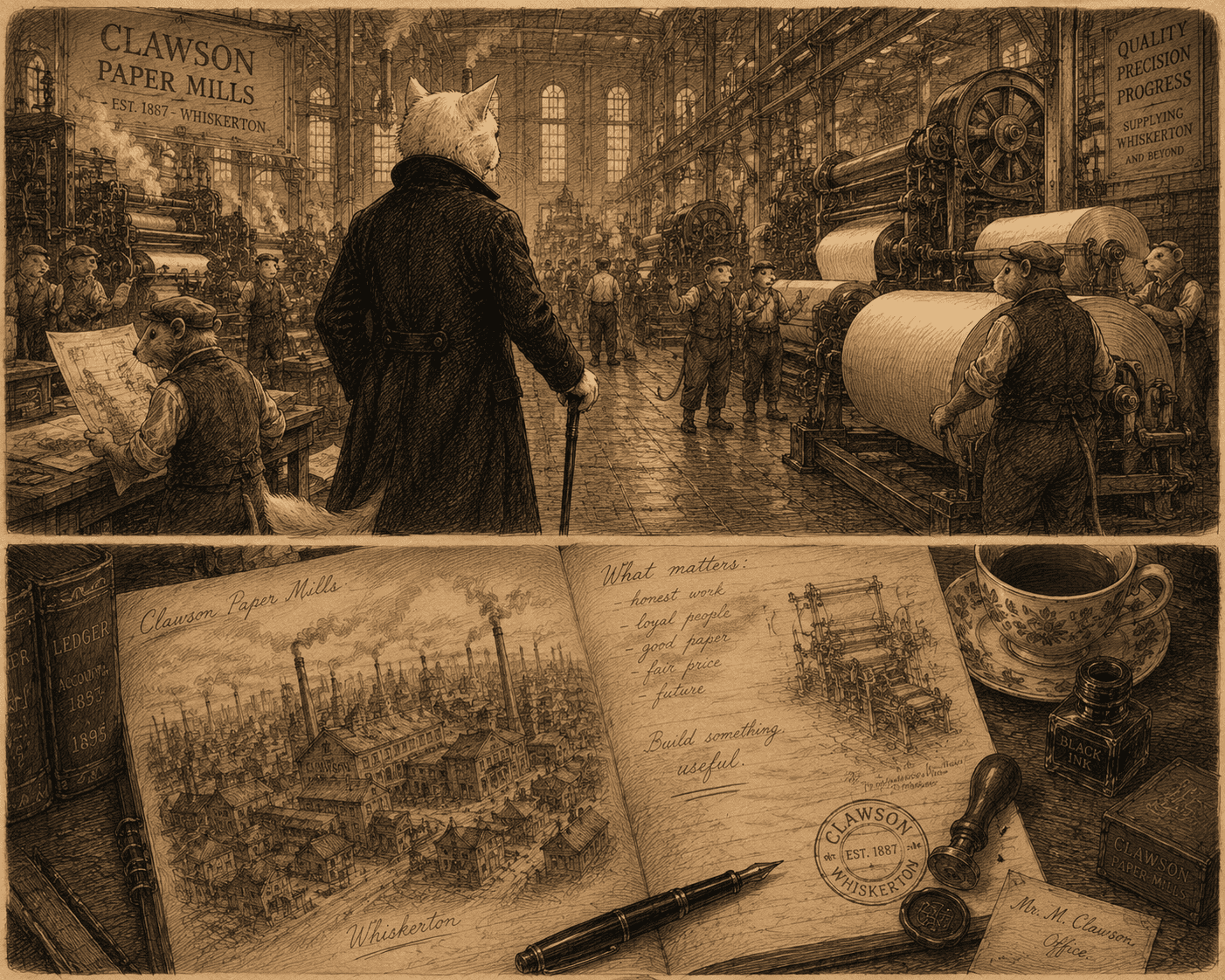
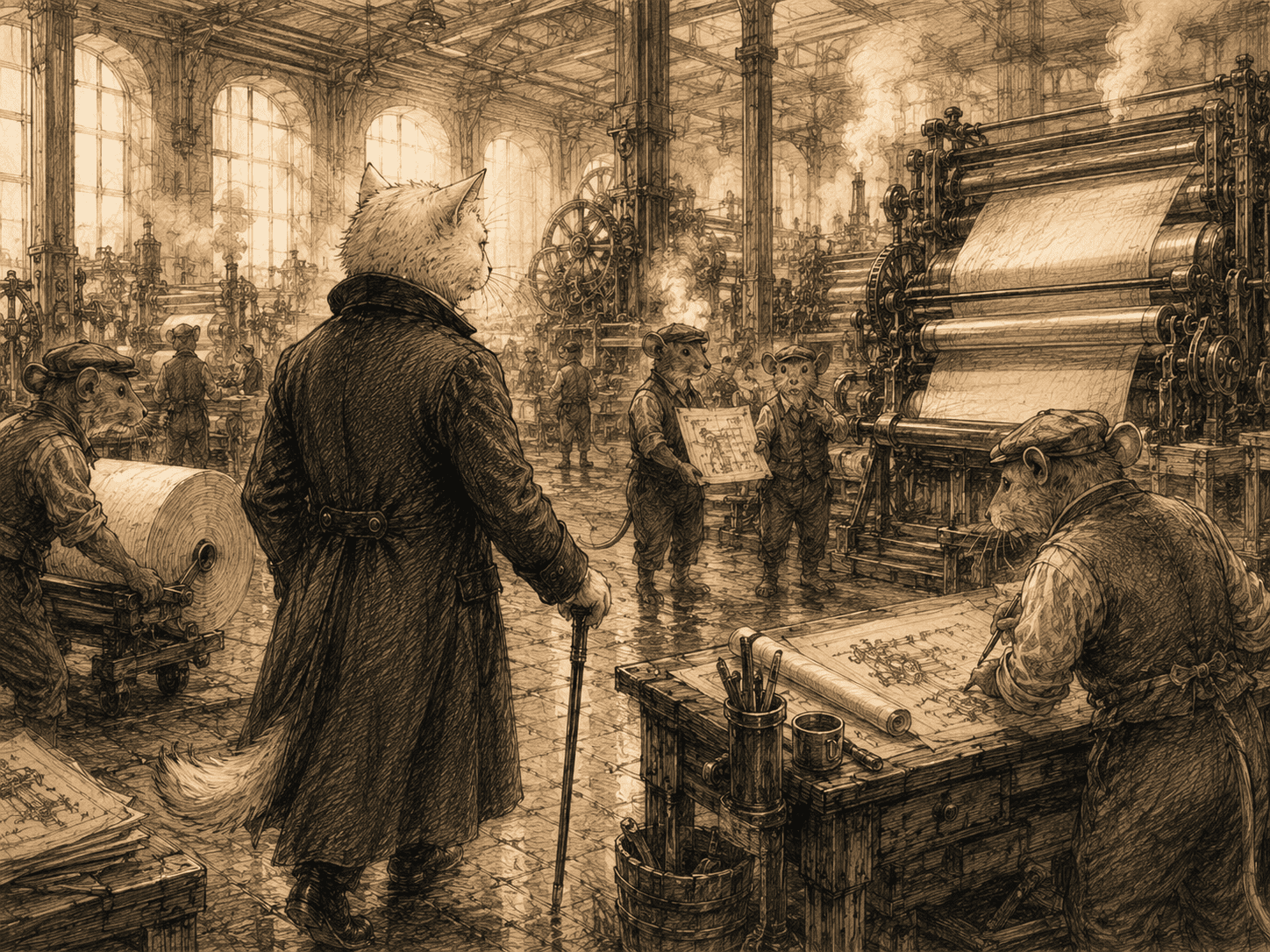
Montgomery Clawson walked the same way every morning: past the loading
docks, past the newspaper press, past workers who still straightened
their posture slightly when he passed.
Not because they feared him.
Because he remembered their names.
He always had.
Some industrialists built factories. Montgomery Clawson built
permanence.
From the City Archives
Montgomery Clawson is the managing proprietor of
Clawson Paper Mills, one of the Copper District’s most respected
industrial institutions.
The family business began before the formal establishment of
Whiskerton as a modest paper workshop: practical, struggling, and
burdened with ageing machinery. Montgomery inherited more
responsibility than comfort — a leaking roof, unreliable equipment,
old debts, and a craft worth preserving.
In 1887, during the earliest growth of Whiskerton itself, he
reorganised and expanded the workshop into what became
Clawson Paper Mills.
Few expected it to last.
Montgomery Clawson disagreed.
Over the years, the mill became an essential part of city life,
producing paper used across Whiskerton for letters, newspapers,
engineering blueprints, patents, scientific notes, official records,
maps, and academy theses.
It is often quietly said that a considerable portion of Whiskerton
has, at one time or another, been written on Clawson paper.
Educated in mechanical engineering during the final years of the The Brass Crown Dominion, Montgomery belongs to the generation often credited with shaping Whiskerton during its earliest years of industrial growth.
Despite his success, he never relocated to the grand avenues
surrounding the Clockwork Spire. His residence remains only two
streets from the mill in the Copper District.
By his own account:
“A mill owner should hear the morning whistle from home.”
Life in the Copper District
Though counted among Whiskerton’s wealthier industrialists, Montgomery
is rarely seen behaving like a distant owner.
He still inspects machinery personally, reviews paper quality by hand,
and walks the production floor without announcement.
Many workers claim he notices problems before the machines themselves
do.
His office remains modest by Copper District standards: oak shelves,
carefully filed correspondence, well-used engineering manuals, factory
reports, and a kettle that never seems entirely empty.
Visitors are usually offered tea.
Advice is less predictable.
Reputation
Young inventors, engineers, and ambitious students occasionally seek
Montgomery’s guidance.
Most leave having received some variation of the same instruction:
“Build something useful.
Build it properly.
Then keep improving it.”
Though respected throughout Whiskerton, Montgomery has little patience
for needless extravagance, rushed craftsmanship, or inventions
designed merely to impress.
Good work, he insists, should outlast admiration.
Known Details
Species:Cat Fur: Pure white District:The Copper District Occupation: Industrialist; Managing Proprietor of
Clawson Paper Mills Education: Whiskerton Royal Institute of Mechanical
Arts Family:Clawson Family Class:The Industrial Upper Class of Whiskerton Known For: Precision, reliability, industrial
leadership Frequently Seen Carrying: A walking cane, folded
notes, factory reports Favorite Habit: Early morning inspections before
breakfast
Rumors & Quiet Speculations
Some claim Montgomery quietly finances scholarships for promising
academy students who cannot afford tuition.
Others insist he occasionally purchases unusual inventions from
struggling young engineers — not because they work, but because he
remembers what it meant to begin with very little.
Montgomery himself has never commented on either rumour.