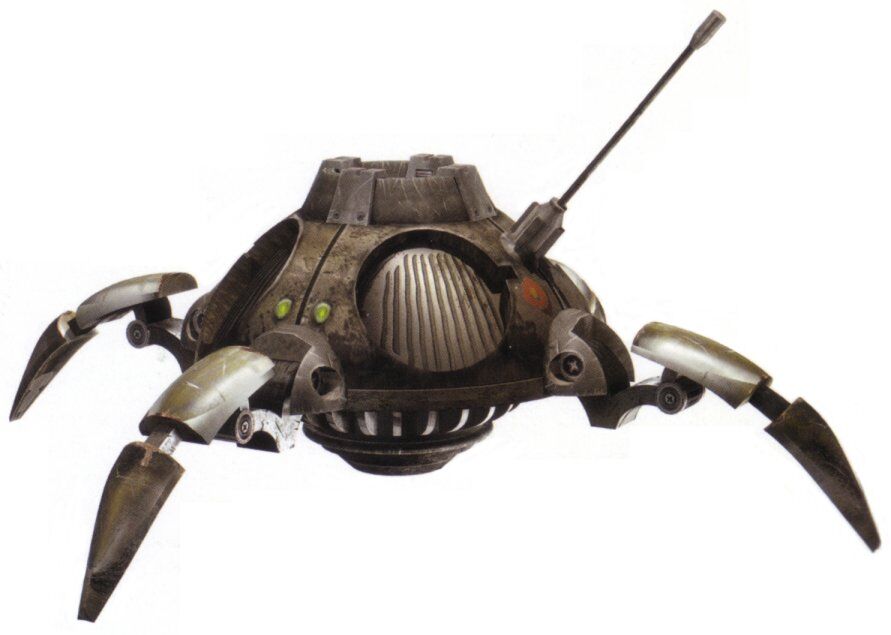
It was only six centimeters wide and had a small circular body supported by four legs with magnetized tips for stability. Within its diminutive casing the fly eye contained a high-imaging holographic lens which could zoom in on tiny details, even small text on a document. However, due to its size restriction, the fly eye had no audio receptors. The tiny droid could be remotely controlled by a joystick control pad from just over half a kilometer away. The presence of an operator was a necessary requirement as the droid was too small and lacked enough power to have any storage capability. It immediately trasnmitted any visual data to its remote user via its tightbeam antenna. Though this left the droid vulnerable to transmission jamming. Once the user had positioned the fly eye, it entered a 'passive mode' in which the engine and all other unnecessary peripherals shut down, making the fly eye very difficult to detect, even with a security scan. The fly eye owed its mobility to a tiny and surprisingly quiet repulsorlift engine situated on the underside of its body. This gave the droid a maximum speed of 10 km/h and allowed it to float up to 9 meters from the ground. However, during the testing process, the Loronar Corporation discovered that prolonged use of the engine often resulted in a circuitry meltdown. As a result, they installed 4 heat-dispersal vents positioned on the upper face of the droid which all but eliminated the issue.