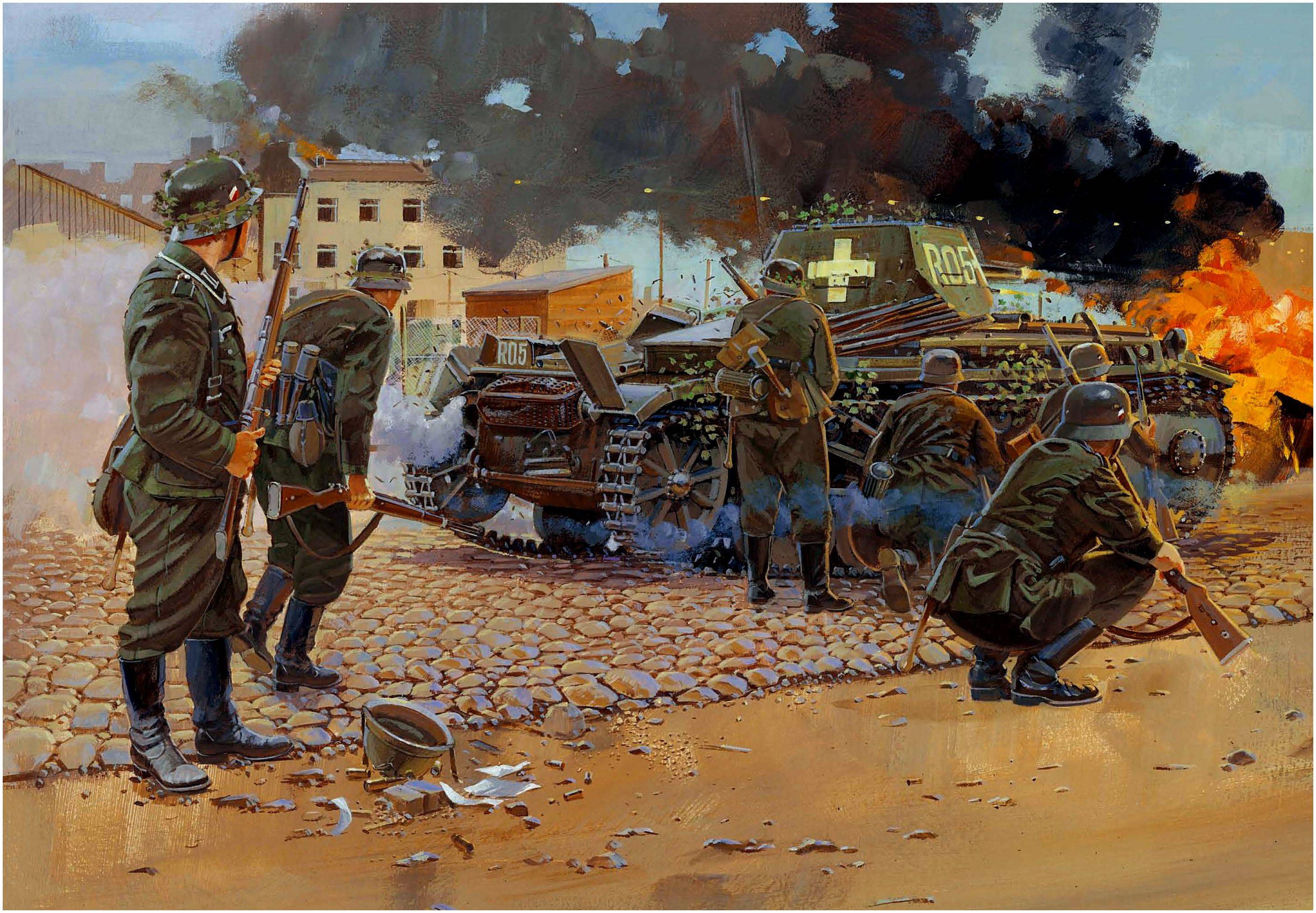
The First Battle of Poland was a major opening engagement on the Eastern Front of World War II, fought throughout September of 1939. It pitted the Soviet Red Army and its allies against Kaiserliche Eisenpakt forces, primarily drawn from the Deutsches Heer's eastern armies and the totality of the Polish Royal Army.
On the 1st of September 1939, France’s invasion of Alsace ignited the global conflict. Leon Trotsky, seeing Germany strategically overextended and attending to his alliance with France, declared war the following day. The Soviet High Command launched a number of concurrent offensives against the Ostwall, a network of fortifications across Poland and East Prussia, hoping to collapse the German eastern flank within weeks.
Soviet forces sought to shatter German defensive belts through sheer weight of fire and massed infantry attacks, but they were unsuccessful and only obtained limited gains. Although Polish and German divisions fought tenaciously, the Third Battle of Tannenberg to the north proved decisive. Zhukov’s 1st Guards Tank Army broke through East Prussia, leaving the northern flank exposed. This loss forced Eisenpakt forces in Poland into an untenable position. Extracting a heavy price in Soviet casualties, the Eisenpakt began a fighting retreat to the west. By late September, Soviet forces stood deep inside central Poland.
The battle was a strategic Soviet victory, forcing the fighting to continue within Germany's borders. The Soviet advance, however, was paid for in blood: estimates suggest the Red Army lost over half a million men in September alone. The withdrawal also left allied Yurizlansian forces isolated in Galicia, setting the stage for the bloody struggle there.