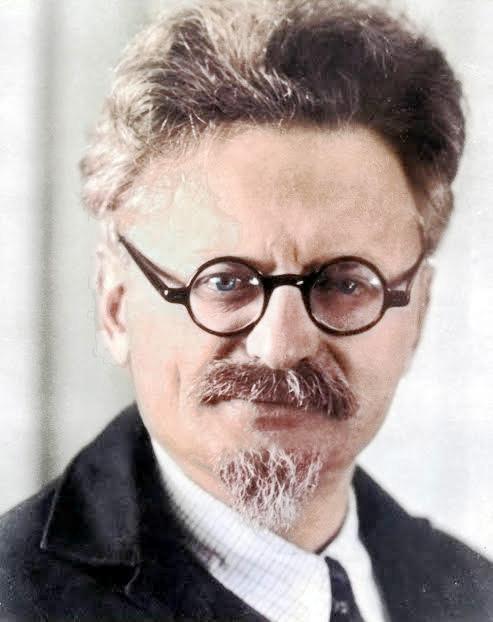
(1879 - 1942)
Lev Davidovich Trotsky, born in 1879 in Yanovka, Kherson Governorate, was the dominant figure of Soviet politics in the early twentieth century. Architect of the Red Army, political theorist behind the doctrine of Permanent Revolution, and adversary to German hegemony, Trotsky’s work was instrumental in The Union of Soviet Socialist Republics' rise in the world stage as a true Superpower 🌟.
Trotsky was among the principal organisers of the October Revolution of 1917, serving as Vladimir Lenin’s closest ally in the Bolshevik seizure of power. As People’s Commissar for Military and Naval Affairs, he built the Red Army from a disorganised militia into a disciplined force, relying on ruthless enforcement, ideological zeal, and the incorporation of former Imperial officers under political supervision.
His greatest triumph came in the Polish-Soviet War, which ended in a relatively astounding victory. Soviet forces led by Marshal Mikhail Tukhachevsky swept westward, smashing Polish resistance and forcing Warsaw and Kyiv to the negotiating table. Though The German Empire, then still recovering from World War I and facing the Velvet Revolution at home, threatened direct intervention, Trotsky was able to secure a diplomatic settlement. The Second Treaty of Brest-Litovsk created The Polish People's Republic in eastern Poland and established the Ukrainian Soviet Socialist Republic, confining the The Kingdom of Yurislanzia to Galicia. This outcome was heralded across the socialist world as the first great breakthrough of the International Revolution.
Lenin’s death in 1924 triggered a power struggle between Trotsky and Joseph Stalin. The former, backed by the prestige of military victory, the loyalty of Tukhachevsky, and the support of much of the party’s intellectual elite, emerged victorious. Stalin was sidelined, then later exiled, and his fate remains a mystery to this very day.
The Soviet Union economy under his regime was not a simple command economy but a carefully engineered balance, the Soviet Dual Model. Lenin's New Economic Policy remained in place, permitting small-scale private enterprise and large-scale market socialism, but strategic sectors such as heavy industry, electronics, chemicals, and above all the arms sector were brought under strict state control. Trotsky understood that the survival of socialism depended on rapid industrialisation, but this was balanced with relative rural stability and agricultural mechanisation, ensuring food supply while funnelling surplus resources into industry. The Soviet economy, already strengthened by the late imperial industrial boom, surged ahead during the 1920s.
Foreign collaboration played a critical role. With Germany hegemonic but unstable, The United States of America saw Soviet industrialisation as a useful counterweight. Thousands of American engineers and experts crossed the Atlantic, designing factories, rail networks, and urban centres. Though this cooperation ended abruptly in the early 1930s once Soviet strength became too obvious a threat, specifically after the Fourth French Revolution, many of those specialists remained, enamoured by the promises and results of socialism, and greatly disappointed with the situation back home.
Trotsky’s rule diverged sharply from the overbearing autocracy of Imperial Russia, but was nevertheless decidedly authoritarian. While political dissent remained banned, Soviet academia enjoyed partial intellectual freedom and heavy state patronage. Physics, aeronautics, chemistry, agronomy, engineering and electronics were showered with funding. Trotsky’s insistence on technical progress produced a generation of Soviet scientists whose discoveries would give the USSR a decisive technological edge when war erupted in 1939.
His right hand throughout The Red Orchestra was Genrikh Yagoda, head of the NKVD, the Soviet Union's hyper-competent intelligence service. Under his stewardship, this institution orchestrated coups, assassinations, and mass subversion across the globe. Communist revolutions toppled governments in France, Japan, the Balkans and the Danube, while the threat of a communist uprising was ever-present within the Kaiserliche Eisenpakt's borders. This global revolutionary network allowed Soviet influence to grow unchecked, further legitimising and strengthening the Permanent Revolution.
Trotsky lived to see the greatest test of his vision: the outbreak of World War II. When France ignited the conflict in September of 1939, Trotsky seized the opportunity. Within a day he declared war on Germany, unleashing the Soviet war machine, built under two decades of careful planning, into Eastern Europe and later into West Asia. Though the war would drag into a bloody stalemate and ultimately reverse against the Eurasian Axis by 1943, Trotsky did not live to see its end. On the 1st of December 1942, after suffering a stroke in Moscow, Trotsky died at the age of sixty-three. His passing marked the end of the Soviet Union’s most aggressive and influential era. Marshal Tukhachevsky assumed provisional leadership, guiding the USSR through the war’s bloodiest years, but he returned Moscow to civilian control in 1948, with Nikita Khruschev being chosen as the next General-Secretary.