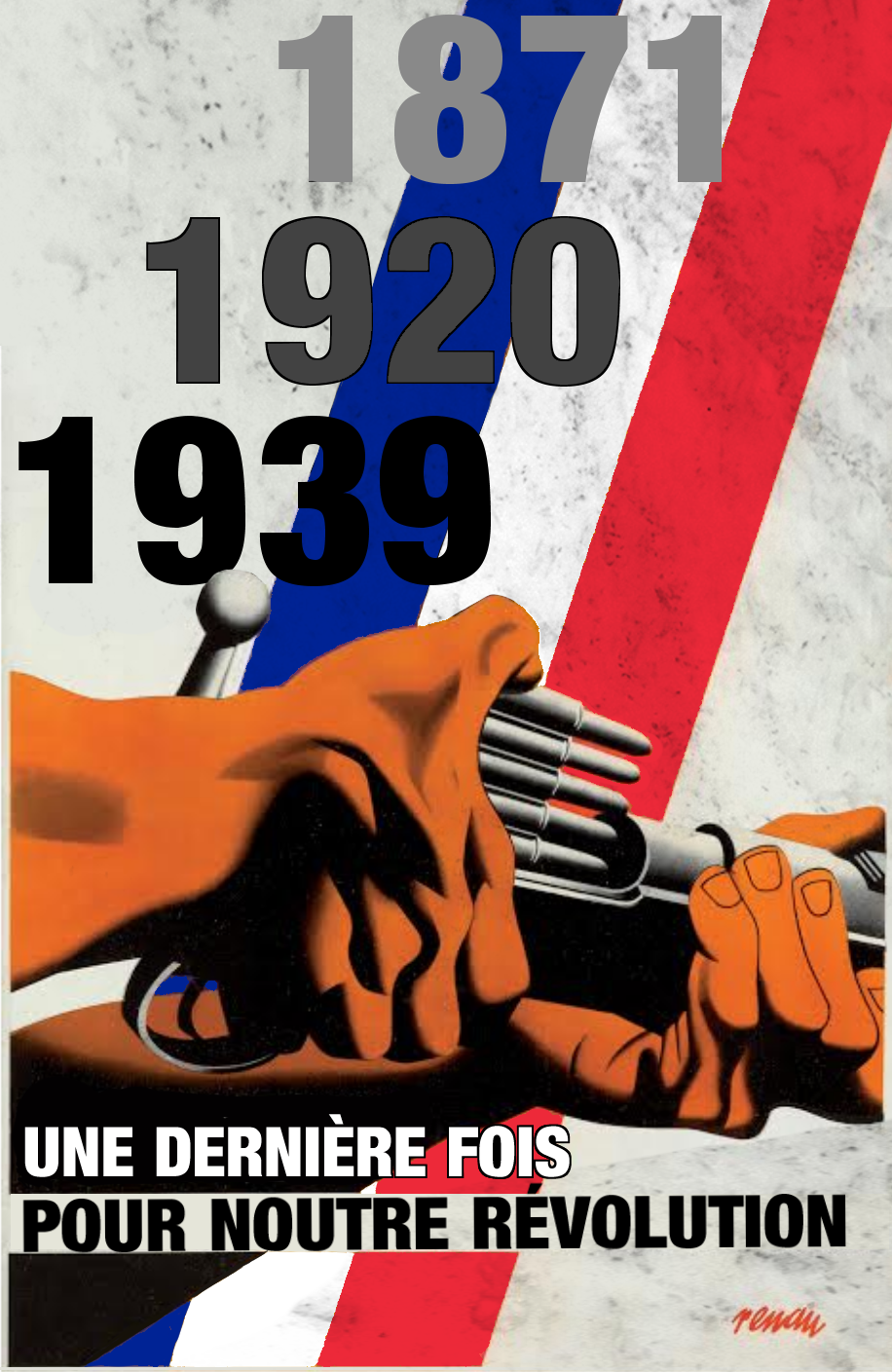
The Fourth French Revolution was a pivotal event in the history of Europe that ended German control over France and allowed the French Neosocialists to rise to power. Installed as a client ruler after the German victory in World War I, Prince Oskar of Prussia reigned as King of France under the terms of the Treaty of Versailles. His government was never popular; his German heritage and open loyalty to Berlin earned him the epithet "le parasite hun" among much of the population. The French Parliament, while outwardly cooperative, remained a constant battleground between German-aligned royalists, moderate republicans, and a fractured socialist left.
By the late 1920s, France’s economy was in free fall. Reparations to Berlin drained the treasury, industrial production lagged, and unemployment soared, all made exponentially worse by the Great Depression. In May 1930 the King, acting without parliamentary approval, authorised steep tax increases on the working and middle classes to meet his financial demands. This was seen not only as a direct assault on French livelihoods but as proof that the King ruled for Berlin’s benefit.
The 1st of May of 1930, Labour Day, was meant to be a show of solidarity. Left-wing parties, from moderate social-democrats to the far-left neosocialists, convened in Tours for the Second Tours Congress to draft a strategy for peaceful de-Germanisation. Plans included nationwide strikes, mass boycotts of German goods, and a coordinated petition to dissolve the monarchy. The King’s security services, informed of the gathering, surrounded the meeting hall. Whether through miscommunication or deliberate order from Oskar himself, they opened fire on the crowd. The massacre killed or wounded much of France’s prominent leftist intelligentsia, union leadership, and local organisers, but most of the neosocialists miraculously survived. News of the bloodshed spread in hours. Spontaneous violent riots erupted in Paris, Lyon, Marseille, and Lille, with rail and telegraph lines being sabotaged and royal garrisons being firebombed.
When ordered to restore order, elements of the French Royal Army refused to fire on civilians. In several cases, troops joined the rioters, proclaiming loyalty to the French people rather than the “Hun puppet”. By the dawn of May 2nd, Paris was in full revolt and the royalists had lost all control. Barricades rose in the streets, and crowds marched on the royal quarter, assaulting the King's palace with whatever arms and working tools they could muster. Prince Oskar, his wife, children, and several senior German advisors were dragged into the streets and executed. Their bodies were mutilated and displayed in public squares.
The King’s death did not immediately end the chaos. Several competing factions, including republican moderates, trade unionists, anarchists, communists, syndicalists, and the rising neosocialists, vied for control of Paris. The capital became a shifting front line between armed political militias, with the rest of the country devolving into de-facto city-states, communes and autonomous regions. The néosocialistes, under the leadership of Marcel Déat, gained momentum through a blend of militaristic nationalism and state socialism, aided by the fact most of the French left's leadership had been butchered at Tours, leaving them alone to represent one of the country's major political currents. They rallied veterans, workers, and radicalised youth under the promise of a unified, self-sufficient, and militarily ascendant France.
Déat’s chief lieutenant, Jacques Doriot, proved decisive in consolidating power. Doriot’s forces systematically eliminated rival factions, employing mass executions, forced disappearances, and public spectacles of violence to terrorise opposition. Within a week, Paris was firmly under néosocialiste control. By the 14th of July, coinciding with Bastille Day, all of France. Initially, the néosocialistes framed themselves as patriotic socialists, committed to rebuilding the nation and avenging Versailles. But under Doriot’s growing influence, the regime became fanatically ultranationalist, ultramilitarist, and violently irredentist. Secret police scoured the country for dissent, while youth organisations and labour corps were militarised. Landowners, business owners, opposition figures, non-conformist writers and every other possible enemy of the state were violently purged, often in public and transmitted through radio.
By autumn of 1930, France had withdrawn entirely from the constraints of the Treaty of Versailles and formally joined the Moscow Pact (MTO) alongside The Union of Soviet Socialist Republics. This alliance evidently served both sides: France provided a western revolutionary spearhead into Europe, while the Soviets offered resources, training, and political support. Later, in November, the French Red Army crossed the Rhone and began the Franco-Italian War, which Germany was unprepared to respond against due to the threat of Soviet invasion from the East and most of its forces being tied in the First Colonial War.
The Fourth French Revolution destroyed what remained of the post-war political order in Europe and made it clear in the minds of every statesman in Europe that a new Great War approached. The German Empire, gripped by its own economic crisis, was powerless to intervene. The brutality of the revolution sent shockwaves across the continent, convincing Italy’s Fascists and Britain’s Socialists alike that communism in its neosocialist form represented an existential threat. By the end of the decade, Europe was no longer an ideological battleground, but rather a slaughterhouse, where Germany, surrounded on all fronts, was the sacrifice.