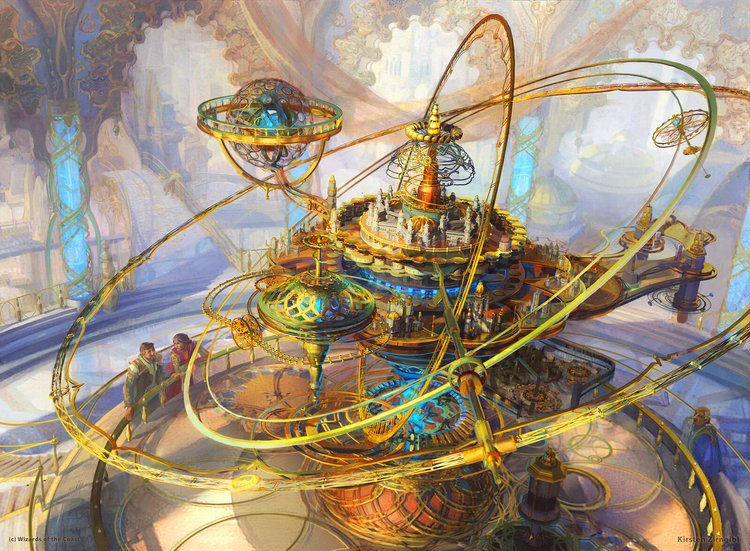
The orrery dominates the center of the vaulted chamber like a mechanical cathedral, its vast brass arms stretching outwards in elegant arcs. Polished to a mirror sheen, the great gears at its base turn with a deep, steady rhythm, the sound echoing softly off the stone walls—tick, hum, click—as though the machine itself were breathing.
At its heart blazed a miniature Sun, a golden sphere made of polished brass. Each planet is a marvel of craftsmanship: veined marbles, burnished metals, and inlaid stones gave texture and life to their surfaces. Tiny moons orbited some of them in perfect harmony, tethered by gossamer-thin rods that seemed too fragile to hold anything at all.
Above the orrery, a domed ceiling depicted the constellations in glowing inlay, responding to the turning of the mechanism below. As the planets rotated, so too did the stars, synchronized with impossible precision, mapping the heavens in real time.
Below the plane of the planets, the entire mechanism sits upon a dark, undulating sheet of pliable metal, dark as night, also rising and falling in gentle curves. Sometimes the sheet is close to the planets, sometimes farther away, moving in conjunction with the planetary bodies.
A web of interlocking gears, hidden beneath the sheet feeds the orrery’s continuous motion—centuries-old clockwork still alive, the slow unwinding of coiled springs some large enough to anchor a ship. An iron crank, waist-high and ornately engraved, stood off to the side, allowing the viewer to accelerate or reverse the passage of time. With a single turn, days slipped into years; the planets danced faster, spinning through the ages like a cosmic ballet.
The air around it shimmered faintly, not from heat, but from something older—an aura of reverence and forgotten science. No one alive fully understood how it had been built, or by whom. It was less a model of the universe than a memory of its making, a relic of minds who had once measured time not in hours, but in orbits and light.