Thanks to the industrious innovation of multiple dragonmarked houses and workshops full of magewrights, the people of Khorvaire can cross the continent in a week or less using magical means. The lightning rail and vessels powered by bound elementals and operated by the dragonmarked houses, can carry passengers as far in an hour as a horse can walk in a day. This section discusses issues related to travel in an Eberron campaign and presents the Gold Dragon Inns, a chain of hotels that offer consistent accommodation for travelers anywhere in Khorvaire.
As described in chapter 5 of the Dungeon Master’s Guide, it’s up to you whether you gloss over travel in your campaign or narrate it in more detail. If the point is to get the characters to their destination so they can get the adventure underway, it’s fine to assume that their journey (whether it’s by lightning rail, airship, or more mundane means) passes without incident. After all, the people of Khorvaire make such trips every day, and most of them reach their destinations safely.
The alternative is to make the journey an important part of the adventure. Travel can play a crucial role in a story, and when it does, you should give it as much time at the game table as it needs.
Elemental Vessels
Long ago, gnome artificers and specialists from House Cannith discovered and developed a means of magical travel. The heart of the process is a set of techniques for binding elementals that uses Khyber dragonshards. This closely guarded procedure requires delicate engineering, arcane skill, and rare materials from around the world, and different workshops employ varying esoteric techniques. Building a new vehicle can occupy a workshop for months while magical energy is painstakingly inlaid into the vessel’s hull. Such work is a complicated task requiring the labor of many; it is not something that can be undertaken by a lone wizard for any amount of compensation.
The construction of elemental vessels requires the use of two kinds of dragonshards. A Khyber dragonshard of the largest size and finest quality is required to bind the elemental to the vessel, and a Siberys dragonshard is needed to craft the vehicle’s helm. Production of new vessels grinds to a halt without a steady supply of both kinds of dragonshards, and a workshop with an order to fill will pay a handsome fee to adventurers who can find them.
Elemental Matrix
Every elemental vessel is imbued with an invisible, arcane matrix. This magical essence extends from the containment chamber at the core of the vehicle to the binding struts, then through the rest of the vehicle’s hull. When a Khyber dragonshard holding a bound elemental is placed in the containment chamber, the matrix comes alive. The unsuppressed elemental emerges from the shard and flows along the matrix in the way that blood moves through the arteries and veins of a living creature.
The binding struts force the elemental into a ring shape and give every elemental vessel its distinctive appearance. From there, the elemental continues to flow along the matrix through the hull, appearing as jagged, snaking lines of living energy that pulse and shift. These conduits of elemental energy take on an appearance associated with the type of elemental bound into the vessel. A fire elemental, for example, sends tendrils of flame along the hull of its ship.
At the command of the vehicle’s dragonmarked pilot, the bound elemental can be suppressed, causing its essence to flow back into the containment chamber and the matrix to disappear from view. A vehicle whose elemental is suppressed ceases to be propelled.
Controlling the Elemental
Piloting an elemental vessel requires effective communication between the pilot and the bound elemental. The elemental controls the vehicle’s movement, and everything from basic propulsion to delicate maneuvering is dependent on the ability of the pilot to control the elemental. If the elemental is uncontrolled and not suppressed, the vehicle moves according to the elemental’s whim until a pilot asserts control again.
A dragonmarked heir at the helm of a vessel can command the elemental easily. Without such a pilot, it’s very difficult to control the vessel. A character who is touching either the Khyber dragonshard where the bound elemental is housed or the magic item at the vessel’s helm can try to communicate with the elemental, but with no guarantee of success.
A character can make a DC 20 Charisma (Persuasion or Intimidation) check to persuade the elemental to cooperate or demand its obedience. On a successful check, the elemental obeys the character for 1 minute.
The dominate monster spell can also enable a character without a dragonmark to control an elemental vessel, even wresting control away from a dragonmarked pilot. The charm monster spell (found in Xanathar’s Guide to Everything) also makes the elemental compliant to the caster’s wishes, but the elemental remains obedient to the commands of a dragonmarked pilot at the helm.
Freeing the Elemental
Shattering the Khyber dragonshard that binds it can free an elemental, preventing the vehicle from moving. On most elemental vessels, the shard is sealed in a protective metal chest with 10 (3d6) hit points, usually made of iron (AC 19) but sometimes of mithral (AC 21) or adamantine (AC 23). The chest is often guarded with a glyph of warding and housed in a room behind locked and possibly trapped doors. The shard itself has AC 17 and 10 (3d6) hit points.
Lyrandar Airship
The airship is the most advanced elemental-powered vehicle on Eberron, the pride of House Lyrandar and the forerunner of the magical advances that many hope will become commonplace in the aftermath of the Last War. The first airships emerged from the Cannith and Zilargo workshops and appeared in House Lyrandar’s service just eight years ago (in 990 YK). For now, though, they remain rare, because the soarwood required for their construction is exceedingly scarce and tightly controlled.
Soarwood is a form of buoyant timber found only on the island of Aerenal, and the elves who live there limit their annual harvest of the precious wood. As a result, production of new airships proceeds at a snail’s pace, unable to satisfy the fervent demand for new vessels. The discovery of a new supply of soarwood could literally change the world, and even convincing the elves of Aerenal to part with more of it would be an achievement worth a handsome reward from House Lyrandar.
How It Works
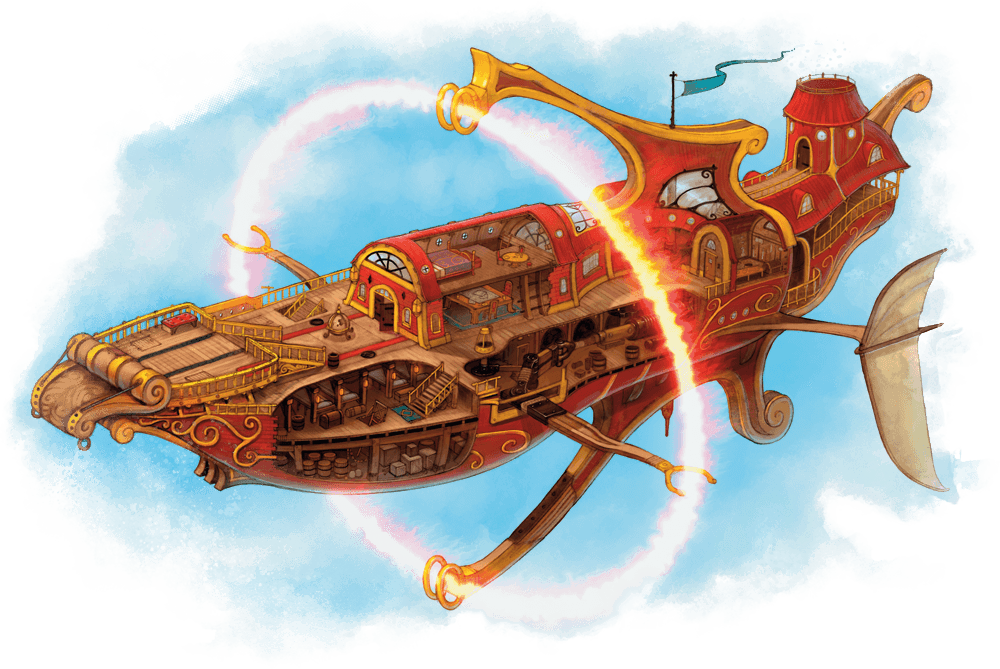
A standard airship (at least as far as standards have been defined for this relatively new creation) looks similar to an oceangoing ship but is rigged with control fins and rudders rather than sails. An air or fire elemental is bound into a ring around the hull, which is suspended on four struts jutting outward. Most airships are outfitted with the finest amenities, including many decorative flourishes and creature comforts.
Operation. A dragonmarked heir of House Lyrandar must pilot a Lyrandar airship, channeling the power of the Mark of Storm through the wheel of wind and water that controls the vessel. The helm is typically situated near the rear of the ship, inside the shelter of a wheelhouse. Controlling the vessel (without the benefit of something like the conductor stones that dictate a lightning rail route) requires constant attention, so at least two pilots typically travel on every journey.
Only a dragonmark heir with the Mark of Storm can use the wheel and command the bound elemental. House Lyrandar pilots train for months to gain a deep understanding of the ship’s powers and limitations. Because of this training, a skilled pilot can execute acrobatic maneuvers in the sky.
Airships can move in all three dimensions, with or without the aid of the wind. Unlike most flying creatures, they don’t rely on wings for lift thanks to their soarwood hulls. They are able to fly equally well on their sides or even upside down (notwithstanding the risks that such maneuvers present to passengers and crew).
Airships cannot actually land, because the struts that hold the elemental ring in place protrude 10 feet from the bottom of the vessel. Thus, passengers and cargo are lifted in elevators and loaded at towers in major cities. Each ship carries rope ladders for use at smaller stations, in open terrain, or in cases of dire emergency.
A typical airship can reach a speed of 20 miles per hour in clear skies carrying up to 30 tons of cargo. Airships are most often employed by explorers and by wealthy travelers who demand luxury — clients who have a need to move quickly to places that might not be served by the lightning rail.
Suppression. Although the elemental bound to the airship is essential for propulsion, the vessel’s soarwood hull provides its lighter-than-air buoyancy. When the elemental is suppressed, the ship remains aloft but can’t move. The pilot always suppresses the elemental before docking, then uses ropes to maneuver the vessel into position.

Lyrandar Galleons
A House Lyrandar galleon, also called an elemental galleon, resembles a Lyrandar airship except that it has a water elemental ring that propels it across oceans and seas instead of through the air. This vessel has a speed of 10 miles per hour but otherwise is similar to a Lyrandar airship.
Orien Lightning Rail
The wondrous lightning rail system once linked the far reaches of the Kingdom of Galifar, prior to the Last War. Now the system is divided, split into eastern and western circuits. Reestablishing the conductor stone paths across Scions Sound and the Mournland is often discussed in the halls of power in the Five Nations, but formidable challenges are involved.
How It Works
A lightning rail train is made up of an elemental vessel linked to a series of connected carts, all of which float about 5 feet off the ground. Each cart, similar in form to a large wagon with no wheels, has a conductor stone embedded in its underside. A corresponding set of conductor stones laid out in a line on the ground interacts with the stones in the carts to form a rail for the train to follow. Lightning arcs between the two sets of stones, accounting for the system’s name.
The elemental vessel at the front of the train, called a crew cart, holds a bound air elemental that propels the train along its route at a speed of about 30 miles per hour. The elemental appears as a ring of lightning encircling the crew cart while the train is in motion. A bound air elemental can move a train of up to ten carts without obvious strain, and most trains are configured accordingly.
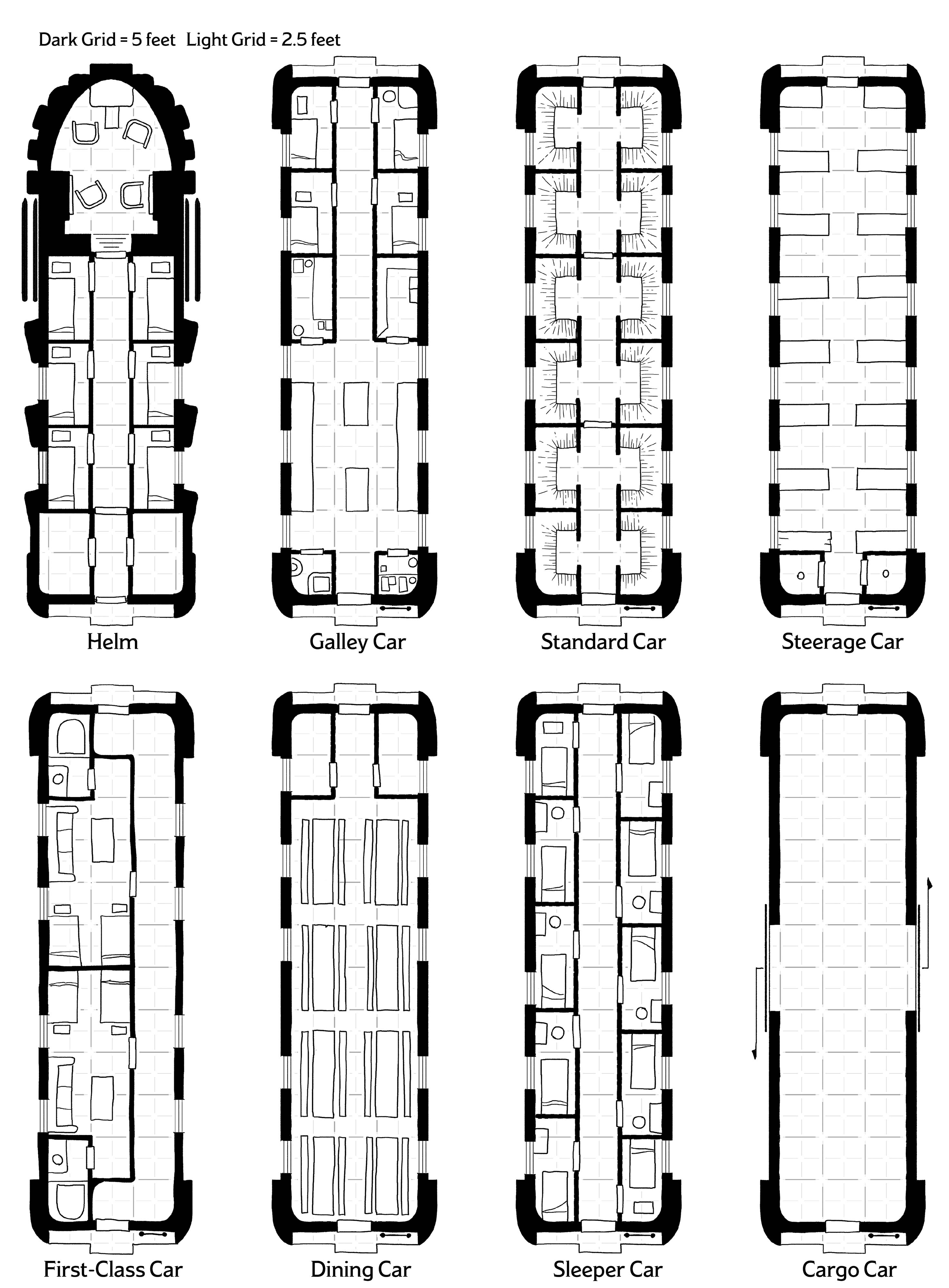
The other carts that make up the train have various purposes. A typical train has a crew cart at each end, with two cargo carts, four passenger carts, and two lounge carts in between. Doors at both ends of each cart enable crew and passengers to walk from one to the next, even while the train is in motion. Both crew carts are identical, except that the bound elemental in one is suppressed. On the return trip, the roles of the carts and the states of their elementals are reversed.
Specialized carts of other sorts vary in configuration depending on their purpose and the degree of luxury afforded to them. Some have solid sides and roofs, while others are covered only with canvas.
Map 4.10 shows the different carts that comprise most lightning rail trains.
Operation. The vessel’s pilot, a House Orien dragonmarked heir, stands at the helm, high atop the crew cart, beneath the elemental binding struts. The pilot controls the elemental and communicates with it during the trip, watching the path ahead through broad windows that encircle the helm platform.
The placement of conductor stone lines dictates where a lightning rail train can travel, but the pilot still must make operational decisions as the coach moves from one city to the next. The pilot controls the vessel’s speed based on conditions around the train. When conductor stone lines split, as they do at various hubs along the way, the pilot selects the intended route and directs the elemental down the correct line.
The crew of a train includes handful of chief stewards overseeing a number of lesser stewards who are charged with seeing to the needs of passengers and keeping cargo secured.

Map 4.10: Lightning Rail Train Carriages
View Player Version
Lightning Rail Stations
Lightning rail stations, where passengers and cargo can be disembarked or loaded, are located in or just outside villages, towns, and cities along the conductor stone paths. There are no stations in the expanses between these settlements, and House Orien rules prohibit lightning rail pilots from stopping anywhere but at a station.
Stations throughout Khorvaire have a similar look and feel, to ensure that each one lives up to the high expectations of House Orien’s patrons. White and gold everbright lanterns continually illuminate each station. When a train pulls into the station, loading ramps are moved into position beside each cargo cart, and stairs by each passenger cart. The cargo is unloaded from one side of the train and the passengers from the other.
Individual stations do have distinct touches that reflect local features. For example, the station in Gatherhold, in the Talenta Plains, is decorated with traditional halfling motifs and offers specialized stables for travelers leaving their dinosaurs behind. On a larger scale, the station at Passage, which is the seat of power for House Orien, is a multistoried structure designed as a monument to the majesty and storied history of the house.
Mysterious Passengers
Lightning rails and airships are good places to encounter a broad sample of Khorvaire’s diverse population. You can use the Mysterious Passengers table to bring curious characters in contact with an adventuring party on any kind of journey. Each of these characters might spark an entire new adventure, or might be little more than a momentary diversion. Determine details about these travelers are, and the stories behind them, as you see fit.
Mysterious Passengers
| d100 |
Passenger |
|---|
| 01–02 |
A human merchant of obvious means seems to be deliberately drawing attention, loudly calling out their name and the time of day. |
| 03–04 |
Two shifters drinking and spoiling for a fight. |
| 05–06 |
A warforged quietly reads a book called The Machine Manifesto. |
| 07–08 |
A half-elf sits down, says, “Beware — the wolf howls at midnight,” and leaves without further comment. |
| 09–10 |
A gnome watches everyone carefully, writing down observations in a tiny orange book. |
| 11–12 |
A one-armed Brelish veteran verbally assaults any warforged he sees, blaming them for his injury. |
| 13–14 |
A well-dressed human sits awkwardly next to the wall, seemingly trying to avoid touching or being touched by anyone else. |
| 15–16 |
A cloaked figure moves slowly past, pausing briefly upon catching sight of the party. |
| 17–18 |
An acolyte of the Silver Flame preaches loudly in an attempt to convert an essentially captive audience. |
| 19–20 |
A destitute bard plays the harp with mediocre skill while asking for donations. |
| 21–22 |
A deaf couple communicate with each other by sign language, but suddenly stop when they notice they are being watched. |
| 23–24 |
A frail human with a small strongbox shackled to one of her wrists is in the company of two heavily armed half-orc bodyguards. |
| 25–26 |
Three hobgoblin mercenaries from House Deneith discuss their plans in their native tongue. |
| 27–28 |
A harried dwarf tries to keep three children corralled, but the oldest one keeps sneaking away. |
| 29–30 |
A bored changeling practices duplicating the faces of the guests. Not all of them are amused. |
| 31–32 |
A shifter glowers in a corner booth, looking angry at the world. |
| 33–34 |
A warforged bard uses its body as a percussion instrument to entertain the patrons. |
| 35–36 |
A dog with no apparent owner wanders around. |
| 37–38 |
Two Karrnathi soldiers seem extremely nervous and speak to no one. |
| 39–40 |
A halfling leads a tiny pet dinosaur on a leash, tugging at it whenever it tries to examine something. |
| 41–42 |
A half-orc sits with a small potted plant, whispering to it in Orc. |
| 43–44 |
A well-dressed dwarf wearing eight copper rings paces restlessly. |
| 45–46 |
A halfling from House Ghallanda offers food and drink to all passengers except elves or half-elves. |
| 47–48 |
An elf bard from House Phiarlan whispers conspiratorially with a member of the vehicle’s crew. |
| 49–50 |
A kalashtar is trying too hard to pass as human, conspicuously and awkwardly using human slang. |
| 51–52 |
A young half-elf in adventuring garb weeps openly. |
| 53–54 |
A silver dragon in human form observes the interactions of the clientele, paying close attention to any dragonmarked characters. |
| 55–56 |
A House Cannith tinker examines the structure of the vehicle closely, looking concerned and asking questions about possible escape procedures. |
| 57–58 |
A one-eyed human (actually an Inspired agent of the Dreaming Dark) watches everyone carefully. |
| 59–60 |
A disheveled human magewright offers meager magical skills in return for food or spare coins. |
| 61–62 |
A warforged leaning on a wooden staff carries on a conversation with the docent attached to its chest. |
| 63–64 |
A human pickpocket circulates among the passengers, looking for another victim. |
| 65–66 |
A human from Aundair obsessively checks and rechecks their traveling papers. |
| 67–68 |
An artificer tinkers with a new invention. |
| 69–70 |
An attractive half-elf makes advances toward a number of other passengers. |
| 71–72 |
An apprentice wizard draws arcane symbols on the window, glaring at anyone who interrupts. |
| 73–74 |
A dwarf with a bandaged wound checks it repeatedly, occasionally pouring whiskey on it and wincing. |
| 75–76 |
A young, red-haired human flirtatiously tries to get other passengers to buy drinks. |
| 77–78 |
An Aerenal elf sits silently, trying to ignore the stares of other passengers. |
| 79–80 |
A disheveled old human loudly proclaims that the end of the world is nigh, according to the dragons. |
| 81–82 |
A human child is apparently traveling with no parent or guardian. |
| 83–84 |
A nervous goblin holds traveling papers out to anyone passing by, as if expecting to be challenged at any moment. |
| 85–86 |
Four kalashtar monks meditate, burning incense and chanting quietly. |
| 87–88 |
A rogue tries to swindle other passengers by using marked cards. |
| 89–90 |
A House Tharashk inquisitive examines the floor of the vessel very carefully, offering no explanation. |
| 91–92 |
A group of unremarkable farmers are transporting a strange device that bears Draconic runes. |
| 93–94 |
A cleric of the Sovereign Host seems annoyed and is rude to several pious passengers who ask for blessings. |
| 95–96 |
An older human reads the Korranberg Chronicle, loudly proclaiming outrage at every story. |
| 97–98 |
Roll again; the travelers are one or more changelings appearing to be whatever the second roll indicates. |
| 99–00 |
Roll twice more; the two travelers indicated are about to come to a very obvious conflict of some kind (verbal or physical). |