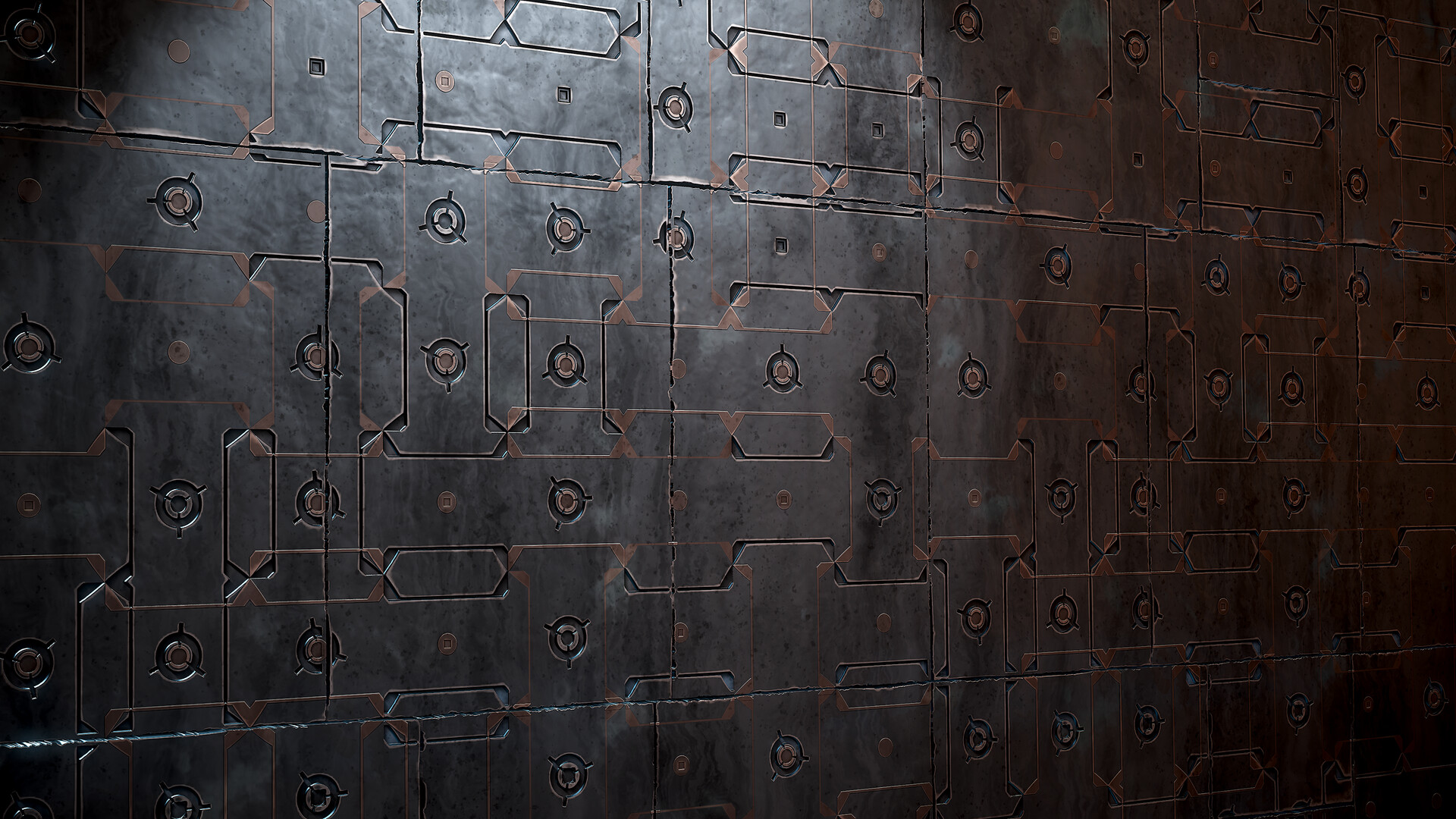
Plasteel is the informal name given by Oceanykan metallurgists to an alloy of entirely unknown origin and composition. It is bluish-grey in appearance, superficially similar to Bluesteel at a glance, and has been recovered from precursor artefacts: structures, machines, and objects of apparent non-human manufacture found primarily in the deeper reaches of The Underdown, Oceanyka's vast subterranean cavern system. No surface deposit, ore body, or raw precursor material has ever been identified. As far as anyone can determine, plasteel does not occur naturally. It was made somewhere, by something, and the process has not been replicated by humankind.
Compositional analysis has been attempted by every major materials science institution that has obtained a sample. The results are consistent: plasteel contains elements corresponding to known positions on the periodic table, but in combinations and microstructural arrangements that no known metallurgical process produces. The atomic bonding geometry is anomalous. Some analyses have returned trace signatures consistent with algeochemical materials, leading to speculation that plasteel's manufacture involved Algeochemistry, but this remains unconfirmed. Foreign institutions that have obtained samples through diplomatic channels, intelligence operations, or purchase on the grey market, report the same findings.
The material's properties are, in the blunt assessment of the University of Cestlep Institute of Algeochemistry, very nearly perfect. Plasteel sustains temperatures comparable to tungsten before softening. Its hardness under the Vickers scale is consistent with iridium, the hardest natural metal. It exhibits a degree of elastic deformation under load more characteristic of engineering polymers than metals, returning to its original geometry after stresses that would permanently deform steel. It is effectively non-corrosive: no acid, base, oxidising agent, or atmospheric condition tested to date has produced measurable surface degradation. Its density is moderate, closer to steel than to the heavier supermetals.
Working plasteel is described by those who have done it as a sustained exercise in problem-solving rather than craftsmanship. Conventional tools make no impression. The material does not respond to standard heat treatment because it does not behave like a conventional alloy at high temperatures; it softens, but the softening window is narrow and the behaviour during cooling is unpredictable. The small community of practitioners who have developed functional plasteel-working techniques, primarily drawn from the ranks of experienced Bluesteel smiths, whose methods are the closest approximation, treat their knowledge as closely guarded trade secrets. Industrial-scale plasteel fabrication does not exist; every plasteel component in active use was either recovered intact from a precursor artefact or shaped by hand at extraordinary cost.
Plasteel does not appear on any legitimate commodity exchange, federally regulated price list, or black-market index denominated in Oceanykan Pounds. The only channel through which it moves is the black-market network, and the Federal Government is always looking. While it is not strictly illegal to salvage, own or trade plasteel, since Oceanykan law would never outright admit that aliens do exist thanks to the Masquerade, the Federal Special Research Division will still kill you over a few bits of metal for "strategic concerns".
This item must be acquired or sold through the black market using Spielkarten.