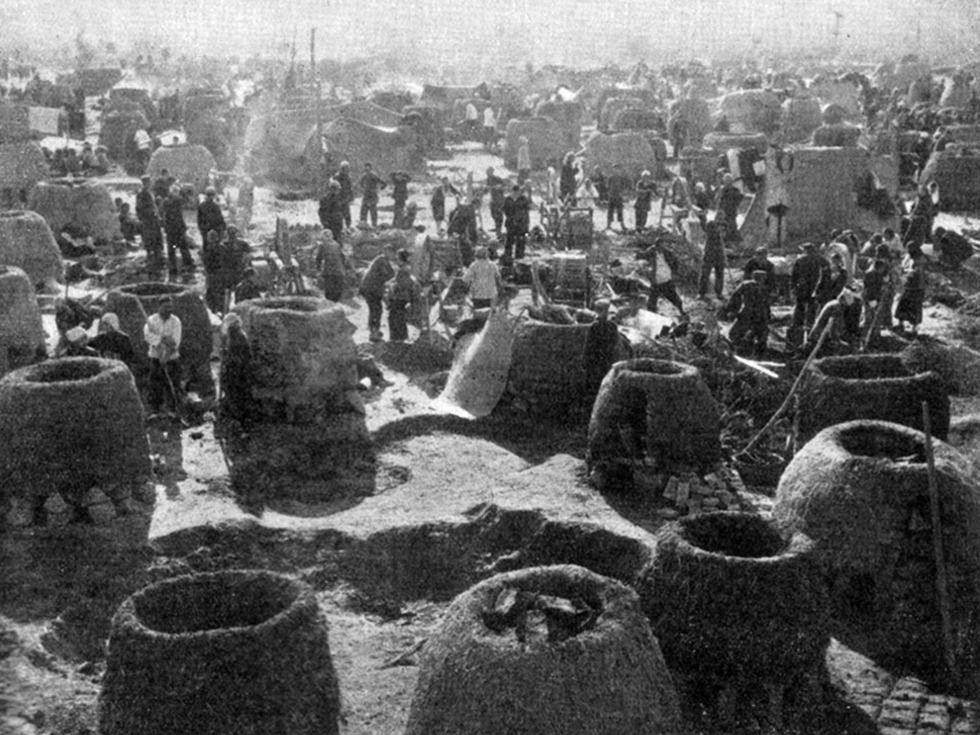
The Korean War had proven China's industrial inferiority against both the west and the Soviet Union. In 1956, Nikita Khrushchev had begun a policy of demilitarisation, forcing many influential Soviet Army generals (including Marshal Tukhachevsky, who had de facto control of the USSR from Trotsky's death in 1942 to 1949. Tukhachevsky's ultra-Trotskyist brand of military communism was much more agreeable to Mao Zedong than Khrushchev's more liberal, civil, modernist approach. He, in his growing paranoia, began to believe that the Soviets could not be considered an ally in the future if this trend continued. As such, a number of programs were begun; ultra-Trotskyist education, a native nuclear program, the purging of perceived Khrushchevites, and most importantly, an economic program, which would be publicised as the Great Leap Forward.
Mao Zedong, having no knowledge of metallurgy or engineering, was deceived by his subordinates into believing that simple "backyard furnaces" could produce good steel in large quantities, given sufficient manpower. Furthermore, the ideas of Trofim Lysenko became popular as an "easy solution" to the Chinese agricultural problem. The third great factor in the Great Leap Forward was the growing ultra-left zeal in Mao's inner circle, pushing them towards further totalitarianism and the persecution of perceived political opponents.
The "backyard furnace" project was a complete failure, as only slag metal could be produced at an enormous cost in material, labour and time. Mao only learned in 1959 that steel could only be produced in actual industrial facilities, and yet chose not to discontinue the program as it would "lower the revolutionary spirit of the masses". However, it was arguably the agricultural sector where the Great Leap Forward had its worst effects. Lysenkoist practices, the siphoning of agricultural labour towards the backyard furnaces, inflated statistics, the extermination of sparrows (which fed on locusts, making swarms worse) and the government's inability to reverse course because it would lose face, led to the Great Chinese Famine, in which 15 to 55 million Chinese citizens perished.
Chinese intellectuals did not fight back against the anti-intellectualist CCP's Great Leap Forward because of fears of being persecuted and purged, as it happened just a few years prior in the Hundred Flowers Campaign.
The Great Leap Forward's political consequences directly led to the fall of Mao Zedong.