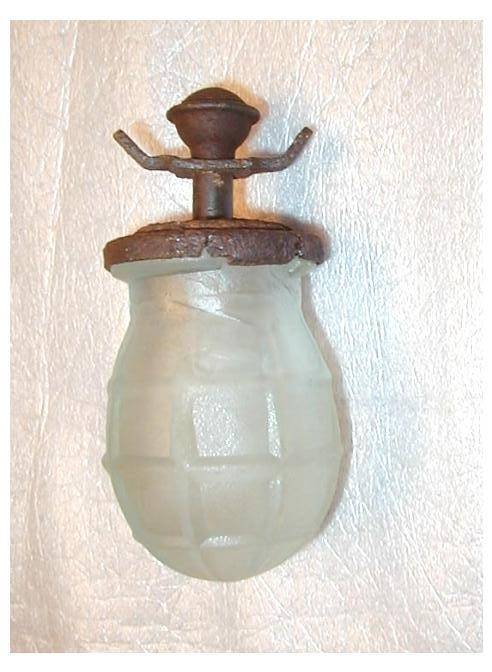
Just before WW2, it was realised by the German leadership that their stocks of weaponry would not last a massive Comintern assault. The glashandgranate emerged as part of the infamous Totalerkriegsplan "Endsieg", part of which was the designing and mass production of extremely cheap weapons meant to arm second line units. It is essentially a cheap M39 Eihandgranate fuze attached to a glass casting. While its fragments do not travel far, and do not carry much energy, glass is razor-sharp and causes deep bleeding wounds. The design was copied in Oceanyka even after being discontinued in Germany, due to its low cost.