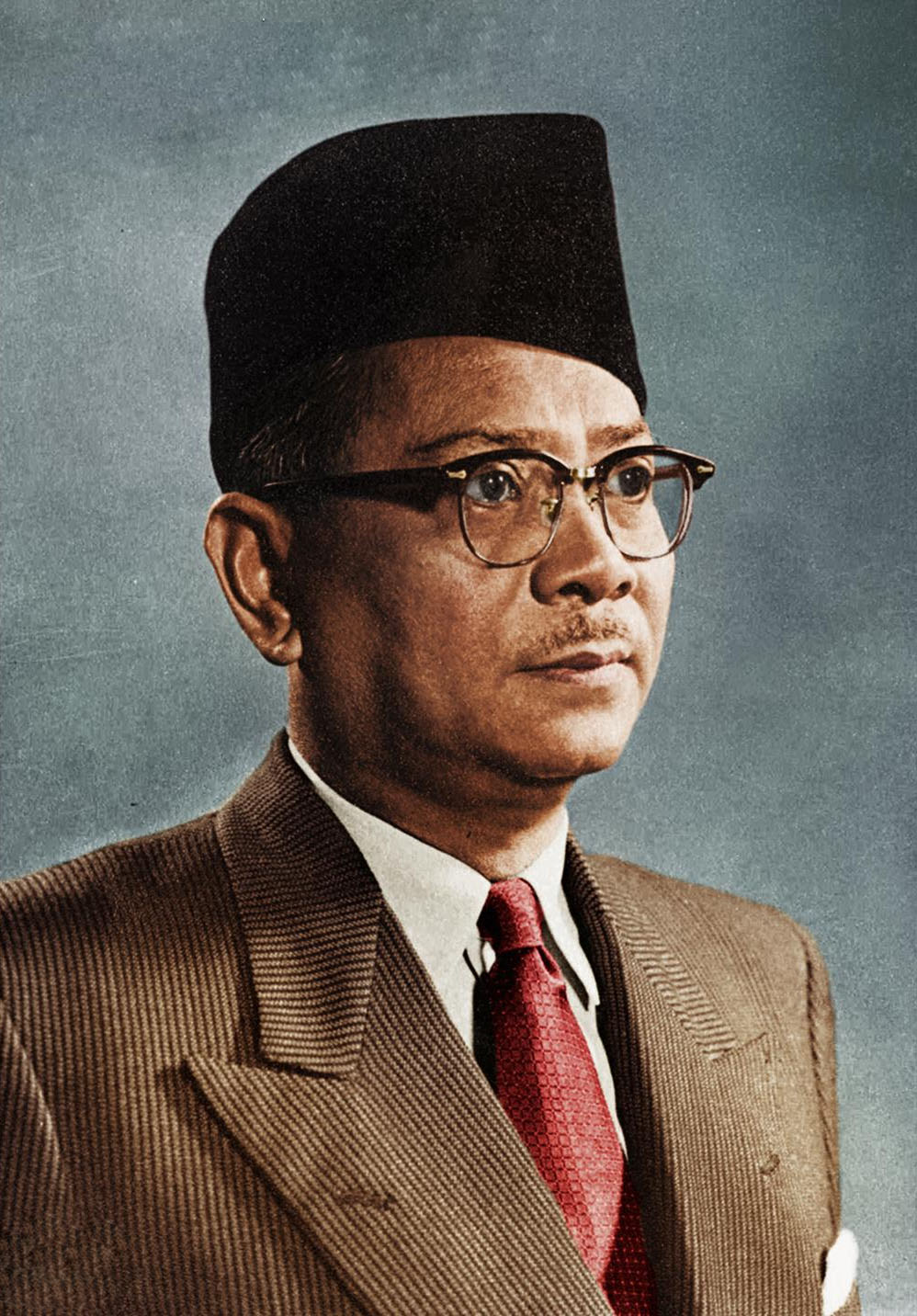
(B. 1903)
Known to many Malaysians simply as the Tunku ("the Prince"), Tunku Abdul Rahman is celebrated as a moderniser and a pragmatic leader. Born into the royal house of Kedah, he was educated in England before returning to the Malayan peninsula, where he steadily rose through the newly independent nation's administrative ranks. Tunku led various Malaysian communities as a capable civil servant, showing extraordinary efficiency and transparency.
In 1941, the Japanese Empire invaded Malaysia, opening a new front for World War II. Tunku continued exercising his profession as a civil servant, though the Japanese occupation forces made great demands of Malaysia's population and its resources, committing various atrocities. Friction between Japanese military government and Malaysia's bureaucracy, of which Tunku was a part of, was frequent. When it became clear that the Allies would soon defeat Japan at sea, from 1944 onwards, Malaysian resistance fighters began to wage a brutal guerilla war throughout the continent, aided covertly by Tunku and many others like him.
Following the end of World War II in 1946, he assumed the role of Prime Minister and oversaw the consolidation of the Federation, resisting both internal communist insurgencies and external threats, particularly from Indonesia. His leadership during the Malayan Emergency (1949–1955) was crucial, successfully coordinating German and British military support while maintaining political legitimacy at home. After the Emergency, Tunku championed democratic reforms under the easing pressures of Kaiser Louis Ferdinand's Neuordnungprogramm, fostering a multiparty system while cautiously containing ethnic divisions between Malays, Chinese, and Indians. He skilfully navigated Malaysia through the early years of the Cold War, steering a firmly Non-Aligned 🕊️ course despite mounting German, British, and Soviet overtures.
His tenure is currently being marred by sporadic violence, particularly the Konfrontasi with The Republic of Indonesia over North Borneo, but he remains a beloved symbol of national unity.