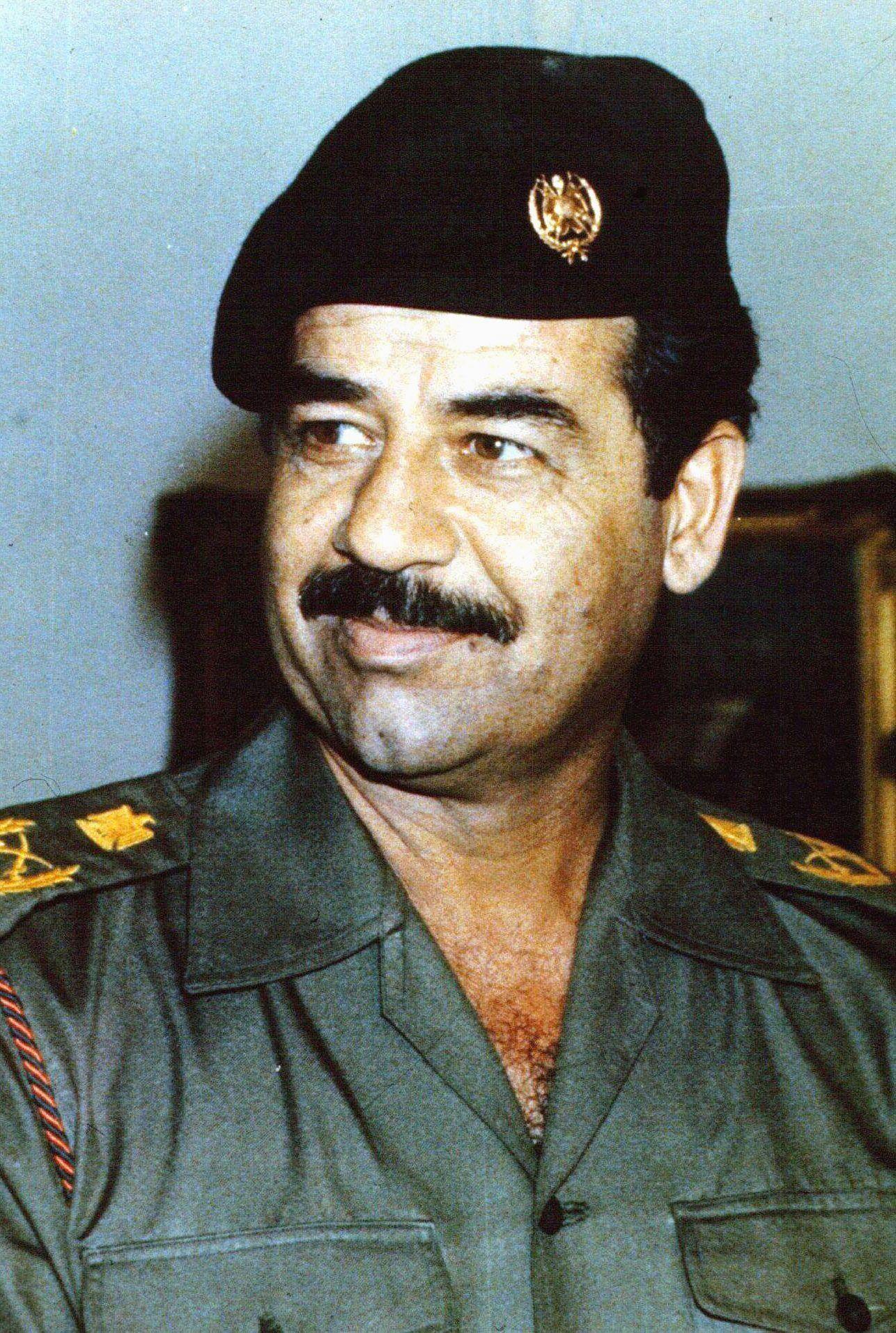
(B. 1937)
Saddam Hussein al-Majid al-Tikriti is the first President of The North Arab Republic, a Ba'athist strongman and the youngest head of state in the modern Arab world. His rise from orphaned militant to the leader of a fractured, rump state is emblematic of the devastation brought forth by the Black Sand War. Once a junior officer in the Arab Regular Army of The United Arab Kingdom, Hussein emerged from the war as both a survivor and opportunist. With most of the Hashemite royal family dead or exiled, and the pan-Arab resistance crushed across the Levant, Hussein seized control of the northern remnant: a war-torn, depopulated stretch of Mesopotamia bordering The South Arab Security Zone, The Imperial State of Iran and The Socialist Republic of Turkey
Born in 1937 near Tikrit, Hussein grew up in one of the regions most benefitted from the Unification of the Hashemite United Arab Kingdoms and its accompanying economic boom. He was orphaned young and reportedly joined a Ba'athist youth cell in his early teens. Later, he joined the prestigious Royal Arab Military Academy in Cairo which, despite the failure of the proto-Ba'athist Free Officers' Movement, was still heavily influenced by the Ba'athists.
During the Black Sand War, Hussein served with distinction as a Captain, earning numerous commendations for his leadership and daring, leading numerous counterattacks against numerically and qualitatively superior Sadatist forces. He was wounded twice and promoted rapidly through a collapsing chain of command as the war grew to apocalyptic proportions under biochemical bombardment and increasing foreign intervention. By the end of the war, he was one of the very few Arab Regular Army officers left alive and held the rank of General.
The end of the war saw the total disintegration of the Hashemite monarchy and the division of its former territory into occupation zones, failed states, and lawless zones. The Ba'ath Party, once suppressed by the Hashemites, transformed into the most powerful political force of the Arab world. Hussein, now a charismatic war hero in his mid-twenties, rallied surviving cadres, tribal militias, and army remnants into a new political-military axis.
In late 1963, Hussein declared himself President of The North Arab Republic, a de facto one-party state centred around the ruined city of Mosul, once the second largest city in Iraq and now one of its few remaining urban centres, though it did not escape mass bombardment nor biochemical attacks. Backed by an uneasy coalition of Ba'ath loyalists, displaced populations, and Royalist veterans, his regime was swift to crush Islamist uprisings, communist rebellions and tribal secessionists. His secret police, the Mukhabarat, quickly became infamous for forced disappearances and political assassinations. Because much of the North Arab Republic is located in the cultural region of Kurdistan, his government has taken a pragmatic approach towards the Kurds, who are treated as equals and hold important government positions. In the Republic, the two official languages are Arabic and Kurdish.
Hussein styles himself as the last torchbearer of Arab unity, in defiance of The Caliphate of Sadati Arabia and the disintegration of the Arab nationalist project. He regularly accuses both the Western Bloc 🦅 and the Eastern Bloc ⚒️ of having deliberately sabotaged Arab independence through economic and diplomatic pressure, thus resulting in the Black Sand War's catastrophic finale. His government maintains itself as a political ally of the other post-collapse state, The Arab Republic of Egypt, which is also ruled by Ba'athists of the Egyptian branch, while amicable relations are maintained with The Socialist Republic of Turkey, The Imperial State of Iran and The Emirate of Greater Kuwait.