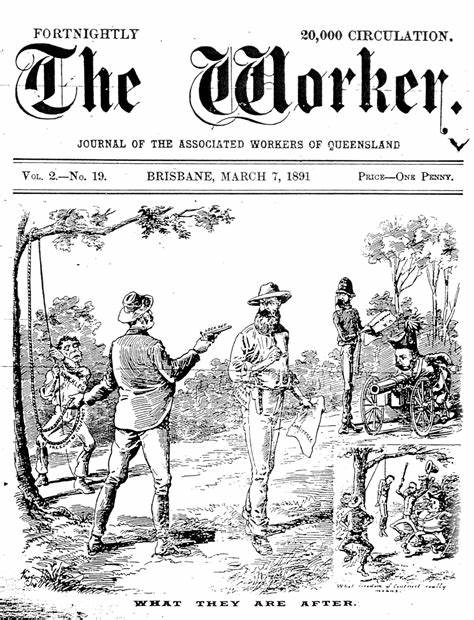
Australia's economy in the late 19th century, once buoyed by successive booms in whaling, shepherding, mining and infrastructure, was facing severe instability. A combination of global economic downturns, speculative financial practices, and over-reliance on volatile commodity exports, coupled with deep political instability (as evidenced by Ned's Rebellion) culminated in a deep economic depression.
- Australia's economy had grown heavily dependent on extractive industries. However, declining international demand for Australian raw materials, coupled with price collapses in key markets, exposed the vulnerabilities of the colonial economic model. Great Britain's industrial might was spared of the effects of this economic phenomenon by the Scramble for Africa (which strengthened their supply of raw materials) and the British Raj, which could partially compensate for any downturn in supply. Investors, previously optimistic about the continent’s limitless potential, began withdrawing capital, triggering financial panic across major commercial centres.
- The banking sector, which had rapidly expanded during the preceding decades to accommodate infrastructure projects and speculative land booms, proved ill-equipped to handle the downturn. A series of bank failures began in the early 1890s as major financial institutions, unable to recover bad loans, collapsed under the weight of mass withdrawals. The most severe crisis struck in 1893, when a wave of bank closures devastated businesses and private savings, plunging the colonies into economic disarray. Without a centralised financial authority to stabilise the economy, the colonial administrations struggled to manage the fallout. The crisis was particularly devastating for small landholders and urban workers, many of whom found themselves bankrupt or unemployed. The social impact of the economic downturn fuelled widespread unrest and disillusionment with the colonial government’s handling of financial affairs.
- In response to the crisis, colonial governments implemented austerity measures, cutting public spending and delaying infrastructural projects. However, these policies often exacerbated the situation, reducing economic activity and prolonging the depression. Efforts were also made to re-establish confidence in the financial system, including the restructuring of surviving banks and the introduction of stricter regulations on speculative investments. The crisis spurred debate over the need for a more coordinated economic policy across the Australian colonies. While some advocated for tighter British oversight to prevent future instability, others saw the depression as proof that Australia required greater financial independence.
Despite the hardships of the 1890s, the economic collapse served as a catalyst for change. By the decade’s end, colonial leaders increasingly recognised the necessity of economic integration and a unified financial system. Discussions on federation gained momentum, with proponents arguing that a consolidated Australian economy would be more resilient against global financial shocks. Although the depression left deep scars, it also laid the groundwork for future economic reforms. The lessons learned from the banking collapse and economic instability would shape Australia's approach to financial regulation, industrial development, and national governance in the years leading up to the Federation of the Commonwealth of Australia in 1901, and with it, the Economy of the Commonwealth of Australia in the 1900s.