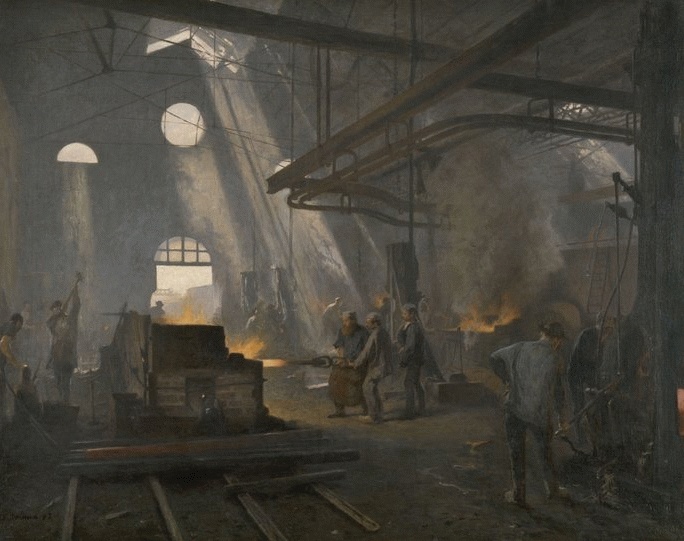
At the dawn of the 20th century, Australia faced a defining moment in its history, having unified for the first time in history during the Federation of the Commonwealth of Australia in 1901. The new government sought to integrate and modernise the continent’s economy through a comprehensive industrial strategy. The Commonwealth Industry Plan, introduced in early 1901, aimed primarily to bolster domestic manufacturing, but it was also meant to improve infrastructure and integrate the economies of the former colonies into a single national framework.
- Prior to federation, Oceanyka’s economic landscape was extraordinarily fragmented, with each colony pursuing its own trade policies, tariffs, and industrial priorities. The Commonwealth Industry Plan sought to standardise economic policy by establishing a common tariff system to protect local industries from foreign competition, particularly from British and American manufacturers. One of the plan’s primary objectives was the promotion of heavy industry and manufacturing, particularly in Mild Steel production, shipbuilding, and railway construction. With an abundance of natural resources including coal, iron ore, and timber, Australia had the raw materials necessary to fuel its own industrial revolution. The government incentivised investment in these industries through subsidies, tax breaks, and direct investment in private enterprises.
- A key pillar of the plan was the expansion and unification of Oceanyka’s railway networks and ports. For this, the National Rail & Road System was devised, though originally it did not contain the parallel highways. The lack of a standardised railway gauge between former colonies had long been a logistical challenge, impeding the efficient transport of goods and people. With the NR&R came the gradual replacement or widening of all tracks with standard gauge. Additionally, the government prioritised harbour expansions and naval shipyards, strengthening Oceanyka’s maritime trade capabilities and ensuring greater self-sufficiency in shipbuilding. These efforts were particularly driven by the need to reduce reliance on British imports and prepare the young nation for future geopolitical challenges, especially with the nearby presence of The Imperial Domain of Kaiser-Willhelmsland.
- Industrial expansion required a capable and disciplined workforce. The Commonwealth introduced policies to standardise labour laws and improve working conditions. Trade unions, which had been growing in influence since the late 19th century, played a crucial role in shaping these policies, securing some protections for labourers in factories, mines, and railways. At the same time, the government launched vocational training programmes to develop skilled labour in engineering, mechanics, and other technical fields.
- Recognising the volatility of Oceanyka’s financial sector following the 1890s banking collapse, the Commonwealth created The Federal Bank, then known as the Commonwealth Bank of Australia, serving as both a national bank and a central institution for managing monetary policy. This move helped restore confidence in the financial sector and provided crucial funding for industrial projects. The CBA also began issuing a new currency: the Australian Pound, which though unable to put the dozens of local currencies out of circulation, now served as the main reference for nationwide financial policy and pricing.
Despite its ambitions, the Commonwealth Industry Plan faced significant challenges. The transition to a unified economic system was met with resistance from both former colonial elites, who were wary of losing their regional economic autonomy, and indigenous polities, which saw it as further extention of British power. Additionally, heavy reliance on British capital and exports created tensions between Australia's push for economic independence and its continued dependence on the British Empire. Furthermore, while industrial expansion created new economic opportunities, it also led to growing urban inequality, with poor living conditions in rapidly industrialising cities. Labour strikes and social unrest occasionally disrupted progress, forcing the government to negotiate with local powerbrokers and refine its policies.
The Commonwealth Industry Plan marked the first major step toward Australia's transformation into an independent, industrialised economy. It was, however, relatively short-lived, as the Commonwealth of Australia's attention was derailed by the Oceanykan War of Independence. Rather pragmatically, The Oceanykan Council, which eventually won this conflict and established The Oceanykan Federation as a wholly sovereign state, carried on with much of the work that was left unfinished, as evidenced by the Economy of the Oceanykan Federation in the 1910s.