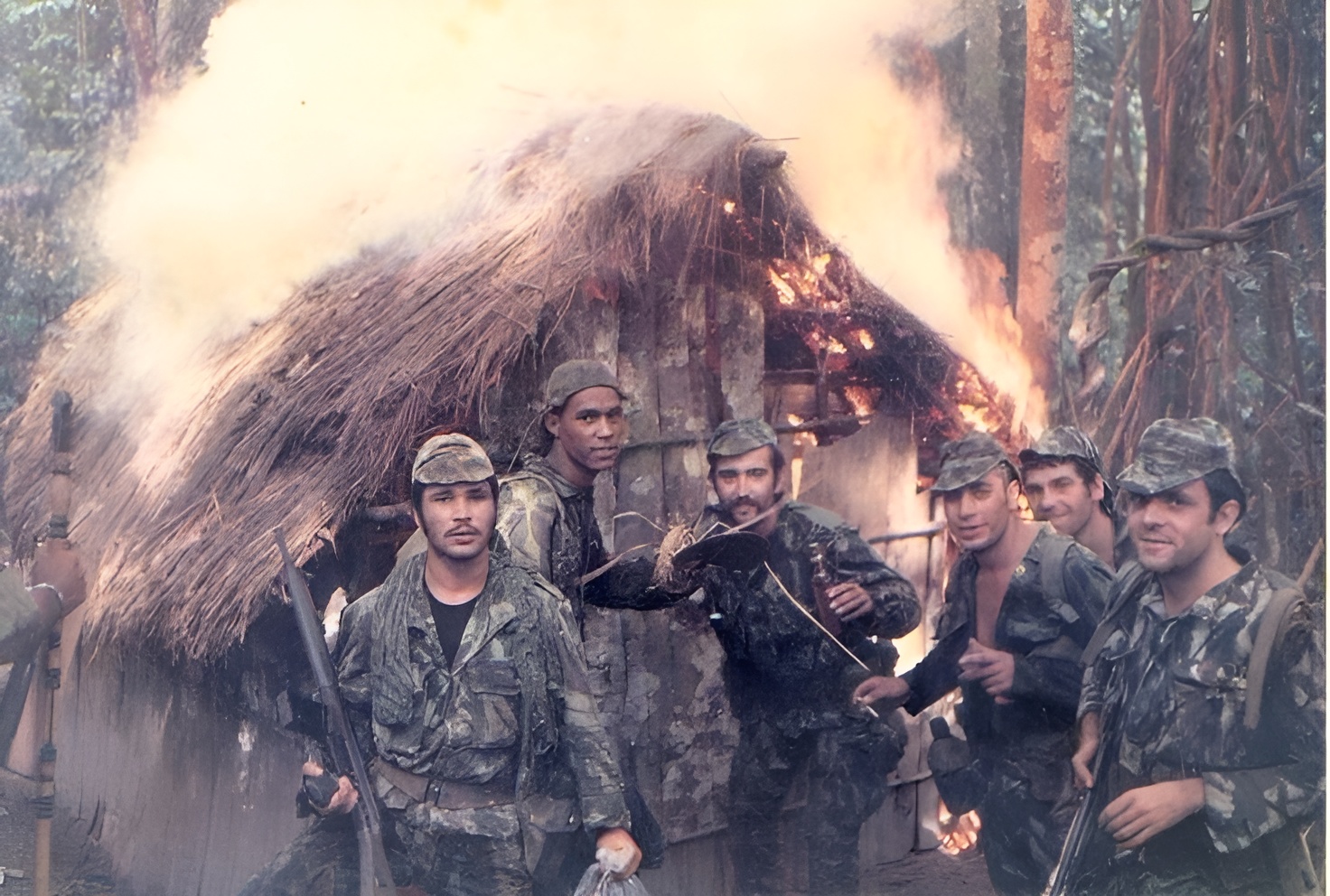
The Second Colonial War (1951-present) refers to a number of separate but loosely related wars of independence and insurgencies with the overarching goal of dismantling The Imperial Domain of Mittelafrika and the continent's apartheid regimes, widely considered to be a major theatre of the Cold War. Its origins lie in the Treaty of Khartoum (1935), which successfully secured independence for native nations such as Ethiopia, as well as post-colonial apartheid states such as Uganda, Somaliland, Sudan, The Republic of Rhodesia and The Republic of South Africa. Native militias, disillusioned with this agreement, continued their guerrilla war in secret with much lesser success.
During World War II, Germany had drafted hundreds of thousands of African men to fight in Europe and in the Middle East, under promises of liberalisation and eventual independence. It was expected that these changes would come soon after the end of the war, but they did not. Kaiser Louis Ferdinand ascended to the throne in 1951 and put his Neuordnungprogramm into action, bringing much-needed reforms and great autonomy to Mittelafrika's constituent divisions, but it was not independence nor democratisation. In response, mass protests broke out in Lagos on December 25th, which were brutally suppressed by colonial authorities. This historical event is known as the Lagos Uprising and it signals the beginning of the Second Colonial War. In response to the crackdown, Lagos' native intelligentsia formed the African Revolutionary Congress (ARC), an underground coalition whose purpose is to dismantle European colonialism. Amongst its ranks one can find communists, socialists, nationalists, liberals, tribal chiefs and even some mercenaries, all of them loosely allied under the banner of African liberation.
However, the ARC's enemies are not only limited to Mittelafrika. It has also declared a state of war against Africa's apartheid regimes, holdouts of the now extinguished British Empire. Hence, ARC-aligned militias fight wars of liberation against The Republic of South Africa, The Republic of Rhodesia, The Republic of Sudan, The Republic of Somaliland and The Republic of Uganda, all ruled and dominated by a white minority. Of these, only Rhodesia and South Africa remain; Sudan fell in 1953, Somaliland in 1958 and Uganda in 1959. Finally, Europe's last non-German colonial empires are also targets of the ARC, with French Algeria and Italian Libya having their own armed conflicts.
The insurgency soon spread out from Lagos which, as de facto capital of Mittelafrika, was most heavily reinforced. To make matters worse, The Union of Soviet Socialist Republics is known to fund and arm numerous guerrillas within Mittelafrika, granting them greater organisation and firepower than they would enjoy otherwise. Other conflicts closely tied with the Second Colonial War (and sometimes considered a part of it) are the Algerian War, the Libyan War, the Rhodesian Bush War, the Portuguese Colonial War, the Congo Crisis, the Biafran War, the Sudanese Civil War, the Bamileke War, the Somaliland Civil War, the Angolan Bush War and a seemingly endless number of local insurgencies. Finally, the existence of The Black Zone, controlled by Heinrich Himmler's SS threatens not only colonial government, but also the very survival of Africa's peoples.
In 1960, the United Nations (UN) Declaration on the Granting of Independence to Colonial Countries and Peoples was vetoed by The German Empire, then a permanent member of the Security Council. The veto emboldened native resistance, hardened Soviet resolve, and deeply disillusioned anticolonial voices in Germany’s allied states, particularly in the increasingly critical United States.