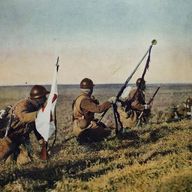
Japan's position following The German Empire's victory in World War I, and the indisputable global hegemony that followed, was less than ideal. The Japanese Empire had been part of the Entente and, while it had not suffered any territorial losses, it was forced to return Qingdao back to Germany. This city was widely perceived to be a loaded gun pointed at the Japanese home islands, especially so after the Kaiserliche Marine began rebuilding its strength and could believably threaten Japan's naval supremacy over the western Pacific. Worse still, The Republic of China, which had remained neutral during the war, enjoyed a great deal of German economic, military and diplomatic support, further threatening Japanese interests.
With this precarious situation in mind, the Imperial Japanese Army received orders in early 1921 to prepare for an invasion of Manchuria. At the time, the region was controlled by the warlord Zhang Zuolin, leader of the Fengtian Clique, who nominally recognised Chinese sovereignty over Manchuria, but de facto ruled it as his private estate, and was currently entangled fighting China's other warlords as part of the Chinese Warlord Era. Japanese troops staged a false flag attack on the 4th of February which resulted in Zhang's troops and the IJA exchanging fire over the border. Under the guise of restoring order to the "lawless Manchuria", Japanese troops crossed the border.
After three months of fierce fighting, the Fengtian Clique surrendered. While they had received significant military support from the other warlords, none committed to the fight in fear of becoming backstabbed by their neighbouring polities. German support in the form of small arms, artillery, munitions and advisors, however, was more significant, and allowed Zhang's forces to resist for far longer than they would have otherwise. On the 12th of May, 1921, Zhang signed the Treaty of Mukden, which recognised the sovereignty of the nominally independent State of Manchuria, in reality a Japanese puppet in all but name. Later, in 1923, the last pretender of the Qing Dynasty would be crowned as Emperor Puyi of the Empire of Manchuria. In the Empire of Japan this region was known as Manchukuo. Germany protested this arrangement, but their involvement in the First Colonial War and the Velvet Revolution, as well as the myriad of proxy conflicts with the Soviets in Europe, prevented them from taking direct action.
Over the next two decades, Manchuria was developed by Japanese capital and settled by Japanese colonists, operating a brutal extractive economy. Manchuria was vital to the development of Japanese heavy industry due to its abundance of raw materials such as iron and Coal, as well as agricultural produce and lumber. Additionally, due to its large population and the presence of iron and coal, Manchuria saw enormous investment in heavy industry, particularly Steel manufacturing. Its economic importance was further highlighted following the Imperial Colours Incident, as Japan's leadership correctly believed that Manchuria would be vital for the war to come.