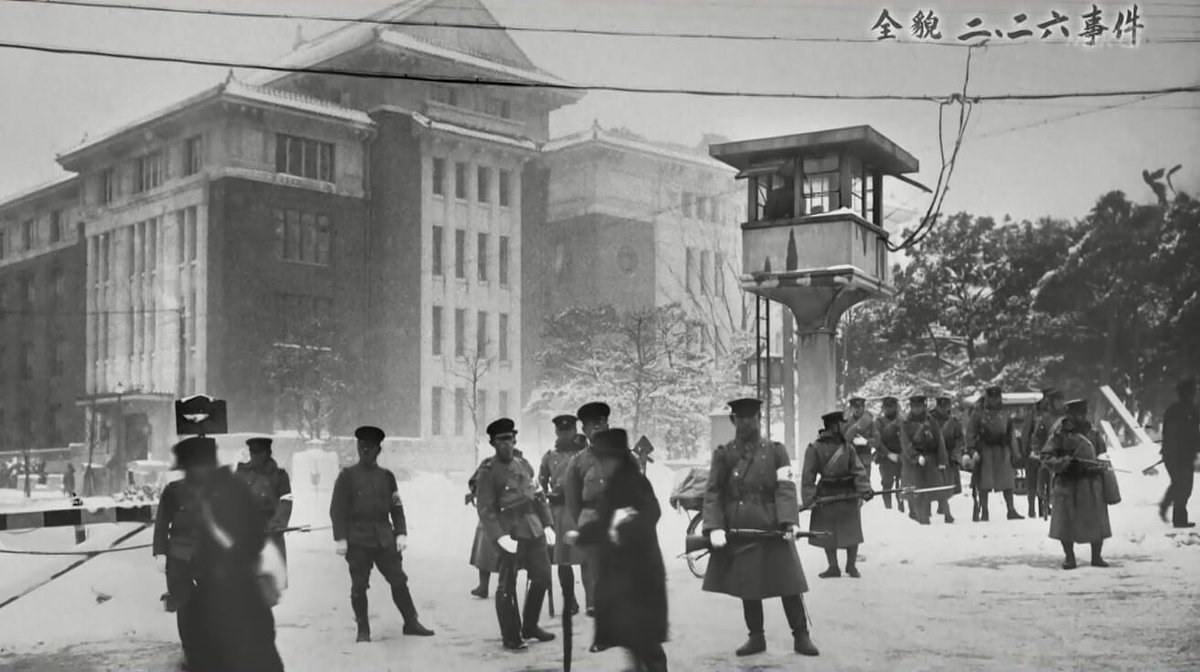
The Flying Colours Incident, sometimes known as the October Incident, was a coup d’état orchestrated by the Sakurakai (Cherry Blossom Society), a neosocialist secret society led by the revolutionary theorist Ikki Kita. The coup dissolved the standing government, placed the Sakurakai at the head of state power, and inaugurated an ideological programme that would dominate Japan through the 1930s. While popularly remembered as a spontaneous domestic revolt by young officers of the Imperial Japanese Army, archival evidence later confirmed it was partially conceived and materially supported by the Soviet NKVD as part of a broader strategy to pull Japan into Moscow’s orbit. In this aspect it was wildly successful, as the Japanese Empire would later join the Eurasian Axis alongside The Union of Soviet Socialist Republics during World War II.
The Sakurakai had formed in the late 1920s as a conspiratorial network of junior officers, political leaders and revolutionary theorists dissatisfied with what they viewed as the corruption and ineffectiveness of parliamentary governance. Drawing on Kita’s synthesis of zealous monarchism, socialist economics, ultranationalism and revolutionary mobilisation, they advocated for a Pan-Asian Empire united under the Japanese Emperor. The ideology, later labelled Social Imperialism, framed Japan as the natural liberator of Asia from European colonial rule, and was later emboldened by the success of the Fourth French Revolution.
Soviet involvement was decisive in the coup’s preparation and execution. Through covert channels, the NKVD supplied small arms, provided military training in Siberian camps, and inserted political advisors directly into Sakurakai planning cells. Moscow’s aim was to fracture Japanese alignment with The United States of America and ultimately shape Japan into a reliable ally for the war to come.
On the 21st of October, 1931, Sakurakai-aligned units seized key ministries, communications hubs, and transport corridors in Tokyo. Civilian leaders were arrested, and within three days the Imperial Diet was formally dissolved. Emperor Hirohito, initially cautious, issued a public statement recognising the Sakurakai as a provisional government. This endorsement was decisive in bridging the generational rift in the IJA; while the coup had been spearheaded by younger officers, the senior leadership gradually aligned themselves once assured of imperial approval.
Under Kita’s leadership, Japan embarked on an aggressive industrial and military reorganisation. The Sakurakai declared the Greater East Asian Liberation Mandate, pledging to dismantle European colonialism, warlordism, feudalism and capitalism throughout the continent. This policy placed Japan in direct ideological and geopolitical conflict with The German Empire and The United States of America, which had been up until that point supportive of Japanese policies against Germany, yet wary of its imperial ambitions following the Japanese Invasion of Manchuria.
The October Incident marked the definitive end of Japan’s experiment with liberal parliamentary politics. It created a uniquely radical Japanese strain of revolutionary authoritarianism, simultaneously monarchist and socialist, whose ambitions were seemingly boundless. Shortly after, Japan created the Greater East Asian Co-Prosperity Sphere (GEACPS), intended to bring about the promised "Pan-Asian Empire". Commercial and political ties with the Soviet Union grew exponentially after the Imperial Colours Incident, as the Soviets possessed key raw materials such as Petroleum, while Japan had much to share in terms of aeronautics, naval construction and industrial engineering.