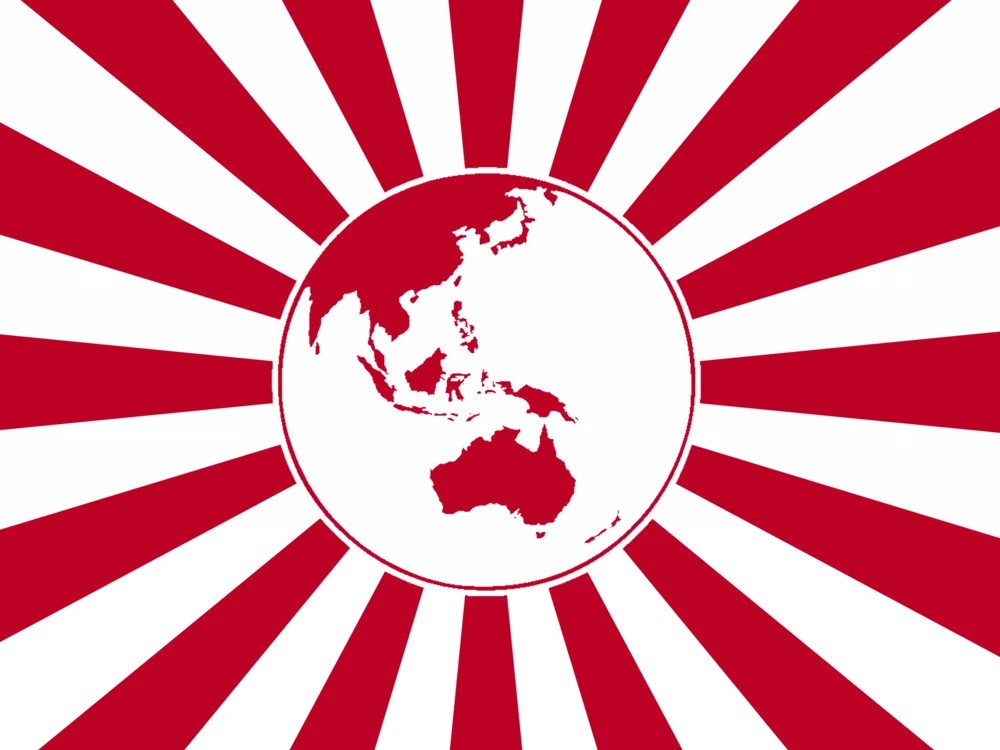
The Greater East Asian Co-Prosperity Sphere was an international political project/organisation that The State of Japan, though then known as the Japanese Empire, established in East Asia following the collapse of Europe's colonial empires at the end of World War I. Its origins lie in the Teuton Panic, a global political upheaval resulting from The German Empire's seizure of French and British colonial holdings across the world, thus establishing a de facto planetary hegemony. At the time, the Japanese public and their leaders (correctly) believed that a devastating confrontation between Germany and Japan was inevitable. The GEACPS itself was founded in 1932 as a result of the Imperial Colours Incident to bring about a "Pan-Asian Empire".
Save for the Kingdom of Thailand, no independent nation was a member of the GEACPS besides Japan. However, multiple proxy governments (including those of the Philippines, China, Myanmar, North Australia, India, Indonesia, Malaysia and Vietnam) were a part of its Greater East Asian Conferences with a small degree of autonomy. The guiding principle of this alliance was that of Social Imperialism, a form of monarchist socialism whose policies were imposed across East Asia with varying degrees of success.
The Greater East Asian Co-Prosperity Sphere made up the easternmost part of the Eurasian Axis, a grand coalition formed with The Union of Soviet Socialist Republics which fought together in World War II. It did not survive the end of the war as Japan was decidedly defeated by The United States of America, occupied and reformed into a constitutional monarchy. Certain geopolitical aspects of the GEACPS, however, live on within the American-led Pacific Containment Pact (PACOP), though directed towards their former allies rather than Germany or the United States.