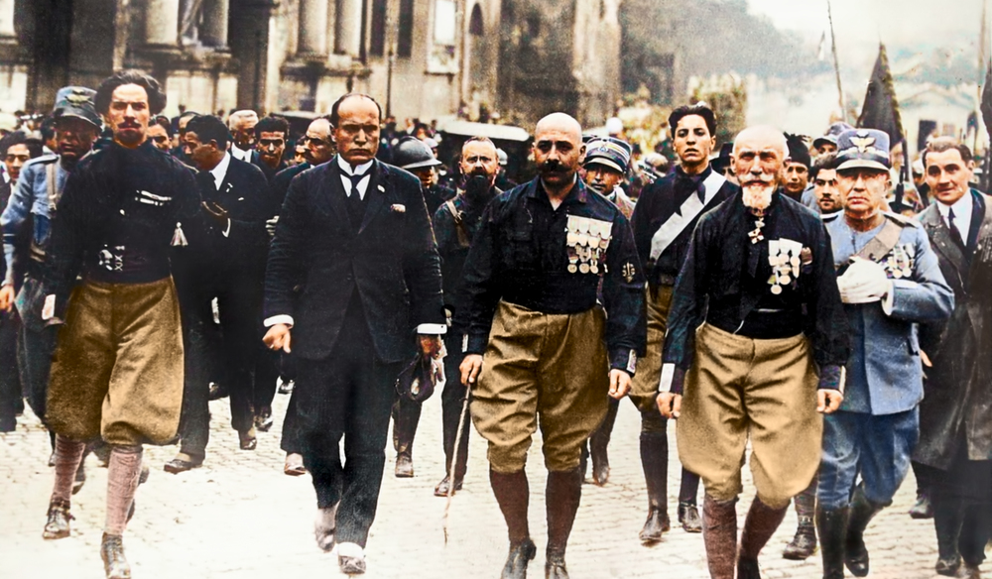
The March on Rome was a coup d'etat in The Kingdom of Italy, which marked a political turning point for the victorious but deeply dissatisfied member of the Central Powers. Having fought alongside The German Empire and Austria-Hungary to secure control over French territories up to the Rhone river as well as Corsica, Italy found these lands transformed into extractive zones whose revenues largely flowed to German industrial conglomerates to pay for war reparations as accorded in the Treaty of Versailles.
Socialists, emboldened by Europe's revolutionary wave, organised general strikes in industrial centres. Liberal and conservative governments faltered one after the other, caught between German economic domination and the threat of leftist insurrection. Veterans of the arditi units and nationalist intellectuals rallied to Benito Mussolini’s National Fascist Party, which promised to break both the chains of German finance and the threat of Bolshevism.
Backed by his squadristi paramilitaries, which later became the MSVN Blackshirts, Mussolini orchestrated the March on Rome as both a show of force and a negotiation tactic with the crown. The King, Victor Emmanuel III, fearing civil war and impressed by Mussolini’s disciplined mass mobilisation, invited him to form a government. The transfer of power was swift and largely bloodless.
Mussolini successfully established a corporatist and nationalist “Third Position” in foreign and economic policy, rejecting both Leninism and what he termed “Saxon imperialism” (a term which targeted both American and German business interests). Thus, Mussolini successfully crafted a nationalist totalitarianism that rejected liberal democracy and was rabidly anticommunist. His consolidation of power over the next years would inspire ideological currents in Germany itself, shaping the rise of National Socialism under Adolf Hitler and Heinrich Himmler.
Once in power, the fascists acted swiftly to dismantle parliamentary opposition, outlawing the Socialist and Communist parties, subordinating the press to state oversight, and fusing veterans’ leagues into the MVSN (Blackshirt Militia). Italy embarked on an ambitious programme of economic autarky and industrial modernisation, particularly in steel, shipbuilding, and armaments. While German loans still underpinned much of this growth, Mussolini pursued new trade and industrial ties with The United States of America, The Kingdom of Spain, The Japanese Empire and Latin America to loosen Berlin’s economic grip. In foreign policy, Mussolini’s early years saw a careful balancing act. Formally still allied with Germany through the Central Powers system, yet cultivating an image of Italy as an equal, not a subordinate. Propaganda exalted the Mare Nostrum as the natural Italian sphere, as descendants of the long-gone Roman Empire.